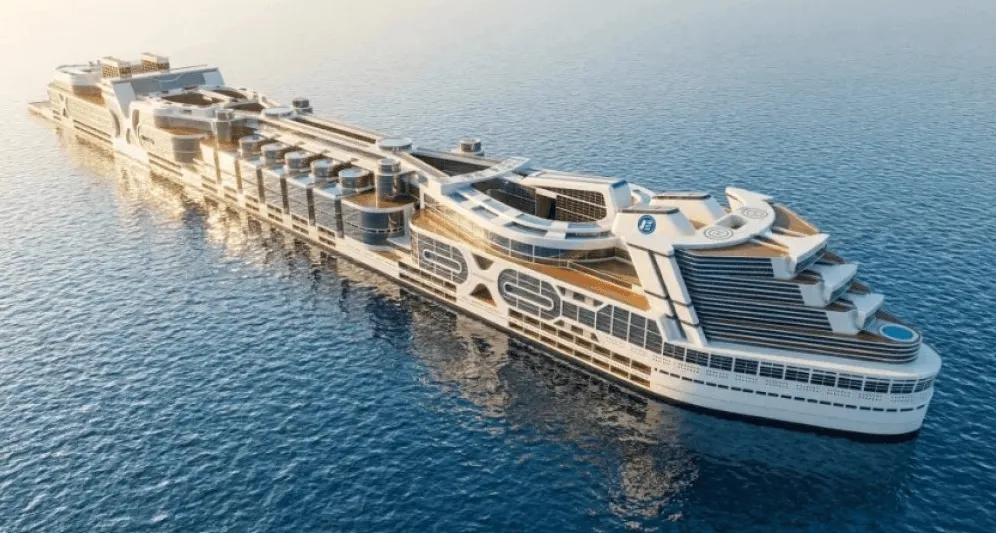
Imagine a city that never docks in port, but constantly sails the world’s oceans. This is precisely the vision represented by the ambitious Freedom Ship project, conceived as the largest floating community ever built.
According to existing plans, this gigantic ship would be almost 1.6 kilometers long, 244 meters wide and as tall as a thirty-story building. It is estimated that its construction would cost around 13 billion euros, while the gross tonnage would reach as much as 2.3 million tons, many times more than today’s largest cruise ships.
About 50,000 residents could live on board, while an additional 10,000 places would be reserved for tourists and one-day visitors. Approximately 20,000 employed crew members would take care of the daily functioning of the city at sea.
City on the water
Freedom Ship is conceived as a completely self-sustaining community with all the amenities of modern cities. The plan includes hospitals, schools of all levels of education, shops, restaurants, business centers, banks and numerous other services.
Luxury hotels, a stadium with 15,000 seats, a congress center, a water park, museums and a concert hall for a symphony orchestra are also planned.
Residents would have access to a large diving aquarium, numerous restaurants and entertainment facilities. Four decks would be dedicated to business and commercial activities, while there would be as many as eight helipads on top of the ship.
Trams instead of cars
Due to its dimensions, the Freedom Ship would not be able to dock in existing ports. Instead, it would stay permanently in international waters, and passengers would reach the coast by smaller ships and ferries, reports Tportal.hr.
The project predicts that the ship would circle the planet in about two to two and a half years, sailing at an average speed of about 13 kilometers per hour.
Movement inside the floating city would be organized by a tram system that would connect different parts of the ship. Pedestrians would have access to more than 24 kilometers of walkways, as well as spacious green areas.
An idea almost three decades old
The Freedom Ship concept originated in the nineties of the last century. It was designed by the American engineer Norman Nixon, and although the project was repeatedly brought back into the public’s focus, it never reached the stage of realization.
In recent months, the project has been revived thanks to Roger Gooch, director of Freedom Cruise Line International, who claims that there is serious interest from investors and future residents.
According to him, the biggest obstacle is not technology, but securing the necessary capital.
Construction in Indonesia
Construction is scheduled to begin in Indonesia after the closing of the financial structure. The ship would be built in segments that would later be joined in the open sea, and the whole process would take between three and four years.
The promoters of the project believe that the first residents could move in even before all the works are completed.
Unlike classic cruisers, the Freedom Ship would not have a home port. Maintenance would be carried out during navigation, while a large part of the income would come from the lease of business premises.
Nuclear power plant and environmental protection
Designers are considering the possibility of using nuclear energy as the main source of propulsion, claiming that such a solution would significantly reduce carbon dioxide emissions.
In addition, the ship would participate in ocean cleanup and marine environment protection programs.
“We want to show that it is possible to create a sustainable community that contributes to the protection of the planet at the same time,” said Gooch.
Bigger than all previous cruisers
If one day it actually sets sail, the Freedom Ship will become the largest passenger ship in history.
With a total of 80,000 inhabitants, tourists and crew members, it would have more than eight times the capacity of today’s largest cruise ship in the world, Star of the Seas.
Although numerous similar projects have remained only on paper over the years, the people gathered around the Freedom Ship are convinced that this very idea could become a reality.
“Great projects are created thanks to persistence and the belief that it is possible to push the boundaries. We will do everything to make this concept come to life one day,” said project manager Sridev Mookerjea.