Buenos Aires/Serving almost seven decades in a dictatorship is a political tragedy as well as an economic and social one, as demonstrated by the case of Cuba, but, at least, this extensive period offers a variety of comparative antecedents to be able to begin a successful transition to democracy.
Since the 1980s and 1990s, many countries that suffered dictatorships began political transitions and are now part of the global democratic community: most of the nations of Latin America and the former socialist bloc, plus South Africa.
In this regard, the million-dollar question is whether the Cuban opposition, inside and outside the country, is prepared to lead a democratic political transition, which can occur by collapse, negotiation or, in the worst case, by a military intervention by the United States.
The government of Donald Trump and, especially, his Secretary of State, Marco Rubio, are putting strong pressure on the old dictatorship, exploring a negotiation to begin an agreed transition process. Also the increase in economic sanctions from the United States, combined with an economic model in Cuba that restricts private initiative with a government that, as it does not submit to free elections, does not need to guarantee good governance, can lead to a collapse, due to the critical social situation, through a social outbreak with unpredictable political consequences.
Donald Trump and, especially, his Secretary of State, Marco Rubio, are putting strong pressure on the old dictatorship
Meanwhile, Cuba’s political opposition, fragmented and dispersed, has the opportunity to begin the transition to democracy. One way to do this is by forming a democratic parliament, made up of representatives inside and outside Cuba, that begins to debate and then adopt proposals for when the formal transition occurs in Cuba. Thus, the legal and institutional model of democratic Cuba, transitional justice and a large number of political and economic reforms that characterize this type of processes, can begin to be put into motion. Today, technology allows it and only requires a willingness to reach consensus among opposition leaders with a recognized track record.
It must be taken into account that there are already other initiatives of this type, such as the Central Tibetan Administration, which has just appointed its new president after a democratic electoral process that mobilized the Tibetan community throughout the world, or the World Uyghur Congress, which appoints its authorities in an assembly.
In addition to learning to live with differences and getting used to forging consensus, a Cuban democratic parliament would also facilitate a more effective international impact, since, by having authorities emerging from an electoral process, this would offer them more genuine representation.
And it would be the Cuban citizens themselves who register to elect their representatives who, through a minimum monthly contribution, contribute to their support and to the work of the authorities that are designated.
Several meetings of one of the most interesting initiatives of the Cuban opposition were held in Havana
In this case, it is interesting to remember that between 2014 and 2015 in Havana several meetings of one of the most interesting initiatives of the Cuban opposition were held: Open Space. The same, convened at his home by journalists Yoani Sánchez and Reinaldo Escobar, brought together the main opposition figures within Cuba, a sort of Czech Civic Forum, which had Václav Havel among its dissident leaders.
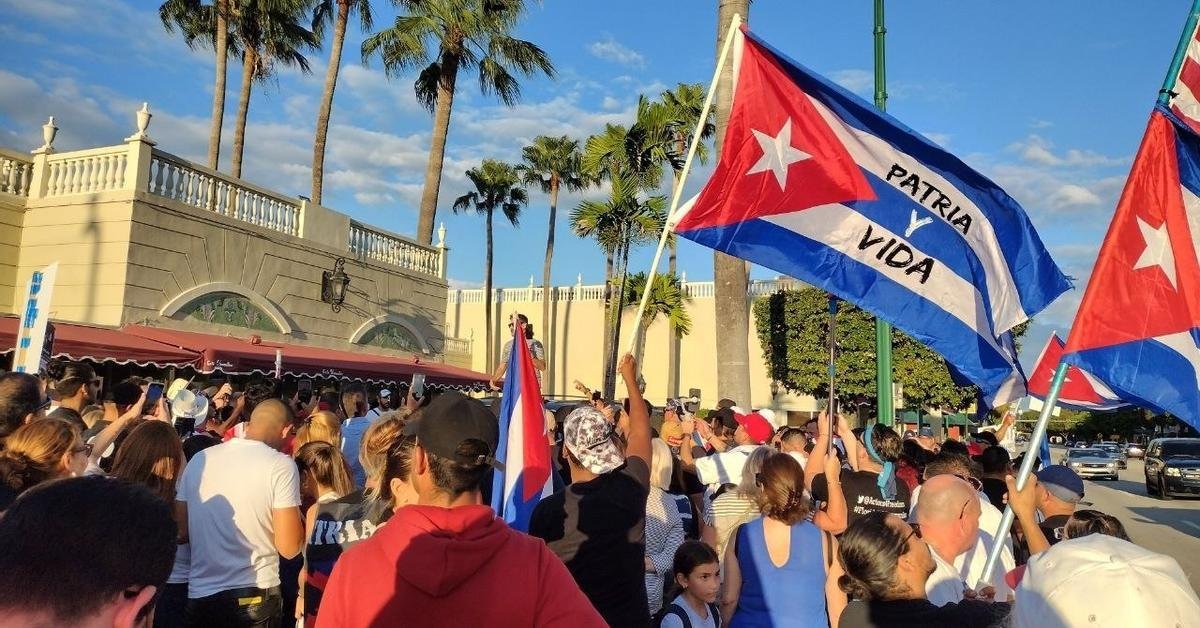
Espacio Abierto was not an external initiative, but rather that of the opponents themselves within Cuba, who, in addition to the founders of the news portal 14ymediobrought together activists and intellectuals, such as Dagoberto Valdés, José Daniel Ferrer, Elizardo Sánchez, René Gómez Manzano, Manuel Cuesta Morúa, Librado Linares, Laritza Diversent, Guillermo Fariñas and Félix Navarro, among others. Some had to go into exile and others remain in Cuba, among them Navarro, who is imprisoned for political reasons with his daughter Saylí after the massive protests of June 11, 2021.
Without a doubt, the greatest initial challenge would be to establish a criterion to form a founding promotion board to organize a democratic parliament, which can be resolved with the requirement of recognizing a minimum history of 10 years in the internal opposition. In any case, the democratic parliament can be integrated by any person born in Cuba who resides inside and outside the country, thus allowing a large number of opposition leaders who emerged from 2018 and 2019 to apply.
The typical rivalries within a diverse space opposed to a dictatorship cannot prevent the realization of an initiative of this type, since in a democratic Cuba they will finally have to coexist. The maturity of the Cuban opposition will decide whether it starts sooner, which will also imply leading the political agenda of its own country, both with respect to the dictatorship of the Communist Party and the United States government.
————————————————————-
Editor’s Note: the author is general director of the Center for the Opening and Development of Latin America (CADAL) and author of the book Memory, human rights and international democratic solidarity.