Many Bogota residents have already begun to take out paper, pencil and calculator to do the math for next year. The Bogotá Council approved to Mayor Carlos Fernando Galán a tax reform that brings with it new charges and more taxes for some people and companies in the capital.
READ ALSO
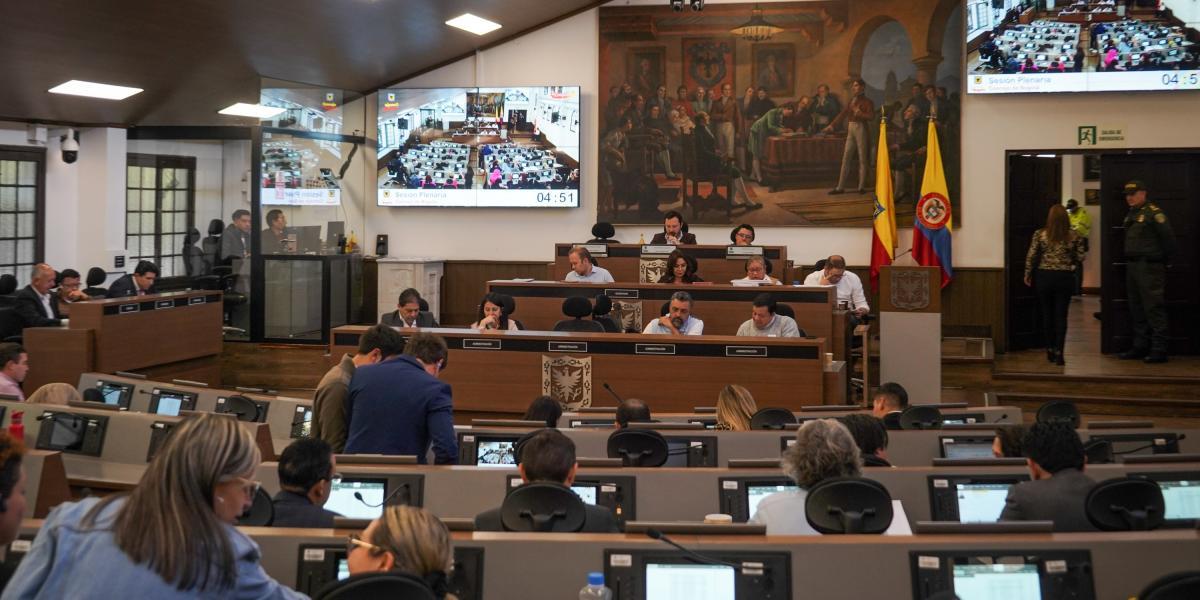
Although there are about 20 articles needed to vote, the most controversial proposals have already been approved by the plenary session of the council. Some sectors insist that several of these represent a blow to the middle class and the productive sector, while others say that they are necessary measures that the city has been postponing for years.
One of the novelties of the reform is the new public lighting charge. This measure, which has already been approved by the Council, will be included in the property tax each year and Some 800,000 owners will have to pay it from 2027 of strata 4, 5 and 6 homes and business properties.
Public lighting. Photo:Bogotá Mayor’s Office
For stratum 4, an average payment of 133,000 pesos is estimatedwhile for stratum 5 it would be 227,000 and for stratum 6 it is 348,000 pesos.
In turn, Commercial properties must pay an average of 807,569 pesos; industrialists, 1,672,343 pesos; the financial sector, 2,342,643 pesos; endowment properties, 2,400,543 pesos, and lots, 577,970 pesos.
Although some 860 municipalities in Colombia already charge this lighting surcharge, in Bogotá It is the first time it is going to be implemented. For some sectors, it is a direct impact on the pockets of the middle class and the productive sector that is already suffocated by tax burdens.
This is how the Bogotá Council voted on the new public lighting charge on the property Photo:Bogotá Council
“This is going to hurt the pockets of all Bogota residents, because it increases the property tax on residential strata 4, 5 and 6 and the entire commercial, business and industrial sector of the city. Naturally, This will make goods and services more expensive. that we Bogota residents consume. I voted no, because I believe that the property tax in Bogotá is very high and Bogota residents today have no way to contribute a cent more,” said Julián Uscátegui, councilor of the Democratic Center, in dialogue with EL TIEMPO.
For its part, councilor Juan David Quintero, who voted in favor of this proposal, he pointed out that this payment is a golden opportunity for the city to be at the forefront.
Julián Uscátegui, councilor of Bogotá. Photo:Private File
“Taxes are always unpopular. But with this payment, Every Bogota citizen contributes to the city installing cameras of the latest generation connected to a large digital brain for more surveillance, security and monitoring. It can be seen more as an investment to attack the great problem of insecurity that we have,” said Quintero.
The purpose is that with this collection the city’s public lighting is modernizedincluding LED technologies for lighting and the installation of security cameras, sensors and other monitoring tools.
Councilor Juan David Quintero. Photo:Bogotá Council.
What alerts some sectors is that certain owners of stratum 4 homes, for example, they cannot pay this lighting surcharge.
“In that stratum we find multiple people who suffer from what is colloquially known as hidden poverty. For family reasons, they may have received an apartment in a stratum 4 sector, but they really do not have a pension, they do not have frequent income or they do not have a job and today it is impossible for them to pay that rate,” added Uscátegui.
The district administration indicated that it will not charge those owners of properties in strata 4, 5 or 6 that are in categories A, B or C of Sisbén. Strata 1, 2 and 3 will also be exempt. and the businesses that are at said levels of the Sisbén.
Public lighting. Photo:Uaesp
Secondly, those who will have to pay more starting next year are some Bogotá companies. The Council approved an increase in tax rates of Industry and Commerce (ICA) for the financial sectors, vehicle trade and the sale of alcoholic beverages and tobacco.
For the first one, the rate goes from 14 to 20 x 1,000 in 2027 and is reduced by one point over the next two years. For banks, it is a direct blow and could make loans and other products for citizens more expensive.
“The banks are the ones in the best position to pay. They have to help us invest in the city because if we make Bogotá improve, that will translate into better opportunities for citizens. Consumption and acquisition of banking products will increase. I bet that in two years the banks will still be here and they will not leave,” added Councilman Quintero.
Bogotá Council Debate. Photo:Bogotá Council.
Who does believe that the financial system can look elsewhere and leaving the capital is Councilor Uscátegui.
“Bogotá was an attractive city for investment, because it did not have such high rates. But with these measures of increasing the ICA, an incentive is generated for companies to go to other territories. It is not just banks, there is also the entire insurance sector and financial intermediaries, and All of them had their ICA increased equally.. It is an exorbitant increase,” said the representative of the Democratic Center.
In turn, the plenary session of the Council voted in favor of increasing the ICA rate for vehicle trade from 6.9 to 8 x 1,000 in the case of electric vehicles, 10 x 1,000 for hybrids and 11 x 1,000 for the rest, which represents an increase of up to 59.4 percent in payment.
READ ALSO
“While municipalities like Chía, Cajicá or Cota have a much lower rate, in Bogotá they raised it considerably. It is It is possible that dealers will go to these sectors of the Sabana to make their sales from there. In fact, Tesla already makes its sales digitally and, by transferring its treasury, it will surely be able to encourage payment to be made from other municipalities so as not to pay taxes in Bogotá,” added Uscátegui.
On the other hand, the approved initiative allows the ICA to drop for 82 percent of businesses and for 89 percent of industries. Among the most benefited sectors are restaurants and hotels, bars, book publishing and publishing, employee funds and cooperatives.
These points were approved with great advantage by city councilors. There are still about 20 articles pending that are not so controversial and will be voted on next Monday, when the debate resumes.
NICOLAS DÍAZ MALPICA
Bogotá Editorial