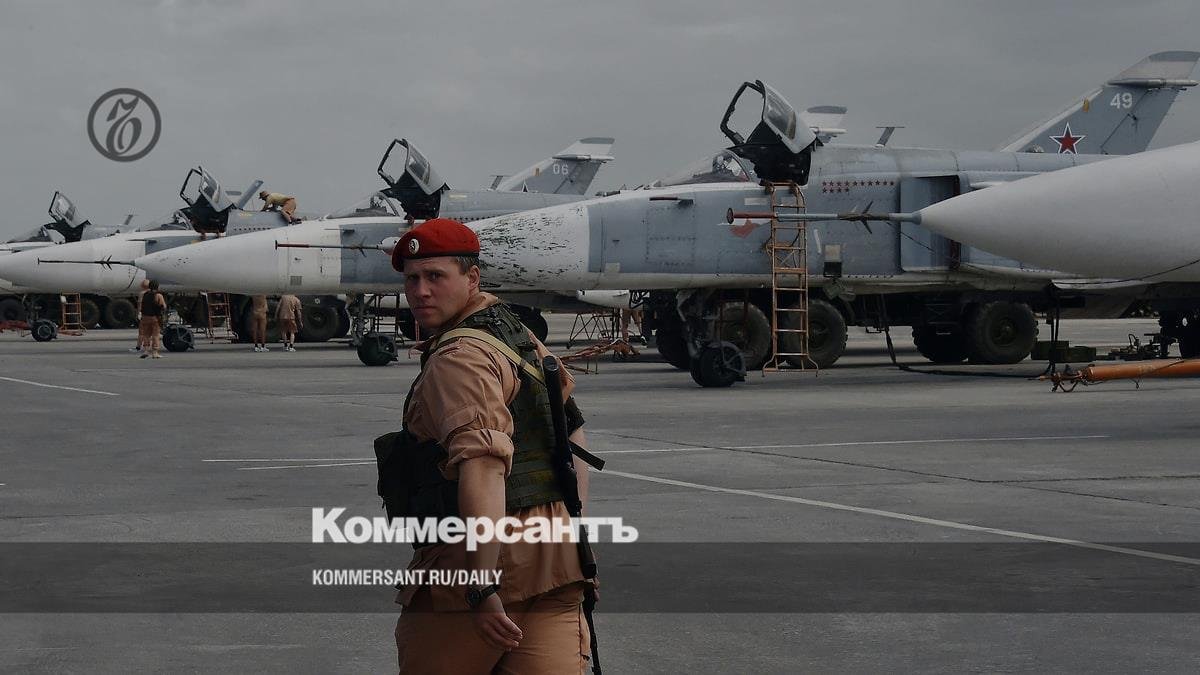
As Kommersant learned, Syria plans to change the operation of Russian military facilities on its territory. The transitional administration of President Ahmed al-Sharaa intends to turn the Khmeimim airbase, which is currently controlled by Moscow, into a training facility where Syrian troops will train. As a Syrian source familiar with the situation told Kommersant, the facility will finally lose its military functions and will come under the joint control of Moscow and Damascus. At the same time, Arab publications do not rule out that Russian instructors will be involved in training the Syrian army, which consists mainly of those forces with which Moscow waged an armed struggle during the era of the presidency of Bashar al-Assad.
The administration of Syrian President Ahmed al-Sharaa intends to turn the Russian Khmeimim airbase into a training and humanitarian point. A Syrian source familiar with the situation told Kommersant about this. “The facility will come under joint control of Russia and Syria, but will serve only non-military purposes,” Kommersant’s interlocutor said. He explained that the Syrian leadership would like to use the capabilities of the base, located in the coastal province of Latakia, to train its forces. They consist mainly of members of former radical formations who lack general military training. Kommersant’s source did not clarify what role the Russian military will play.
However, as sources of the Lebanese newspaper Al-Modon in the Syrian Ministry of Defense clarify, Damascus would like to involve Russian instructors in the training programs.
Moscow’s participation in training is critically necessary, because the Syrian troops are armed with predominantly Russian and Soviet-made equipment, Al-Modon’s interlocutors point out.
A small share of the arsenals is made up of Turkish products. Al-Modon sources suggest that Russian assistance may be limited to the training of ground forces; there is no talk of training Syrian pilots or giving them access to Russian aircraft.
Currently, Russia controls the Khmeimim airbase (Latakia province) and the Navy logistics center in Tartus in the Arab Republic. In an interview with the Al-Arabiya channel, which aired on February 18, 2026, Russian Foreign Minister Sergei Lavrov drew attention to the fact that the Syrian transitional government is interested in maintaining the Russian military presence, considering it a means that “balances the influence of other players.” However, he did not rule out that the two Russian bases will completely change their purpose. “These are no longer purely military functions, as they were before December 2025, but quite suitable facilities for repurposing into humanitarian hubs,” Mr. Lavrov reasoned.
The training of the Syrian military is now mainly carried out by Türkiye. On October 31, 2025, Ankara began training programs under the terms of the defense agreement with Damascus. It was assumed that the United States would also take part in training the Syrian military, with which Mr. al-Sharaa entered into an agreement on cooperation on November 10, 2025 within the framework of the coalition to fight the Islamic State (recognized as terrorist in the Russian Federation and prohibited). However, the Pentagon put the brakes on the idea of training Syrians after on December 13, 2025, a Syrian Interior Ministry employee recruited by jihadists killed two American military personnel and a civilian translator in Palmyra.
As Anton Mardasov, an expert at the Russian International Affairs Council, explained to Kommersant, after the collapse of the Bashar al-Assad regime, the de facto status of Russian bases changed.
“Previous containment operations, which the Russian Ministry of Defense has carried out all these years in the Eastern Mediterranean, reducing the area of positional areas of the 6th Fleet of the US Navy, have become impossible,” the expert noted. “Both Russian military installations are under fire control from commanding heights and are vulnerable to sabotage even with the use of firearms.”
Kommersant’s interlocutor recalled that back in January 2025, all weapons systems located in Syria were withdrawn to Russia and Libya, including the S-300 and S-400 air defense systems and the Bastion missile systems, so now the two bases are difficult to use even for short-term basing of strategic aviation. “The ships in Tartus are vulnerable from the sea,” Mr. Mardasov continued. “In the new conditions, this PMTO is almost not used by the High Command of the Navy. This is due not only to security threats and the need to escort bulk carriers, but also to Turkey’s ban on the passage of warships through the Black Sea straits.”
The situation with the Khmeimim airbase is similar to the situation in Tartus, except for one aspect, Kommersant’s interlocutor explained. “Damascus still allows the Russian military to use Khmeimim as a jump-off airfield for transporting cargo to Africa, since their tonnage is limited during direct flights,” noted Mr. Mardasov. “But our withdrawal from Khmeimim is not excluded: in this case, the Syrians could declare that they have achieved the withdrawal of Russians from the coast and closed the chapter of history in which the Russian Aerospace Forces have been bombing the opposition from this airbase since 2015.” Idlib (a province considered a stronghold of supporters of Ahmed al-Sharaa.— “Kommersant”)”.
At the same time, in reality, Damascus would leave the opportunity for the Russian military to act as instructors and use the runway for logistics operations in Africa, the expert concluded.