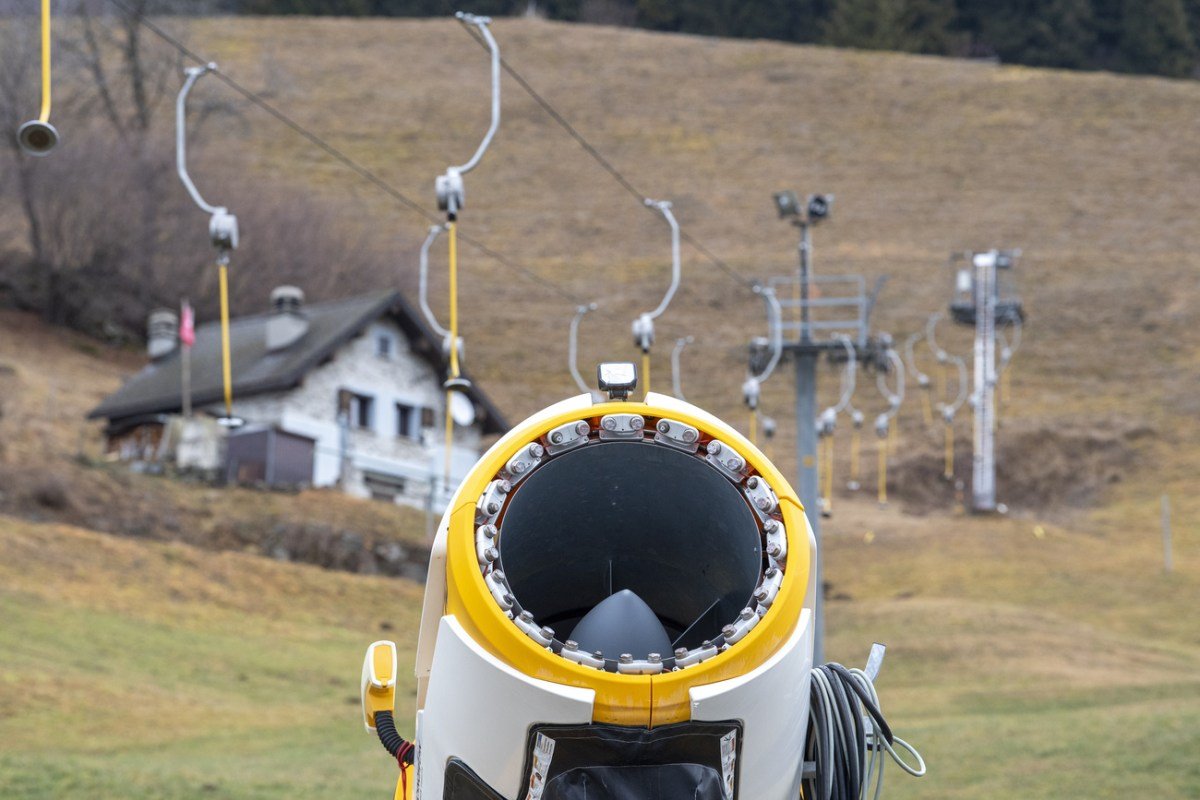

Snow cannons are used in other countries to fight fires
Keystone / Ti-Press / Francesca Agosta
Snowmaking infrastructure at Swiss ski resorts could be adapted to meet the growing threat of forest fires. The ski region of Adelboden-Lenk in the Bernese Oberland offers an example of how this could work.
Dry soils, low water levels and limited rainfall have pushed the risk of forest fires sharply higher after weeks of hot weather. The Federal Office for the Environment classifies the danger as high or very high in many parts of the country.
Large quantities of water are needed to extinguish forest fires. The infrastructure used in mountain resorts to produce artificial snow in winter could therefore play an important role during the summer months if a fire breaks out.
+ Should Switzerland prepare for a severe drought this summer?
Internationally, snowmaking systems have already been used to combat wildfires. During California’s Bridge Fire in September 2024, the Mountain High ski resort deployed snow cannons as giant sprinklers, helping protect buildings and lift infrastructure from major damage. In Australia, the Mount Buller resort incorporates more than 300 snow cannons into its bushfire protection strategy. The system can be activated remotely and distribute around one million litres of water per hour across the area.
Some manufacturers are now developing dedicated wildfire suppression systems based on snowmaking technology. One example is the FireCat system from United States company SMI Snow Makers, which uses existing pumps, pipelines and hydrants from snowmaking networks and can operate as either a fixed or mobile firefighting system.
Emergency firefighting
Similar ideas are being considered in Switzerland. In Adelboden-Lenk, a reservoir supplies water through pipelines that extend across the ski area. In winter, these pipelines feed snow cannons. During summer, however, the same network could be used to deliver water for firefighting purposes.
“We could also release water through these pipelines in summer,” said Stefan Buchs, operations manager of Bergbahnen Adelboden-Lenk. Fire services could tap into the network wherever water is needed, while helicopters could draw water directly from the reservoir.
If a fire were to break out in the region, local fire services could quickly coordinate with the ski lift operator. According to Buchs, water could be delivered across the area through the network within a short time. Snow cannons could also be used as sprinklers to help extinguish or prevent fires during dry periods.
The system has not yet been needed in a real emergency. Nevertheless, Bern cantonal fire inspector Christian Bieri said it is important to have such plans in place. The canton has therefore incorporated snowmaking infrastructure into its emergency planning.
Enough water available
To ensure a sufficient supply of water, authorities also move water between different reservoirs. “We pump water back and forth between various storage lakes,” Bieri said. This helps ensure that every region has enough reserves available if needed.
One question is whether firefighting operations could leave ski resorts without enough water to make snow in winter. Buchs does not believe this would be a problem. “It would take an enormous fire to use up all the water,” he said.
The Leiterli reservoir alone can hold up to 60 million litres. Buchs added that the ski resort has a direct interest in ensuring any fire is extinguished as quickly as possible. Even if using reservoir water for firefighting left slightly less available for snowmaking, he said the priority would be preventing damage. He also believes the reservoirs would not be empty by autumn, even if a forest fire occurred.
More
More
Forest fire risk level raised in parts of Switzerland
+ How we produce English news
Translated from German, reviewed by an English Department journalist.