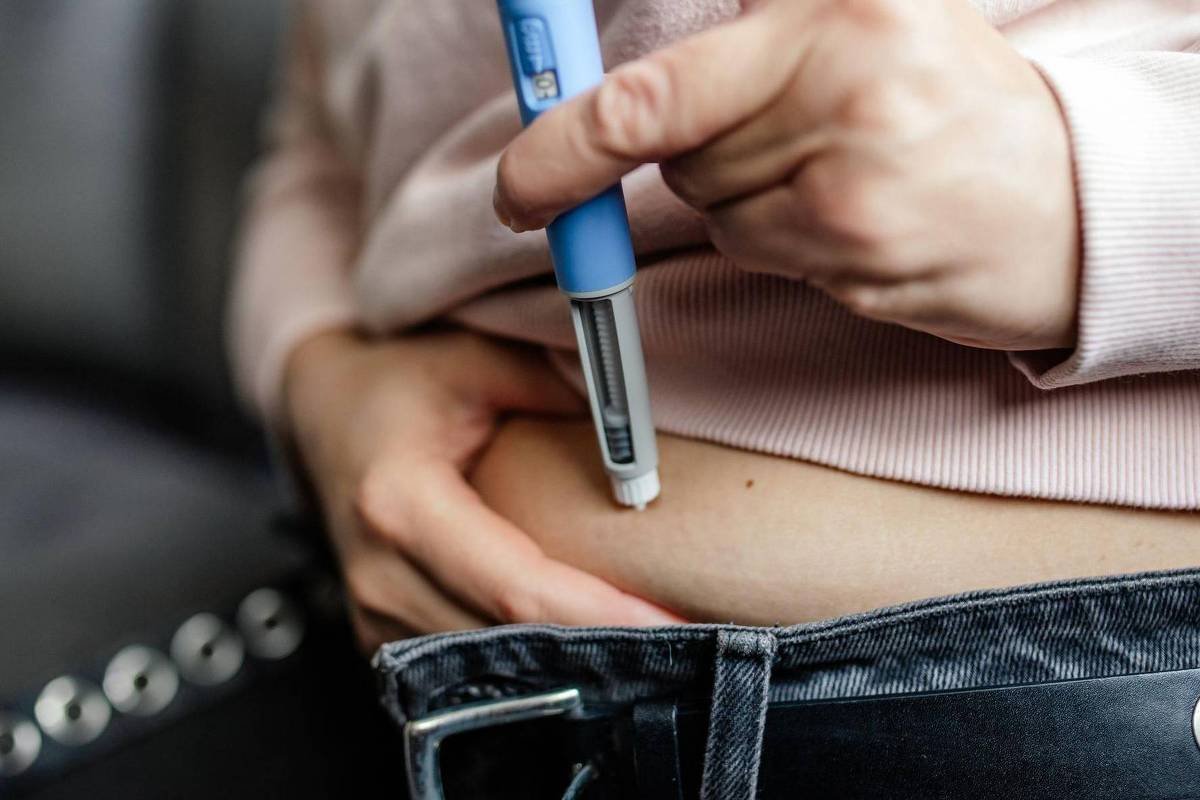
People who have variations in two genes linked to appetite and digestion may lose more weight when using slimming pens like Wegovy and Mounjaro in the treatment of obesitysuggests a recent study.
The findings, published in the scientific journal Nature, may help explain why some people lose much more weight than others and why some experience more intense side effects, such as nausea and vomiting, when using these drugs. medicines.
The medicines, widely used in several countries, reduce the feeling of hunger by acting in a similar way to a natural intestinal hormone that induces satiety.
Although genes may play a relatively modest role in the effectiveness of these treatments, experts say that other factors, such as gender, age and even a person’s origin, can also influence the results.
It is estimated that at least 1.6 million people in the UK have used weight loss medication in the last year, a number that is expected to grow.
Most of these products are purchased privately, through online pharmacies. The public system of health British NHS only offers Wegovy and Mounjaro to a small proportion of people with obesity and other associated conditions.
The proportion of body weight lost using these medications can vary greatly. Clinical trials indicate an average weight loss of 14% with semaglutide (Ozempic and Wegovy) and 20% with tirzepatide (Mounjaro).
In this study, based on data from 15,000 people who used these medications to lose weight, the average loss was 11.7% of body weight over approximately eight months of treatment. Some lost up to 30% of their weight, while others lost little or nothing.
All 15,000 participants had previously signed up for genetic testing by the company 23andMe, which used this data to map the experience of weight loss medication users. By analyzing millions of genetic variations, researchers identified a pattern that suggests a relationship between some variants and the effectiveness of treatments.
Professor Ruth Loos, from the University of Copenhagen, Denmark, who commented on the study in the scientific journal Nature, said: “The study identified a genetic variant associated with weight loss, which is also linked to the occurrence of nausea.”
“People with this variant tend to lose more weight,” Loos said.
This additional difference corresponds, on average, to around 0.76 kg, but among those who have two copies of the gene, the loss can be twice as much.
According to Loos, the variant is common in people of European descent: 64% have one copy, while 16% have two. By comparison, about 7% of African Americans carry one copy of the gene.
“If you have this variant, you will lose more weight,” says Loos.
The study also identified another variant that may be related to side effects, such as nausea and vomiting, in users of tirzepatide (Mounjaro).
This could mean that up to 1% of people using the medication experience intense episodes of vomiting, almost 15 times more frequent than usual.
Professor Loos said the genetic effect, although modest, “is comparable to other factors, and is not irrelevant.”
She emphasizes, however, that the findings still need to be reproduced in other studies, which, to date, has not occurred.
For Marie Spreckley, from the University of Cambridge, in the United Kingdom, “genetics is just one part of a much more complex picture.”
According to her, the main determinants of the results are “behavioural, clinical and treatment-related factors”, such as daily physical exercise, healthy eating while taking the medication, support and guidance received, in addition to pre-existing health conditions.
But other factors also influence
Previous research indicates that women are more than twice as likely to lose 15% of their body weight using Mounjaro compared to men.
Being younger, white or Asian is also associated with greater weight loss, although the reasons are not yet fully understood.
Furthermore, the type of medication, dose and time of use are also linked to more significant results.
In the long term, the combination of genetic information with other data could guide the choice of the most appropriate treatment for each patient, an approach known as “precision medicine”.
But this scenario is still a long way off, says Professor Naveed Sattar, an expert in metabolic health at the University of Glasgow, in Scotland.
“Overall, these results are scientifically interesting, but they are still far from changing clinical practice,” he said.
“What we need now is more robust data from clinical trials to better define the balance between benefits and risks of these and other emerging treatments.”
Access in Brazil
In Brazil, access to these medicines is beginning to change. Rio de Janeiro became the first city in the country to offer the drug Ozempic through the Unified Health System (SUS), on 03/18.
The measure occurs in the context of the end of the patent for semaglutide, an active ingredient present in medicines such as Ozempic and Wegovy, used to treat type 2 diabetes and obesity, which expired in the country on 03/20. With the end of the exclusivity of the pharmaceutical company Novo Nordisk, other companies are now able to develop versions of the compound.
In practice, the change opens up space for competition and possible price reductions, although this effect should not be immediate, due to regulatory and industrial obstacles, as shown in the BBC News Brasil report.
Currently, the monthly cost of treatment is around R$1,400, which limits access, especially among the lower-income population, most affected by obesity.
How do weight loss pens work?
Some key points about ‘weight loss injections’
Weight loss medications
There are weight loss injections, such as semaglutide (known as Wegovy) and tirzepatide (sold as Mounjaro).
They are known as GLP-1 (glucagon-like peptide-1) medications and give the feeling of a full stomach even without eating or eating less.
Appetite control
When we eat, food activates receptors in the brain known as appetite centers.
These centers control the release of hormones from the intestine, which make us feel full.
One of these hormones is GLP-1.
Mimicking hormones
GLP-1 medications work by mimicking the GLP-1 hormone that the body naturally releases after eating.
This hormone regulates blood sugar and appetite.
Feeling of satiety
When you take a GLP-1 medication, it causes your pancreas to release insulin when needed, stops another hormone from raising your blood sugar, and slows down digestion, making you feel fuller for longer.
The result is that the person consumes fewer calories and loses weight over time.
Fewer calories
The shot helps reduce the urge to eat, or the “food noise” as some describe it.
In addition to reducing hunger, Mounjaro also affects metabolism and helps regulate energy balance.