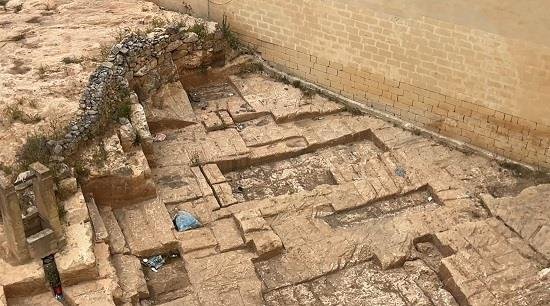
Din l-Art Ħelwa – National Trust for Malta on Friday expressed its profound dismay and serious concern regarding development permit PA/2946/24, which proposes a massive seven-storey residential complex with an underground garage directly over a recently discovered Late Classical Period catacomb and quarry in Qawra, St Paul’s Bay.
While the Superintendence of Cultural Heritage (SCH) has issued its clearance to the Planning Authority, its final report (dated 12th March 2026) and the earlier assessment (16th May 2025) reveal an approach that Din l-Art Ħelwa finds evasive, technically inadequate, and a grave dereliction of the duty to safeguard Malta’s cultural heritage. The Superintendent’s clearance reads less like a conservation directive and more like an archaeological obituary for this site.
The SCH’s own documents confirm the discovery of “significant archaeological features… of considerable cultural heritage value,” including a burial chamber and a Classical Period quarry. Yet, the proposed outcome is not in situ preservation and public valorisation, but construction over these features, subject to a series of conditions that are fundamentally incompatible with their long-term survival or accessibility, the NGO said.
The specific objections are as follows:
1. The illusion of a “buffer zone” is a surrender to development.
The SCH’s May 2025 letter demanded a 2-metre buffer zone around the principal archaeological zone (Area A). However, the final clearance allows construction to proceed immediately adjacent to, and effectively over, this area. A “buffer” that is built over is no buffer at all. It is a tombstone for the heritage it purports to protect. The very concept of a buffer has been emptied of all meaning.
2. “Preservation” by geotextile is an absurdity.
The SCH’s primary mitigation measure (Condition 2) is to cover the archaeological remains with geotextile fabric throughout the construction works, “which is to be removed upon completion of construction (in areas where no concreting has taken place).” This is not preservation; it is a temporary dust sheet. Construction of a seven-storey block, including pile-driving, excavation, and heavy machinery, will cause irreversible vibration, fracturing, and micro-displacement to fragile rock-cut catacombs, irrespective of what is laid on top. To suggest otherwise is scientifically illiterate and does a disservice to Malta’s heritage management standards.
3. Public access is entirely forfeited.
The SCH’s report makes no mention of public access to these catacombs. The Malta Today and Times of Malta articles (March 2025) highlighted that these are catacombs – a category of heritage that, elsewhere in Malta (e.g., St. Paul’s Catacombs in Rabat), is recognised as a site of national and international importance worthy of public presentation. Under this permit, these remains will be sealed forever beneath concrete and residential apartments, invisible and inaccessible to the Maltese public or future generations. This is not conservation; it is obliteration.
4. Archaeological monitoring is not a substitute for preservation.
The conditions requiring an archaeologist on site are welcome only as a damage-limitation exercise, not as a conservation strategy. The SCH itself acknowledges (Condition e) that new discoveries may require plan amendments, yet the permit is being cleared in principle before any such work has begun. This inverts the correct planning hierarchy. Heritage should define development; development should not simply proceed and hope heritage can be “managed” around it.
This development, as approved, should not proceed, the NGO said. The presence of a Late Classical catacomb demands a fundamental redesign of the proposal, or its outright refusal, to allow for the preservation, study, and public display of this nationally significant site. The permission should be revoked or suspended until an independent review of the SCH’s mitigation measures is conducted and the true extent and significance of the catacomb and quarry is determined.
The Executive President of Din l-Art Ħelwa, Patrick Calleja said that “our cultural heritage has once again fallen prey to inappropriate development and commercial interests. Our cultural heritage is our wealth and it is not renewable. Yet, instead of safeguarding it, our authorities justify its disposal, in this case crowning it with a seven storey tombstone. This archaelogical site clearly has immense historical and cultural value and should be protected.”
The decision notice for this permission was published on 1 April 2026. In view of the clear abdication of responsibility by both the Planning Authority and the SCH, the objectors have up until 30 April to appeal the decision. Din l-Art Ħelwa extends its help in this regard.