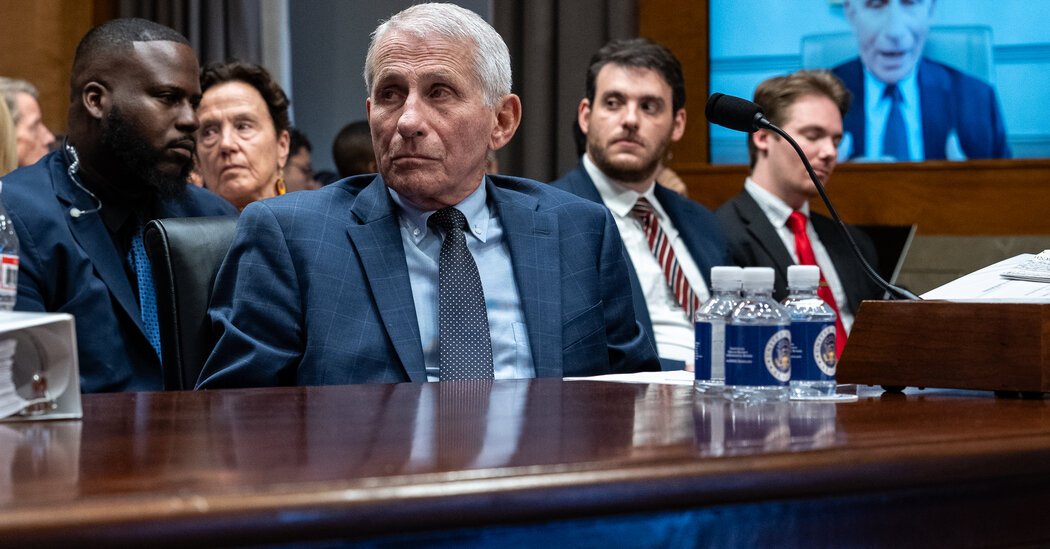
The Senate Homeland Security Committee voted along party lines on Thursday to hold Dr. Anthony S. Fauci in contempt of Congress for his refusal to answer questions at a hearing last week, clearing the way for the committee to ask the Justice Department to prosecute him.
Dr. Fauci invoked his Fifth Amendment right to remain silent more than 100 times last week, as Republicans accused him of funding research in China that started the coronavirus pandemic, and lying about it to Congress — accusations he vigorously denies.
Thursday’s vote addressed a different question: Did Dr. Fauci fail to comply with a congressional subpoena, a federal misdemeanor that carries a prison sentence up to 12 months? The panel adopted a resolution concluding that he did.
The vote once again exposed the sharp partisan divisions around Dr. Fauci. With the midterm elections coming up in November, it also thrusts Dr. Fauci’s handling of the pandemic back into the political debate. As far back as 2022, Republicans including Senator Rand Paul of Kentucky, the panel’s chairman, have made Dr. Fauci a boogeyman, attacking him to raise money for their campaigns and whip up the party’s base.
In a statement after the hearing, Dr. Fauci’s lawyer, David Schertler, called the vote “a crude political stunt intended to punish Dr. Fauci for exercising his constitutional rights.”
Ordinarily, when a Senate committee passes a contempt resolution, it is forwarded to the full chamber for a vote. If the Senate approves, with a 60-vote majority, the resolution goes to the U.S. attorney in the District of Columbia, who can bring it to a grand jury.
But Republicans cannot muster the 60 votes, and the Senate is now headed into its August recess. So Mr. Paul is bypassing the Senate vote. He said after the hearing that the panel would hand-deliver the contempt resolution to both the Justice Department and the U.S. attorney later in the day.
“It’s the committee’s verdict that he should be held in contempt, and it will be sent,” Mr. Paul said. “But no one said that we won’t bring it before the Senate. We’ll see what happens over time.”
Democrats protested that Mr. Paul was circumventing federal law.
Several said that rather than vote to hold Dr. Fauci in contempt, Congress should abandon its partisan bitterness and the government should convene a bipartisan commission, akin to the 9/11 commission, to have an independent inquiry into Covid’s origins and the pandemic response.
Congress had a chance to do that in 2022, when a bill to create an independent panel passed the Senate health committee with bipartisan support on a vote of 20 to 2. But the bill died. The Biden White House never took a position on it, and Senator Chuck Schumer, the majority leader at the time, did not bring it to the floor for a vote.
Dr. Fauci served for nearly 40 years as the government’s top infectious disease expert and was well regarded by both parties until the pandemic turned him into polarizing figure — lionized on the left and a symbol of lockdowns and government overreach on the right.
He has said that he testified or briefed members of Congress more than 200 times during his tenure. In appearances before Mr. Paul during the pandemic, he was often combative. In a brief opening statement last week, Dr. Fauci said that it pained him to remain silent but that he had concluded that Mr. Paul had an “unhinged obsession” with him and was acting on his lawyers’ advice.
Thursday’s vote was yet another turn in a yearslong effort by Republicans to prove that he funded “gain of function” research, involving altering viruses, at a laboratory in Wuhan, China, the city where the pandemic began, and that the coronavirus that causes Covid-19 leaked from a lab.
While the National Institute of Allergy and Infectious Diseases, which he led, did fund such research, Dr. Fauci told a House panel in 2024 that it was “molecularly impossible” for the taxpayer-funded experiments in Wuhan to have produced the pandemic-causing virus. He also said the research he funded did not meet the government’s strict definition for gain-of-function work.
Republicans were not convinced. “You belong in prison,” Representative Marjorie Taylor Greene of Georgia said then.
Such statements from Republicans including Ms. Greene and Mr. Paul prompted President Joseph R. Biden Jr. to give Dr. Fauci a “pre-emptive” pardon before he left office in January 2025.
Republicans argued that the pardon shielded Dr. Fauci, rendering him ineligible to take the Fifth. Pointing to his brief statement, they also said he could not testify and refuse to testify at the same time.
“The chair directed Anthony Fauci to answer. He refused,” Mr. Paul said before the vote. “That is what we are voting on today — not his opinions, not his policies, not anything he said from the podium six years ago. We are voting on whether a witness who has received the benefit of a federal pardon can be ordered by this committee to answer questions and then defy that order without consequence.”
The politics of the contempt vote are nuanced. President Trump said after last week’s hearing that he has “never been a big fan” of Dr. Fauci. But he gave Dr. Fauci a medal during his first term, and has not embraced Mr. Paul’s call for the scientist to be thrown “in prison.”
Asked earlier this week about Dr. Fauci’s decision to take the Fifth Amendment, the president said, “His lawyer told him to.” Mr. Trump’s social media post before last week’s hearing was also telling. Instead of criticizing Dr. Fauci’s pandemic response, he derided the weak first pitch Dr. Fauci threw at a Washington Nationals game six years ago.
Polls have consistently shown that Dr. Fauci has the support of a majority of Americans. A 2025 survey by the Annenberg Public Policy Center found that 57 percent of Americans trusted Dr. Fauci to give them accurate health information, compared with 39 percent for Health Secretary Robert F. Kennedy Jr.
It is unclear if public sentiment will shift in the wake of the recent release of Dr. Fauci’s diary, which included entries about his fame, his friendships with celebrities and his pursuit of cash awards. Celinda Lake, a Democratic pollster, said the contempt resolution would play well with the Republican base, but not with independents.
“Swing voters want the focus to be on their lives and their problems,” she said. “They want to move forward, not backward.” The intense focus on Dr. Fauci, she said, makes Congress seem “completely irrelevant.”
But John Feehery, a Republican strategist, says there is a “hidden majority out there who strongly resent” what happened during the pandemic. “Fauci taking the Fifth frustrates that silent majority and was a bad look for him,” Mr. Feehery said, adding that the vote would please Republicans “who want accountability.”
The vote came after a spirited debate in which Democrats, one by one, introduced motions to postpone consideration of the resolution. In rapid fire, those motions failed along party lines, and Mr. Paul eventually cut the Democrats’ effort short.
Senator Richard Blumenthal, Democrat of Connecticut, argued that before taking the “immensely historic step” of holding Dr. Fauci in contempt, the committee needed to at least “hear from his counsel as to what he feared.” Mr. Paul threw Dr. Fauci’s lawyer, Mr. Schertler, out of the hearing last week after Mr. Schertler tried to speak.
Senator Gary Peters of Michigan, the top Democrat on the committee, accused Mr. Paul of conducting a “rushed investigation” without Democrats’ participation. He warned that if the committee approved the resolution holding Dr. Fauci in contempt, it would discourage others from testifying in the future.
“This committee should not damage its future investigative authority to advance the chairman’s yearslong campaign against single individuals,” Mr. Peters said.
The vote followed another twist in Republicans’ investigation of Dr. Fauci. On Wednesday night, Senator Ron Johnson, Republican of Wisconsin and the chairman of the Senate’s Permanent Subcommittee on Investigations, said he had received a copy of Dr. Fauci’s government-issued cellphone. “Hopefully this device will address many of the questions he refused to answer at last week’s hearing,” Mr. Johnson wrote on social media.
Thursday’s vote represents only part of Dr. Fauci’s travails on Capitol Hill. Representative James R. Comer, Republican of Kentucky and the chairman of the House Committee on Oversight and Government Reform, said after last week’s hearing that he would be “asking Dr. Fauci whether he stands by his previous testimony to our committee.”
Florida’s attorney general, James Uthmeier, also vowed after last week’s hearing to investigate Dr. Fauci.
Dr. Fauci’s pardon covers only his activities from 2014 through Jan. 19, 2025, Mr. Biden’s last full day in office. His allies said that if he testified and made a misstep, he would open himself up to possible perjury charges. Republicans on the panel said the pardon protects him, so he was ineligible to take the Fifth.
On this issue, legal scholars disagree. Some said his invocation of the Fifth was proper because he was legally vulnerable. Others said the pardon offered him immunity.
There is precedent for Congress holding a government official in contempt for invoking the Fifth Amendment after initially testifying, as Dr. Fauci did last week. In 2013, Lois Lerner, an Internal Revenue Service official, appeared before a House committee under subpoena and insisted she had not misled Congress in previous testimony.
Like Dr. Fauci, she then refused to answer questions. Ms. Lerner was promptly suspended from her job, and in 2014, the House voted along party lines to hold her in contempt of Congress. But in 2015, federal prosecutors refused to prosecute her, saying they disagreed with House Republicans who said that by making her initial statement, Ms. Lerner had waived her Fifth Amendment right.
Senator James Lankford of Oklahoma, the sole Republican to question Dr. Fauci gently at last week’s hearing, raised the Lerner case at the end of the session, suggesting that the homeland security panel needed to at least consider having a contempt vote.
“The parliamentary question that I think we’ve got to be able to deal with is: Is this consistent with Lois Lerner?” Mr. Lankford asked. He voted on Thursday to hold Dr. Fauci in contempt.
Two advisers to Mr. Trump who served in his first administration, Stephen K. Bannon and Peter Navarro, each spent four months in prison in 2024 for failing to comply with congressional subpoenas. But rather than invoke the Fifth Amendment, Mr. Navarro and Mr. Bannon simply did not show up to testify.
Representative Jamie Raskin of Maryland, the senior Democrat on the House Judiciary Committee and a former constitutional law professor, said that Mr. Paul had already tainted a prosecution by asserting he wanted to see Dr. Fauci in prison, while at the same time trying to force him to testify.
“I do have some sense of the ethics of a legislative investigation,” Mr. Raskin said. “It just would never occur to me to go around saying a witness should be in prison and then try to prevent them from invoking their Fifth Amendment privilege against self-incrimination over the very matter I’m claiming is criminal.”