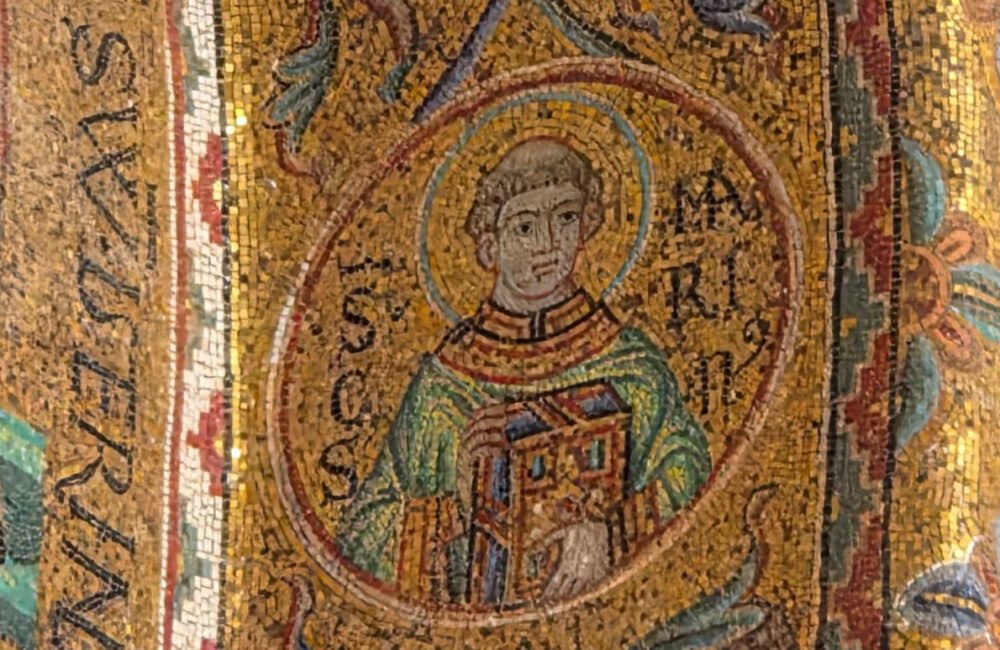
VENICE – The Captains Regent Alice Mina And Vladimiro Selva participated on Saturday 26 September in a ceremony in the Basilica of San Marco, in Venice, after the recent identification of an ancient mosaic depicting Saint Marino, founder and patron of the Republic. Accompanying them was the Secretary of State for Culture Teodoro Lonferninithe San Marino consul in Venice Lorenzo Mel and an institutional delegation.
The mosaic, dating back to the period 1260-1270, is located in the northern arm of the atrium of the Basilica and depicts a half-length portrait of Saint Marino. The identification is confirmed by the Latin inscription present in the work and was recently verified by the professor Alberto Peratonerdirector of the Office for the Pastoral Care of Culture of the Patriarchal Curia of Venice, following a study initiated by Sister Maria Gloria Riva.
The presence of the Holy Founder among the mosaics of the Basilica testifies to a devotion dating back over seven centuries ago. Among the possible historical reasons for the depiction are Marino’s Dalmatian origins and the ancient relationships between Venice, the Adriatic coasts and the San Marino territory.
Welcoming the delegation were Chiara Boldrinprosecutor of the Basilica of San Marco, and the vice prefect Giuseppe Vivola. At the end of the ceremony, the Captains Regent and the Secretary of State were received by the Patriarch of Venice, Monsignor Francesco Moraglia.
In their speech, the Captains Regent expressed gratitude for the recognition of the ancient depiction, underlining the historical and spiritual value of the discovery and the ties that unite the San Marino and Venetian communities.
The Secretary of State Teodoro Lonfernini highlighted how the identification of the mosaic contributes to the knowledge of the historical roots of the Republic and its relations with Venice.
The Regency extended particular thanks to the consul Lorenzo Mel for the coordination of institutional contacts and to the scholars who contributed to the identification of the work. Acknowledgments also to Valentina Garavini, Alessandra Frollo Mel And Fabio Righi for their contribution to the initiative.