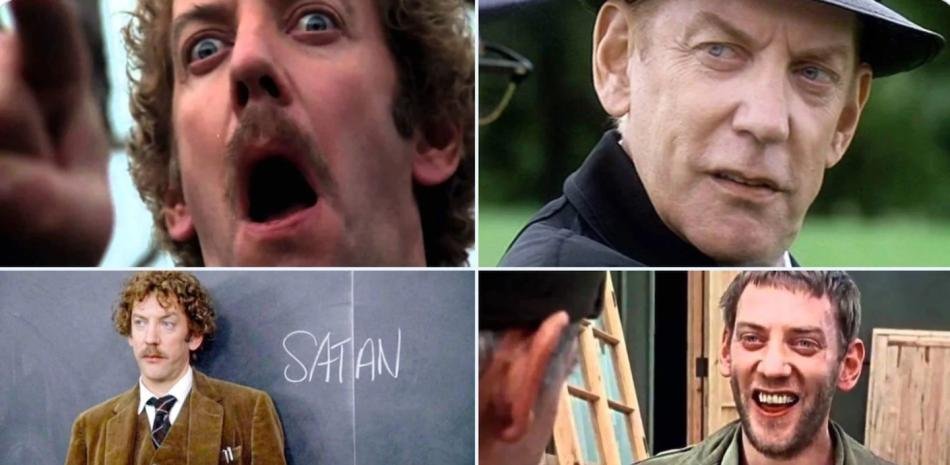
A couple of years ago, a great actor in both lead and supporting roles passed away, being a very versatile artist throughout Hollywood. We are referring to Donald Sutherland.
This great actor was born in Canada where he spent his entire childhood and adolescence in that country before going to Finland as an exchange student. He began studying engineering and dramatic art both in his country of origin and in England. He stood out in small roles in school works, and in some series or films for television, making himself known in the film world. His first successes came with the film “The Dirty Dozen” (1967), however, his fame came by acting as an American military doctor in Korea in the successful comedy M*A*S*H* (1970), directed by Robert Altman and co-starring Elliot Gould. Later that same year he worked on another successful film “Kelly’s Violence”, alongside Clint Eastwood.
In the mid-seventies he worked with the director Federico Fellini in the film “Il Casanova” and with Bernardo Bertolucci in the film “Novecento” where he received good reviews for his work in Italy. Entering the decade of the eighties of the last century, he established himself as one of the most multifaceted actors, acting in very diverse roles, demonstrating his histrionic abilities in films such as: “People like one” playing a father devastated by the loss of his son. This film won several Oscars including Best Picture. This film has been debated within the Awards classifications; since that year a Masterpiece by director Martin Scorsese such as “The Raging Bull” was competing, opening a challenge of analysis in relation to the justice of awarding works in a moment of ecstasy of the moment.
Throughout his life he was never short of work in the industry, whether as a lead or supporting actor, accumulating a large filmography of almost 200 films for both film and television, but not before working in plays accumulating great experience on stage. However, as a curious fact, with a trail of great productions on his resume, he was never nominated for an Oscar Award. The Academy during the 90th edition of the 2017 Awards awarded him an Honorary Oscar, perhaps as a way to repair this injustice.
Sutherland was also noted for his political activism throughout his career alongside Jane Fonda, in which they protested against the United States war in Vietnam and were a standard bearer of civil actions against the war.
As part of his long filmography we can mention some such as:
1) “The Twelve of the Chapter” (1967)
2) Kelly’s Heroes (1970)
3) 3) M*A*S*H (1970)
4) “Klute”
5) 5) Shadow Menace (1973)
6) “Animal House” (1978)
7) “The Invasion of the Ultracorps” (1978)
8) JFK (1991)
9) Outbreak (1995)
10) A Time to Kill (1996)
11) Limitless (1998)
12) Space Cowboys (2000)
13) Cold Mountain (2003)
14) Pride and Prejudice (2005)
15) And the Hunger Games franchise (2012–2015).
The generation of the first half of the last century is leaving us. The legacy that many intellectuals and every artist in each of the manifestations of the arts are leaving us from earthly life to be able to unite in another unknown dimension with the great personalities of the past. However, the legacy they leave us must remain forever, thanks to the excellence of their works, as a great manifestation of excellence that will transcend the barrier of time.
That is why I recommend to this new generation of film buffs that they look for some of the films of this established actor to learn about his histrionic abilities in films that have endured through the years.