When the war with Iran began, officials at the Federal Reserve shied away from providing detailed forecasts about how the economy might be affected in all but one dimension. What they acknowledged, aside from the vast uncertainty, was that the longer the war lasted, the bigger the fallout would be.
Six months later, with no end to the conflict in sight, policymakers at the central bank are contending with the mounting consequences.
Growth has held up surprisingly well, a resilience that has continued to defy economists’ expectations. But elevated inflation, pushed up as well by a boom in artificial intelligence spending, has created a conundrum for the Fed — one that has prompted officials to consider raising rates at their next meeting on Sept. 15-16 if price pressures do not continue to ease as they have over the summer.
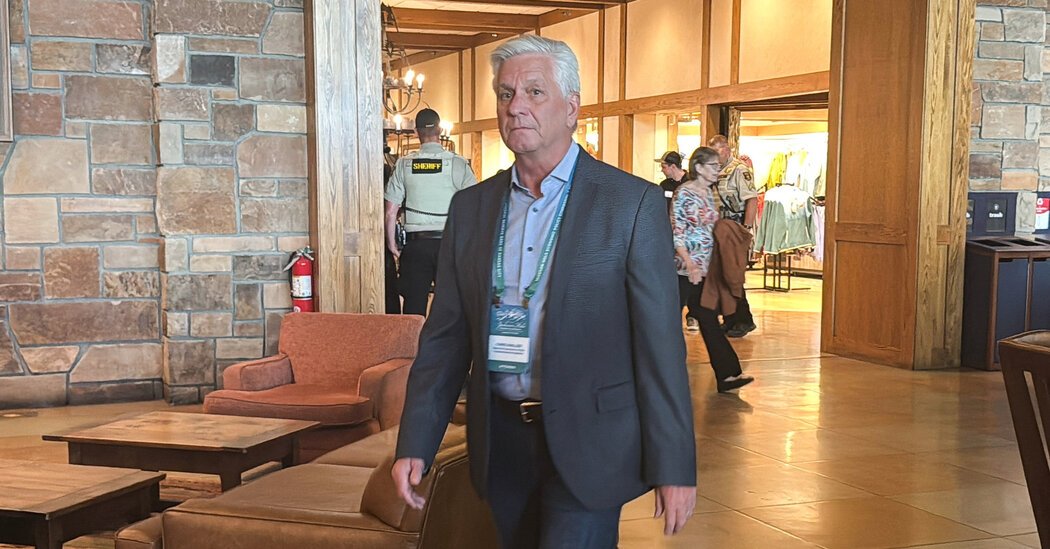
Christopher J. Waller, a central bank governor, on Thursday struck an upbeat tone about the trajectory of inflation despite that it had overshot the Fed’s 2 percent target for more than five years. The central bank, he said in a speech, was “finally seeing some signs of disinflation.”
Still, Mr. Waller, like other policymakers recently, said he was putting significant weight on forthcoming data releases, most notably August’s Consumer Price Index report to be released on Sept. 11, in deciding whether to support a rate rise later this month.
“If there is continued progress toward our 2 percent goal, then I am willing to support holding the policy rate at its current level,” Mr. Waller said of the August data. “But if inflation comes in hot, I would consider a rate hike.”
He added: “I judge that policy is currently only slightly restricting aggregate demand, and it may not take much acceleration in inflation to nudge me into supporting tighter policy. If there is evidence that progress toward 2 percent inflation reversed in August, a small adjustment in our stance would help ensure that it resumes.”
In a discussion with Reuters after his remarks, Mr. Waller framed the upcoming rate decision as a matter of risk management.
“What’s the cost of waiting one meeting? Hiking 25 basis points one meeting right now is not going to bring the C.P.I. down to 2 percent,” he said. “You want to take a chance to see if disinflation continues, but I’m not taking a big chance on it.”
Mr. Waller’s comments are among the last from top officials ahead of a communications blackout before the next meeting. Investors, who on Thursday pared bets that the Fed would raise rates later this month, still see the decision as a close call.
Kevin M. Warsh, the Fed chairman, indicated in a speech last week at the Fed’s annual conference in Jackson, Wyo., that the central bank would have “work to do” if underlying inflation was not moving down “clearly and at sufficient speed.”
He also downplayed recent evidence over the summer that showed slightly less acute price pressures. “They do not tell me that underlying trends have meaningfully improved,” he said. Moreover, he suggested that with the labor market “quite stable” and inflation running above target, “the Fed’s predominant focus right now should be on prices.”
Mr. Warsh stopped short of endorsing a rate increase if the data do not comply, in keeping with his opposition to providing guidance about what the Fed might do next. But like Mr. Waller, his colleagues have been more direct about their thinking.
Earlier this week, two top officials conveyed a different sense of urgency around raising rates.
Michael S. Barr, a Fed governor, expressed concern about “broader price pressures taking hold” and said that if inflation did not soon ease, he would support the Fed taking action.
“If trends in the data give me some confidence that inflation is moderating on a path to 2 percent, then I think we can take a bit more time to assess our policy stance,” Mr. Barr said in a speech in Washington on Tuesday. “However, if inflation appears not to be moderating sufficiently, then I think we should act decisively to raise rates.”
A day later, John C. Williams, president of the Federal Reserve Bank of New York, indicated that it was still an open question whether a rate increase was necessary later this month. He emphasized that much of what had lifted inflation were temporary factors, such as tariffs, whose impact is starting to fade.
“There’s no clear signs right now whether monetary policy currently is sufficient to make sure we bring inflation back to target in the next year or two, or whether you need to see further action to do that,” Mr. Wiliams, who is the vice chair of the policy-setting committee, said in an interview with CNBC on Wednesday.
Whatever the Fed decides, officials will have to contend with a jittery U.S. government bond market. Yields are sharply higher compared with earlier this year, in part because of higher growth prospects stemming from A.I. and also uncertainty about the policy path forward for the Fed.
The moves have been substantial enough to prompt Scott Bessent, the Treasury secretary, to intervene in the bond market last month. Mr. Waller on Thursday questioned the utility of those moves, saying it was unclear to him whether “these kinds of interventions do much.”
Mr. Waller on Thursday also explained in greater detail his rationale for outlining his views on the economy as well as how he might respond to changes in the data. How the Fed communicates has been a focal point ever since Mr. Warsh took over as chairman in May. Mr. Warsh has made a point of keeping his preference close to this chest in a bid to get what he describes as a clear signal from markets, rather than having the markets reflect back what officials say.
But that has also let to some confusion as investors have struggled to get a sense of how Mr. Warsh views the current economic backdrop and the policy choices in front of the Fed — something he sought to address in his speech last week.
Mr. Waller on Thursday said providing a “reaction function,” meaning how the Fed responds to changes in the data, allowed for consumers, businesses and investors to “better understand how I will vote on policy given the range of outcomes and then factor that into their planning for the future.”
Asked during the discussion whether Mr. Warsh was “letting the perfect get in the way of the good” when it comes to how the Fed communicates, Mr. Waller agreed.
“Why do you want to surprise people? What good does that do?”