
Listen to this article
Estimated 4 minutes
The audio version of this article is generated by AI-based technology. Mispronunciations can occur. We are working with our partners to continually review and improve the results.
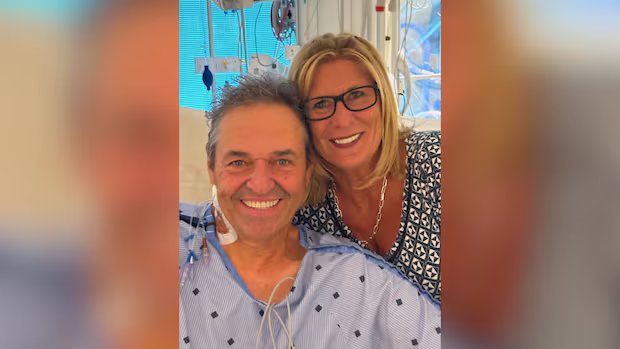
A 64-year-old Quebec man has become the first patient in North America to receive a regenerated liver thanks to a breakthrough technology that could make dozens of additional livers available for transplant in its first year alone.
Gérard Landry, a resident of Nouvelle on the south shore of Quebec’s Gaspé Peninsula, spent about 15 years dealing with liver problems that eventually progressed to cirrhosis and liver cancer.
Just before he was wheeled into surgery for a liver transplant, his doctor gave him some unexpected news about the organ: it was regenerated by a new machine, used for the first time at Montreal’s Centre hospitalier de l’Université de Montréal, or CHUM.
“[My doctor] told me about the new machine that he worked on for a few years,” Landry said. “It was like a Christmas gift.”
The technology, called Liver Assist, allows doctors to treat and assess a donated liver outside the human body before transplanting it. For Landry, it meant receiving an organ that might otherwise have been considered too risky to use.

Gérard Landry had been suffering from liver disease and cancer for 15 years. But now, he’s cancer-free thanks to a liver regenerated by a new machine – technology that could lead to more life-saving transplants.
Giving a donated liver a chance to recover
Dr. David Hénault, hepatopancreatobiliary surgeon and liver transplant specialist at the CHUM, led the project and performed Landry’s operation.
He said the team had been preparing to use the technology for about three years.
The Liver Assist system works by connecting a donated liver to a machine that circulates an oxygen-rich fluid through the organ, which can help reverse some of the damage caused by a lack of oxygen while the organ is outside the body.

The technology then allows doctors to switch to a blood-based solution and assess how the liver functions in conditions designed to mimic the human body.
“If it works on the machine, then it’s going to work in the human,” Hénault said.
The liver Landry received was particularly well suited to the technology because it was susceptible to damage caused by a lack of oxygen during the organ transfer process, Hénault said.
Boost to number of available livers
The CHUM performs about 70 liver transplants each year. Hénault said a study done with Transplant Québec looked at livers that had previously been declined for transplantation and assessed which ones might have been recoverable using the new technology.
The team estimates the machine could make an additional 20 to 24 livers available for transplantation during its first year of use. That number could grow as the technology becomes more widely used.
“We will be able to help so many more patients in need of a liver that are waiting on the transplant list,” Hénault said.

He also says studies have shown the technology can help reduce complications, reoperations and hospital stay times for appropriate patients.
For Landry, doctors saw signs of a successful transplant almost immediately.
Hénault said Landry’s blood work the day after the operation was already better than expected for the type of transplant he received.
“I do believe that the machine really helped in this case,” Hénault said.
Landry’s recovery also appeared to be going unusually well.
“He was feeling way better than the average patient that gets a liver transplant,” Hénault said. “He did amazingly well.”
Looking forward to home
Landry is still recovering in Montreal and returns to the hospital for blood tests once or twice a week so doctors can adjust his medication.
Eventually, he hopes to return back east to Gaspésie and continue his recovery there. But after 15 years of illness, he’s already thinking about what comes next.
“I’m in a hurry to see my family, my grandson, my friends and my horses,” he said.

Landry also hopes his experience will encourage people to talk to their families about organ donation.
Even the most advanced technology cannot help, he said, if there are no donated organs available.
Because, as Landry put it, “if you have a horse without a rider, you don’t have a ride.”