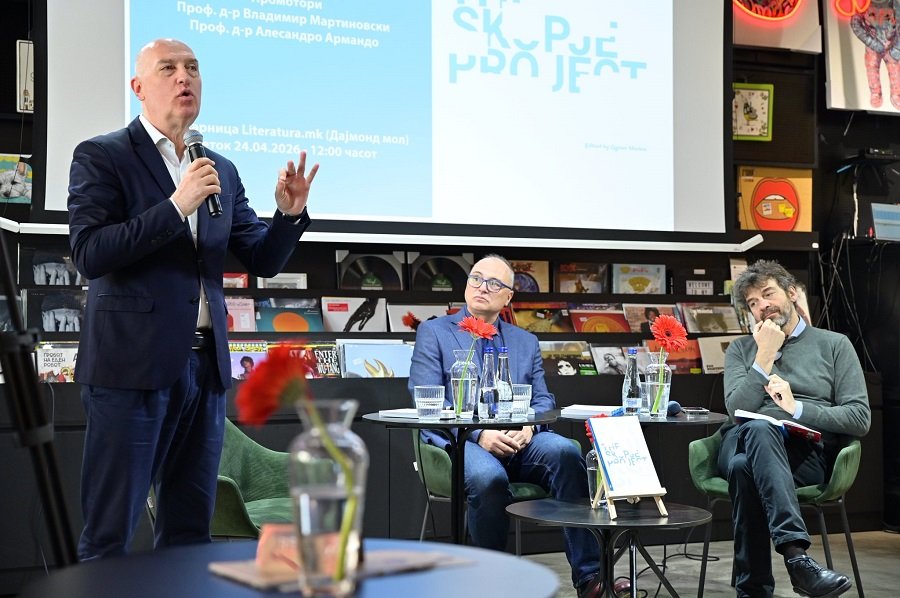
On Friday (April 24) the book “The Skopje Project” by the author and editor, prof. Dr. Ognen Marina, professor and former dean of the Faculty of Architecture at UKIM in Skopje.
The book, which is published by “Ars Lamina”, was presented within the framework of the international conference “Shaping Skopje’s Future: Culture, Urban Policies and Sustainable European Cities”, which was held these days organized in partnership with the City of Skopje, the Center for Advanced and Postdoctoral Research of UKIM in Skopje and UNDP in Skopje.
This important event marks the beginning of the strategic conversation about the development of Skopje for the next 20 years, and at the same time strengthens the city’s path towards Skopje – European Capital of Culture 2028. The conference brought together all the leading institutions, mayors, European partners, experts, universities and international organizations in order to open a meaningful dialogue about the future of Skopje through the exchange of ideas.
The publication “The Skopje Project”, published in English, is a work that opens one of the most significant urban, architectural and political stories of Skopje: the reconstruction of the city after the catastrophic earthquake of July 26, 1963. The book has its clear genesis in the international conference “The Skopje Project”, held in 2023 on the occasion of 60 years since the Skopje earthquake and 110 years since the birth of the Japanese architect Kenzo Tange. That conference again gathered in Skopje the architects, urban planners, researchers and theoreticians who think about the city as a space of solidarity, knowledge, political vision and social transformation.
– “The Skopje Project” is not only a historical study of the reconstruction of Skopje. It is a book about the idea that cities are built not only with plans, streets and buildings, but also with values: cooperation, knowledge, culture, solidarity and public responsibility. In it, Skopje appears as a global urban experiment — a city rebuilt with the support of almost ninety countries and under the auspices of the United Nations; a city in which architecture, urbanism, diplomacy and politics came together in an attempt to imagine a new, modern and humane city – said Prof. Dr. Fire Marina.
The focus of the book is the great visions, but also their limitations, idealism and compromises, the role of Ernest Wiseman, Konstantinos Doxiadis, Jaap Bakema and Kenzo Tange, but also the wider context in which Skopje, positioned between the East and the West, became a laboratory of modern architecture and urban planning.
Prof. Dr. Ognen Marina, architect, professor and researcher of the urban transformations of Skopje, with this work continues his long-standing scientific and professional commitment to the city. His work places Skopje not only as an object of historical research, but also as an active model for thinking about contemporary cities, their crises, their potentials and their future.
– This book arose from the need to read Skopje again as a world architectural and urban story. Reconstruction after the earthquake was not only a technical process of reconstruction, but a project of international solidarity, knowledge and hope. Today, when Skopje is preparing for the European Capital of Culture 2028, that memory should become the basis for a new cultural and urban transformation of the city – Prof. Dr. Fire Marina.
The promoters of the book were Prof. Dr. Alessandro Armando, with whom Ognen Marina has been collaborating for 15 years, and Prof. Dr. Vladimir Martinovski, Dean of the Faculty of Philology “Blaze Koneski” at UKIM in Skopje.
The promotion of the book takes on special significance because it is held within the framework of the “Shaping Skopje’s Future” conference, with which Skopje opens its new European development perspective. The event connects culture, urban policies and sustainable development as the foundations of preparations for Skopje – European Capital of Culture 2028.
Thus, “The Skopje Project” becomes more than a book, it is a bridge between the past and the future of Skopje. From a city of international solidarity after 1963, to a city of culture, knowledge, cooperation and sustainable transformation on the eve of 2028. With that, Skopje once again has the opportunity to imagine its future, but this time through culture as a force that changes the way we plan, build and live the city.