Worldwide, press freedom is worse than it has been in 25 years. Liechtenstein remains at the top – with a structural weakness.
Reporters Without Borders has published its 2026 press freedom rankings. Liechtenstein ranks 13th out of 180 countries and is classified as “satisfactory” with an overall score of 82.62 points. In 2022, Liechtenstein was still in the top 10. It was not just the Volksblatt shutdown and the shutdown of Radio L that contributed to the country slipping further and further in recent years. The report also cites the increasingly difficult advertising market as a reason.
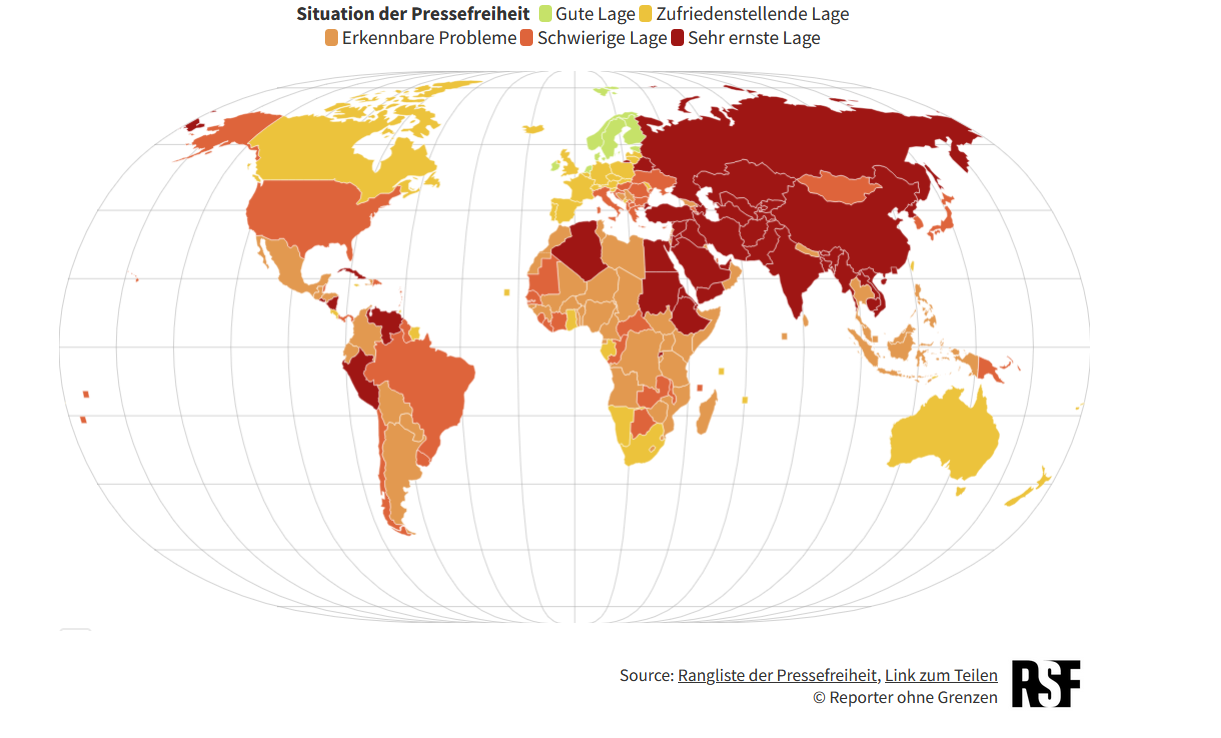
The first 19 places are occupied exclusively by European countries. Norway tops the rankings for the tenth time in a row; This is followed by the Netherlands and Estonia. At the lower end there are still Eritrea, North Korea and China.
strengths and a structural weakness
The partial scores for Liechtenstein show a differentiated picture. In the area of security, the country achieved the best score with 95.83 points: no journalist was killed, arrested or disappeared. The legal framework was also rated highly with 89.69 points, the socio-cultural context with 84.84.
Liechtenstein performs significantly worse in the economic area: 65.41 points – the lowest sub-score in the country. The background is the structural weakness of the Liechtenstein media market: small advertising environment, limited reach and the loss of the Liechtensteiner Volksblatt, which was discontinued at the beginning of 2023 for economic reasons. Since then there has been only one daily newspaper in the country. The 2024 referendum on the privatization of Radio Liechtenstein has also raised questions about future media diversity. There are also isolated threats and slanders against journalists, particularly in connection with pandemic protests.
Worst worldwide than it has been in 25 years
Viewed globally, the rankings paint a bleak picture. For the first time in 25 years, more than half of all countries surveyed fall into the two worst categories. In 110 of 180 countries – or 60 percent – the legal framework for journalists has deteriorated. Reporters Without Borders notes that only one in a hundred people worldwide has access to a diverse and healthy media landscape. Journalism is increasingly being criminalized, even in democracies.