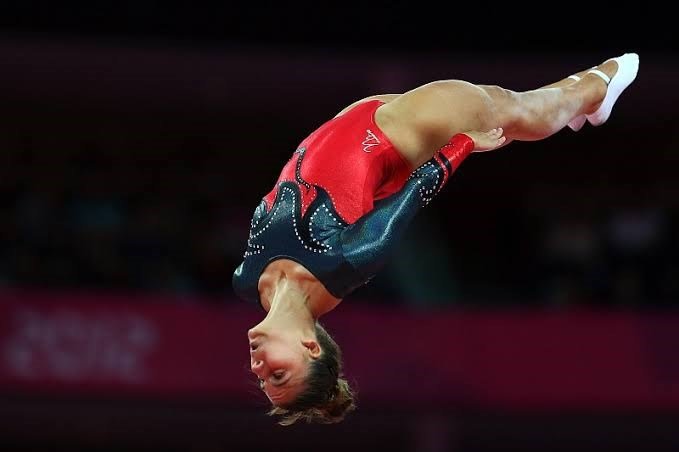
A number that perhaps not everyone knows. Portugal is the 10th country with the most medals won in Trampoline World Cups, a place reinforced by the three medals won in the ones that took place these days in Nanjing, one of them being Vasco Peso’s gold in tumbling. The easy (and correct) conclusion is that Portugal is a powerhouse in this spectacular discipline of gymnastics, a status that it began to build almost four decades ago and that has always grown without low points. This generation of Portuguese gymnasts is golden, but it is not the first.
First the present. Portugal won three medals in Nanjing, one of each metal: gold from Vasco Peso in tumbling, he who had already been European champion last April, silver in the men’s double mini-trampoline by teams, bronze in the all around. In the medalist, a sixth place among 13 countries that achieved podium positions, and one of seven nations to win a title. In many sports, this would be an excellent Portuguese participation, but in trampolines, excellence has been normal over the last 40 years.
Portugal began winning medals at European and World Championships in the 1980s. It was at the European Championships in Burgos in 1983, Portugal’s international debut, that the men’s double mini-trampoline team, formed by Luís Oliveira, João Casimiro, Rui Santos and Fernando Saldanha, won a bronze. And, since then, it has always been present in the continental championships, for a total of 95 medals in 23 editions – 23 gold, 35 silver and 37 bronze – and a seventh place in the historic medalist.
In the World Cups, Portugal took a little longer to reach the podium. In Birmingham (USA), 1988, the men’s double mini-trampoline team (João Ferreira, Jorge Moreira, Luís Nunes and Jorge Pereira) won bronze, with Jorge Moreira (7th) being the best in the individual competition. Two years later, this same quartet combined for a silver medal in Essen, and Moreira, from Ginásio Clube Vilacondense, was also entitled to his silver medal.
His teammate Jorge Pereira, who had already been European champion in 1987 and 1991, was the first Portuguese (and European) world champion in double mini-trampoline two years later, in Auckland, New Zealand. “I’m very happy to break the mess and now I want more”, said Pereira at the time. Wish fulfilled two years later, in 1994, in Porto, with a new individual and collective title in the same discipline. Double mini-trapoline is, in fact, a discipline in which Portugal has multiple champions, such as the Lico brothers (Nuno in 2001, and André in 2009 and 2010). Total achievements in World Cups, including the three medals from the competition in Nanjing: 13 gold medals, 15 silver and 16 bronze.
Putting things into perspective, it is therefore not surprising that Portugal is a regular customer of the trampoline podiums. It is a quality that crosses generations, from the beginning of the 1980s, with the aforementioned Jorge Pereira, Jorge Moreira and Luís Nunes, or Rita Villas-Boas, through Sílvia Saiote, already in the 21st century, to more contemporary athletes such as Nuno Merino, Diogo Ganchinho or Ana Rente, who, in addition to the honors achieved in major competitions, were also Olympic pioneers of a discipline that only entered the Games program in 2000.
At the Games, we already know, there is little space for trampolines – only men’s and women’s individual competitions because the International Olympic Committee has rules for the number of events and podiums. Still, there is always a Portuguese presence. There was none in Sydney 2000, but there was in Athens 2004, with Nuno Merino coming in 6th. Ana Rente was the female pioneer, with a long Olympic life (2008, 2012 and 2016, where she came 11th, her best classification), while Diogo Ganchinho was a two-time Olympian (2008 and 2012), as was Diogo Abreu (2016 and 2020).
In the last Games, in Paris 2024, young Gabriel Albuquerque had the best participation ever, a 5th place in the final, but promising greater things. “I just found out. I don’t want to seem convinced, but I know I’m on the same level as those guys”, said Albuquerque in Paris. Meanwhile, he won a team bronze at the 2025 European Championships, won a gold at the World Games in synchronized trampolining (with Lucas Santos), and a silver at the European Championships in Portimão, last April, in individual. At these World Championships, he was fourth in the individual final, but left his mark by breaking the world record for difficulty, with 24,300 points – he performed nine triples and one double with three pirouettes.