Saadet Gokce
26 September 2026•Update: 26 September 2026
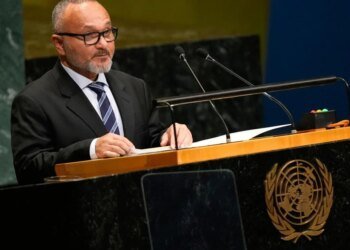
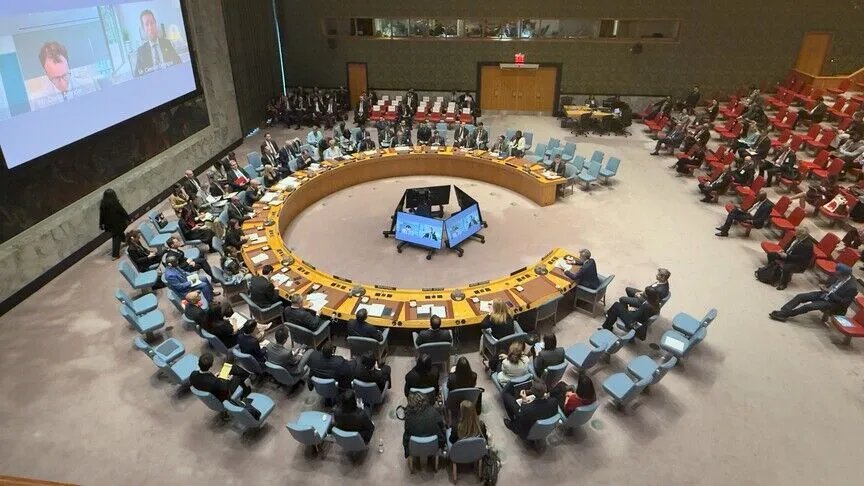
Pacific island leaders highlighted climate threats at the UN General Assembly in New York on Friday.
Tuvalu’s Prime Minister Feleti Teo said sea-level rise is “not a future threat” but a “present reality” for his nation.
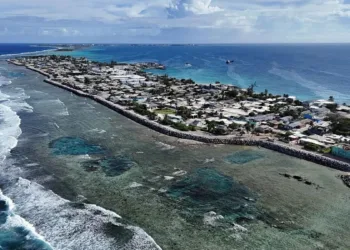
“Climate change is and remains the single greatest existential threat to Tuvalu’s survival, security, and sustainable development,” he added, noting that a coastal adaptation project has reclaimed 15.3 hectares (38 acres) of elevated land on the capital Funafuti, with another 10 hectares being reclaimed.
Teo said climate finance should be provided as “grants at the scale required to address the climate impacts already unavoidable and the increasing loss and damage caused by further warming.” He urged faster progress on the Sustainable Development Goals, particularly SDG 14 on life below water.
Solomon Islands premier says single natural disaster capable of erasing years of development
Solomon Islands Prime Minister Jeremiah Manele said his archipelagic country remains highly vulnerable to external shocks, with a single natural disaster capable of erasing years of a nation’s development.
He said the Multidimensional Vulnerability Index — a UN tool designed to measure a developing country’s structural vulnerability and lack of resilience to external shocks — better captures the special circumstances of small island states than income measures alone.
Manele warned that armed conflicts, energy crises and global trade disruptions affect small island economies, with higher fuel prices driving up shipping, electricity, food and essential service costs.
He noted that global military spending exceeded $2.9 trillion last year, far outstripping official development assistance and climate finance for developing countries.
“In less than 18 days, the world spends more on arms than developed countries provide in a full year of climate finance,” he said.
‘We have only one Earth’: Papua New Guinea premier
Papua New Guinea Prime Minister James Marape said “we have only one Earth,” urging world leaders to prioritize human welfare, peace and environmental protection over war and narrow geopolitical interests.
“What value is development if we destroy the environment that sustains human life?” he said, warning about disappearing forests, polluted oceans and an increasingly unstable climate.
“The challenges confronting humanity do not recognise the size of our economies, the strength of our militaries or the boundaries on our maps,” he added.
Separately, the Leaders of the Pacific Islands Forum (PIF) held a meeting with UN Secretary-General Antonio Guterres, and discussed implementation of the Blue Pacific Ocean of Peace Declaration and PIF and UN reform processes.
The forum has 18 members: Australia, the Cook Islands, Fiji, French Polynesia, Kiribati, the Marshall Islands, the Federated States of Micronesia, Nauru, New Caledonia, New Zealand, Niue, Palau, Papua New Guinea, Samoa, the Solomon Islands, Tonga, Tuvalu and Vanuatu. American Samoa and Guam are associate members.