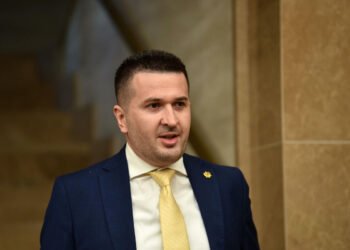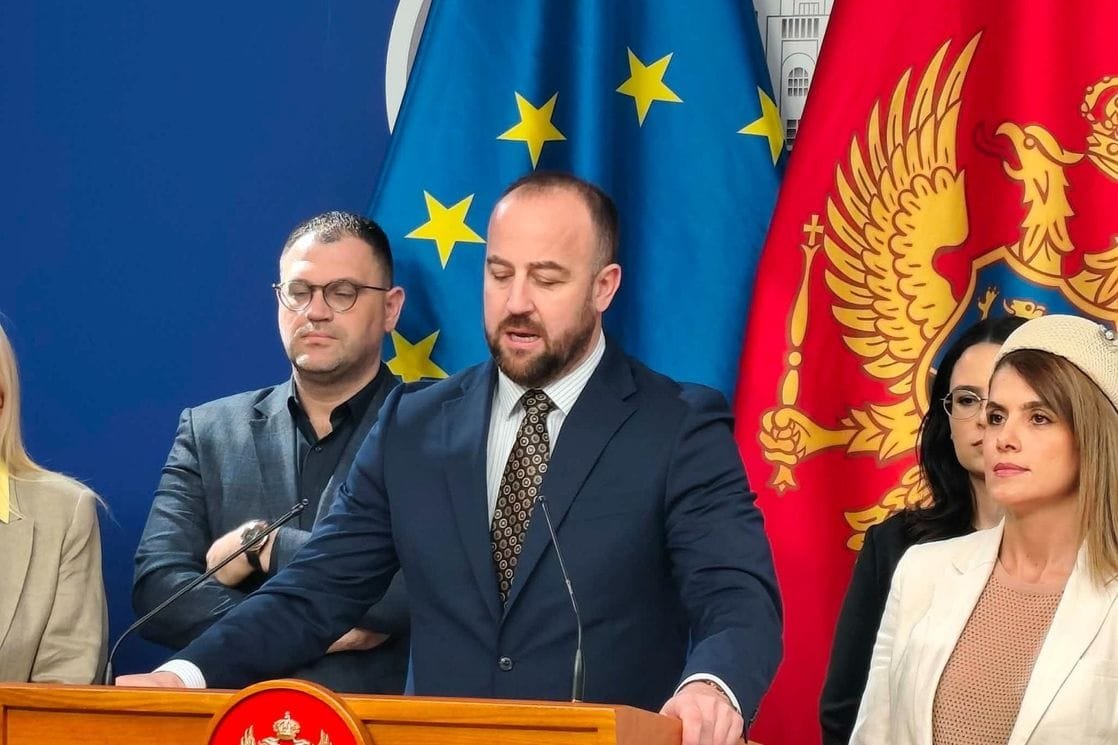
The head of the Deputies’ Club of the Democratic Party of Socialists (DPS), Andrija Nikolić, said that the representatives of this party initiated the hearing of the Minister of Economy Nik Đeljošaj, the Minister of Finance Novica Vuković, the Minister of Social Care, Demography and Family Care Damir Gutić and the director of the PIO Fund Vladimir Drobnjak due to the impact of rising prices on the living standards of pensioners.
Their proposal, Nikolić said at the press conference, was also signed by the president of the Committee for Economy, Finance and Budget Boris Mugoša and the representative of the Civic Movement URA Miloš Konatar.
“According to the official data of the PIO Fund, the average pension in Montenegro is about 553 euros. Should I recall the false promise of Spajić, who announced that from January 1, 2025, the average pension will be 600 euros. Or should I remind you of how they equated those who have paid contributions to the PIO Fund for 40 years with those who have done so for 15 years. The question is how pensioners with such incomes will survive, where over 47,000 receive the minimum pension, and 112,000 receive below the average salary in the country of 1,000 euros,” Nikolić points out.
“And what happened to the purchasing power of those pensions? According to official data from MONSTAT, cumulative inflation in Montenegro from 2021 to 2024 is more than 30 percent. According to Eurostat, inflation in Montenegro in 2025 is 3.9 percent — almost twice as much as inflation in the European Union, which is 2.3 percent. So much for the authorities’ claims that inflation in Montenegro was imported from the EU,” he said. Nikolić at the press conference.
He pointed out that the prices of food and non-alcoholic beverages, health services and housing recorded continuous growth, quarter after quarter, according to official MONSTAT announcements
“And how did the government respond to that growth? Pensions were adjusted by 0.38 percent in January 2026 and by 0.95 percent in May 2026. These are the official data of the PIO Fund. The total increase in 2026 is 1.33 percent. Inflation 3.9 percent. The difference is minus 2.57 percent. Every year pensioners are poorer in real terms. Every year they buy less. Every year the government tells them that this is progress,” said Nikolić.
He reminded that the January adjustment brought a pensioner who receives the minimum pension an increase of around 1.71 euros.
“The May reconciliation brought in about 4.3 euros. In total, for six months — less than six euros. Six euros. That’s the price of half a kilogram of veal in a Montenegrin supermarket. That’s not reconciliation. It’s an insult to the people who built this country for forty years. The health dimension of this problem is particularly worrying. According to a World Health Organization survey published in April 2025, almost every tenth household in Montenegro — exactly 9 percent — spends a catastrophic share of their income on health care. That percentage is higher than in most European Union countries. Medicines that are not on the positive list are a luxury that no one can afford. A pensioner with diabetes, heart disease or hypertension has to choose between food and medicine,” said Nikolić.
He pointed out that the Democratic Party of Socialists is making two clear demands to the Government today.
“First: an urgent change in the pension adjustment model. The adjustment must follow the real increase in the prices of food, medicine and utilities, and not the general inflation rate that masks the real jump in the cost of retired life. We demand the introduction of a special pensioner consumer basket as a legal basis for adjustment.
Second: the urgent expansion of the positive list of medicines and the abolition of administrative barriers that prevent pensioners from exercising their right to free medicines. According to the World Health Organization, medicines and medical products are the main cause of catastrophic health spending in Montenegro,” said Nikolić.
He emphasized that these are not political demands.
“These are demands dictated by elementary social justice and what official data clearly shows. The government has a parliamentary majority. It has a budget that records, as they say, record revenues. It has all the tools. What it lacks is the political will to use them for those who built that country.
A society that allows its oldest citizens to choose between food and medicine has no right to speak of economic prosperity. It is a society of social indifference. And that carelessness has an address: the Government of Montenegro,” NIkolić said.