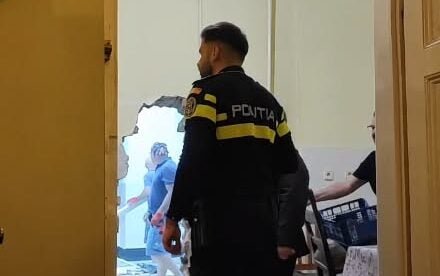

Romanian police officers break through the wall of the Hungarian monastery
Is the forced eviction of Rudolf Anzelm Fejes, the Premonstratensian abbot in Oradea (Nagyvárad), truly a Romanian domestic matter? This was among the questions posed by members of parliament to representatives of the TISZA government during Monday’s session of the Hungarian Parliament, Krónika reported.
Lőrinc Nacsa, former State Secretary for National Policy and a member of the Christian Democratic Party (KDNP), recalled in his interpellation that Foreign Minister Anita Orbán had stated a week earlier before the National Assembly that “the government is determined not to interfere in the internal affairs of other countries.” This, he continued, was the response to the Romanian authorities’ forcible eviction of the abbot, during which they broke through the monastery wall at dawn.
He said: “Hungarians living across the border are in a far more precarious situation due to their status as a minority.”
The Hungarian government has a moral and political duty, as well as a responsibility, to advocate for the interests and rights of the Hungarian community across the border,
especially when they face injustices.
Enikő Tompa, Parliamentary State Secretary at the Ministry for Social Relations and Culture, quoted in her response the Roman Catholic Bishop of Nagyvárad, László Böcskei, who, in connection with the events surrounding the Premonstratensian monastery, stated, “It is sad and regrettable that what could be resolved through lawful procedures and a willingness to engage in dialogue for the good of the Church and the community is being driven toward an ethnic conflict for political reasons.” She added that the TISZA government is convinced that contentious issues must be resolved peacefully through dialogue, mutual respect, and legal means. The State Secretary noted:
They are confident in a lawful and compromise-oriented solution,
to this end, discussions were held with the Apostolic Nuncios in Hungary and Romania, and “encouraging feedback” was received indicating that “the Roman Catholic Church in Romania is closely monitoring developments in this matter and is doing everything in its power to bring about a solution.”

László Toroczkai. Photo: MTI/Hegedüs Róbert
Last Monday, a political confrontation erupted in the Hungarian Parliament after László Toroczkai, chairman of the Our Homeland Movement (Mi hazánk Mozgalom), asked Foreign Minister Anita Orbán what the Budapest government was doing about the forced eviction of the Premonstratensian Abbey. According to Toroczkai, the scandalous case of the violent nationalization of the abbey’s properties—which has been ongoing for months—is rife with anti-Hungarian hostility.

Anita Orbán. Photo: MTI/Purger Tamás
The leader of the opposition party asked Anita Orbán whether she had summoned the Romanian ambassador in Budapest regarding this matter. The Foreign Minister of the TISZA Party explained in her response: Although this is not an intergovernmental matter, the Hungarian government is making every effort to promote a peaceful solution using all means at its disposal. For this reason, talks were immediately held with Michael Wallace Banach, the Apostolic Nuncio to Hungary, and contact was also made through the embassy with the Apostolic Nuncio to Romania. Anita Orbán added, however:
The government does not wish to interfere in the internal affairs of other countries, including the workings of their judicial systems.”
Fact
As was to be expected, the TISZA government is washing its hands of the matter. A reliable partner in this tragedy is the local Roman Catholic bishop, who, despite his Hungarian ancestry, always acts in accordance with Romanian national interests. It is no coincidence that he was elected chairman of the Romanian Bishops’ Conference, a body in which the Romanian side is overrepresented by Greek Catholic bishops, all of whom are ethnic Romanians.

László Böcskei. Photo: Elekes Andor/Wikimedia Commons
The fact that the Apostolic Nuncio in Hungary has no jurisdiction in this matter is merely a footnote. Far more significant is the resurgence of the “non-interference” mantra, dusted off from the attic of communist and left-liberal diplomacy. The TISZA government is clearly continuing a long and disastrous tradition of failure with regard to Hungarians across the border, who must now abandon any illusions. Despite Péter Magyar’s grandiose promises, the Hungarian minorities—as desired by the majority of TISZA voters—will be left to their own devices.

Via Krónika; Featured photo: Facebook/Istoria Ordinului Premonstratens din Oradea