A film from a tiny island just 25 square kilometres in size has found a global audience and gone viral, with more than 820,000 views on YouTube since it launched two months ago.
Far End of the Sea is Naoero’s (formerly known as Nauru) first feature film and puts the Pacific nation’s people, culture and landscape at its centre.
It’s also a homecoming for co-producer Cramer Cain, Naoero’s most famous actor and familiar face on Australian film and television screens.
“It took me 34 years to finally do a film back home,” said Cain, who’s appeared in Home and Away, The Straits and Troppo — and on the big screen in James Cameron’s 2011 cave-diving thriller, Sanctum.
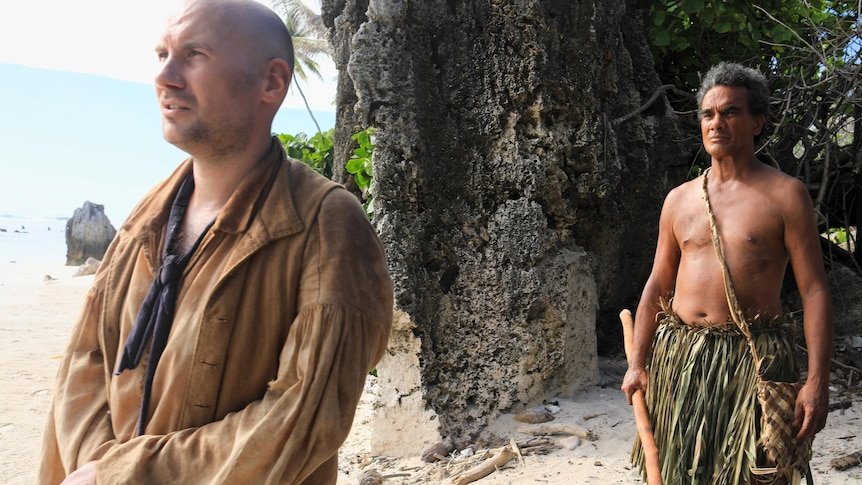
Set in 1842, the drama features Cain as a local warrior, Adiben, who crosses paths with a shipwrecked Scottish sailor Hamish McKay, and the two form an unlikely connection.
With haunting music, sweeping beach shots and a battle in the rainforest, the film gives a snapshot of a history where Naoero — like other Pacific islands — was caught in the middle of a colonial super highway.
Phosphate strip mining may have left 80 per cent of the island’s interior barren, but the film shows that its beauty still exists.
And cultural pride remains.
“It’s an amazing feeling to play a character from Nauru and speaking in Nauruan,” Cain said.
The connection between Cain and Coffa is one that goes beyond the screen.
Naoero-Australian reunion
Australian actor and screenwriter Jamie Coffa, who plays the sailor, moved to Naoero as an infant, when his father took the job as the country’s national weightlifting coach and also ran a local television station.
Cain was the news presenter and remembers Jamie as a youngster “running around the studios, waiting for his dad to finish work”.
In the intervening years, Coffa’s family moved around the Pacific, but the young man never forgot that island — or Cain.
In 2011, Coffa saw Cain in Sanctum, and this lit a fuse.
“I remember thinking, ‘Well, if he can do it, and he lived on Nauru, maybe I could do something like that one day,” Coffa said.
Fifteen years later, Coffa wrote the part of Adiben specifically for Cain, and tracked him down.
Cain recalled: “He goes, ‘Hi Cramer… I’m writing this short film, it’s about Nauru, and I’d like you to be in it because you’re Nauru’s only actor.”
Love letter to Naoero
Coffa spent 17 years living throughout the Pacific and almost half of those in Naoero and that small nation stole his heart.
“I wanted to tell a story and showcase a side of Nauru from a cultural and historical side,” he said.
“I wanted to write something that was important to me, and it was a way to explore Nauru.
“To me, it’s a love letter to Nauru.”
Initially, Far End of the Sea was a 20-minute short film that would be shot in Cairns, north Queensland, and recreate a Naoero beach to keep expenses down.
But Cain put a stop to that — it had to be filmed in Naoero.
After a year of planning, along with fellow producer Yannick Detsiogo, and searching for money, the Naoero government decided to fund the film and granted permission to shoot on the island.
“This is a very important milestone; it’s the first film ever allowed to shoot in Nauru for Nauru, backed by Nauruans and crewed by 58 Naurans,” Cain said.
The film became a 50-minute feature, with the authentic Dorerin Naoero language of the time, so language consultants were brought in.
Like Jason Momoa’s Chief of War series on Apple TV, careful attention was paid to historical and cultural details, including the species of fish and its preparation in an eating scene.
Language consultants were brought in to help shape the film’s dialogue, as the version of Dorerin Naoero spoken by the island’s ancestors differs from today.
Magic of smoke and mirrors
An Australian crew included director Matthew Holmes and director of photography Peter Szilveszter, who both created the award-winning independent film The Legend of Ben Hall.
“Obviously, the Australians brought years, and some of them brought decades, of experience,” Coffa said.
“What I loved was that the Nauruan crew were able to soak it up in whatever discipline it was, whether it’s props or sound recording or unit management.
“It was really great to see that kind of unison come together.”
There were obvious challenges of filming on an island that takes just half an hour to drive around.
“Nauru is not the size of Tonga or Samoa or Fiji, where you can just go into the bush and if you keep going, you hit more bush,” Coffa said.
“And if you want to shoot on the beach, most of the population lives around the coastline, so we had to use the magic of cameras and smoke and mirrors to hide houses and infrastructure.”
International support
Far End of the Sea was uploaded to YouTube in June, and within a fortnight it had clocked half a million views, with positive comments coming from views well beyond the Pacific.
“We were releasing it for the Pacific… but didn’t know it’d reach far corners of the world… we’re shocked, but we’re also very stoked and very happy that that’s putting Nauru in a good light for once,” Cain said.
And this reception is also a far cry from the feedback Coffa received when he first showed his script to colleagues in Australia.
He was met with: “Who cares about Nauru? Who cares about this story? Who cares about any of this?
“Fast forward a couple of weeks ago, and those same people were like, ‘Oh, fantastic work’.”
Coffa urged young people, particularly from small islands in Micronesia, to be creative and “don’t let things hold you back”.
Far End of the Sea recently premiered in Brisbane, the first time both Coffa and Cain saw it on the big screen.
“This production has been like the highlight of my life. It has literally been one of the best experiences I’ve ever had,” Coffa said.
And Cain: “Just a big thank you again to everyone in Naoero when they supported us when we were shooting the film and when we had the premiere and everything, and now — we’re going to show the Nauruans right here in Queensland.”