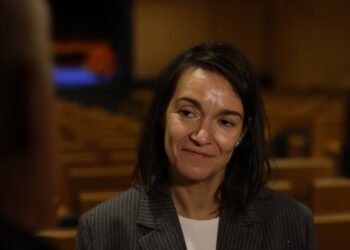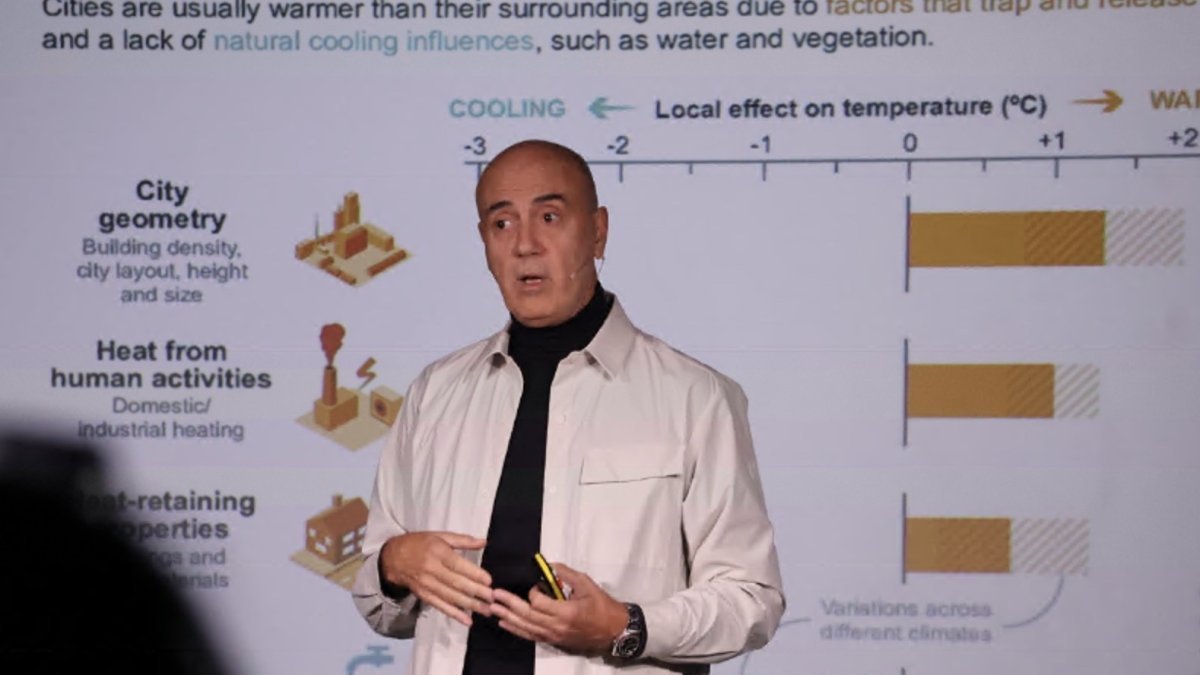
The meteorologist and presenter of 3Cat Tomàs Molina has focused on the temperature in the places of origin of the skiers as a factor that may end up conditioning the demand for the resorts of the Pyrenees. As he explained, even if the slopes maintain good snow conditions, the heat outside the mountain areas can influence the willingness of customers to travel to ski.
Molina has pointed out in statements to the Andorran News Agency that the resorts can produce snow and keep the slopes in condition for skiing, but he has remarked that this is not the only element that determines the behavior of customers. In this sense, he gave as an example that a person from Barcelona who finds himself with temperatures above 20 degrees in his place of origin may be less inclined to make a trip in the snow.
This situation, according to the meteorologist, forces the sector to take into account not only the conditions on the slopes, but also the perception that customers have and their willingness to travel. “If you lose the trust of the user, of the customer, you have a serious problem,” he warned.
For this reason, Molina believes that the sector will have to take a “new commercial approach” to climate change and take into account how user habits evolve. In this context, he pointed out that it is not only a matter of advertising, but also of informing and maintaining customer confidence in a scenario where snow conditions can be more variable.
The meteorologist has identified two particularly relevant moments for the sector: the beginning of the season, especially during the Puríssima bridge, and Holy Week. In this second case, he pointed out that the proximity of higher temperatures and other tourist options can make it difficult for customers to choose to go skiing, especially when Easter falls in April.
In this scenario, Molina has proposed that the stations will have to assess issues such as the prices of the passes, a new commercial approach and the diversification of the activity. As indicated, climate change does not only involve analyzing whether there will be snow, but also how this context can modify the behavior of people who consume snow tourism.
More margin to the west of the Pyrenees
Molina has also differentiated the impact of climate change according to the area of the Pyrenees. In this regard, he pointed out that the most western and north-western areas, such as the Aran Valley, Alta Ribagorça, Pallars and Andorra, can have more routes than the eastern areas. “You’re better off here in Andorra, that’s without a doubt”, said the meteorologist, who pointed out that the stations in this part of the Pyrenees can have “like one more route” and “endure more” in the face of global warming.
On the other hand, he has remarked that this perspective cannot be applied in the same way to the stations of the eastern Pyrenees, and he has put as reference areas such as Ripollès and Cerdanya. In this sense, he pointed out that stations like La Molina are already experiencing more difficulties.
In addition to the geographical location, Molina has pointed out that the specific conditions of each season also depend on factors such as orientation, wind and exposure to the sun. He explained that the northerly winds can bring snow, but they can also move it or dry the ground, and in this context he cited stations such as La Molina, Núria and Vallter.
For the meteorologist, this territorial difference and the evolution of climatic conditions will force the stations to consider the activity beyond the punctual availability of snow. In this context, he insisted on the need to diversify and to adapt the commercial strategy to a scenario in which both the conditions of the slopes and the behavior of customers can change.
Seasons with irregular starts
Regarding the evolution of the seasons, Molina has described a pattern that, as he explained, has already been observed in recent years: a first part of the winter with good conditions, with snowfall at the end of November or during December, followed by a situation that can change suddenly from January. In this sense, he pointed out that the resorts can maintain the slopes thanks to the production of snow, but that this situation does not always correspond to the state of the environment. This can generate, as he explained, a difference between the snow available for skiing and the visitor’s perception of the winter landscape.
Molina has also related this evolution to the behavior of the atmospheric circulation of the Atlantic. He explained that the Atlantic meridional return circulation (known as the AMOC) is changing, although the models do not indicate that this circulation should disappear. As he explained, the cold water coming from the arctic areas after the summer melt moves south during the autumn and can influence the temperatures of the Atlantic and, subsequently, the weather that affects Europe.
In the case of the Pyrenees, he pointed out that westerly winds mean that this evolution of Atlantic temperatures can have effects on the start of winter. In this context, he pointed out that between October and November and during December colder situations and precipitation that favor snow can occur.
A change that will not be linear
Molina has warned, however, that the evolution of the climate should not be understood as a linear process. To explain this, he compared the change to a table that gradually loses stability as different legs fail. “This change that we are saying, one and a half degrees, and it seems to be a gradual thing, is not true. It is making a lot of noise,” he pointed out. According to his forecast, during the next 15 years the ski seasons in the Pyrenees may still start with “a certain normality”, but in a horizon of 15 or 20 years more abrupt winter situations may occur. In the longer term, he pointed out that there will be winters in which some areas may not have enough snow due to too high temperatures.
In this sense, he explained that the snow usually occurs with temperatures of about three positive degrees at most and that the snow level is approximately between 1,800 and 1,900 meters, although it can vary depending on the conditions. For this reason, he has warned that stations with a significant part of the domain below these levels may have more difficulty maintaining their activity in the coming years.