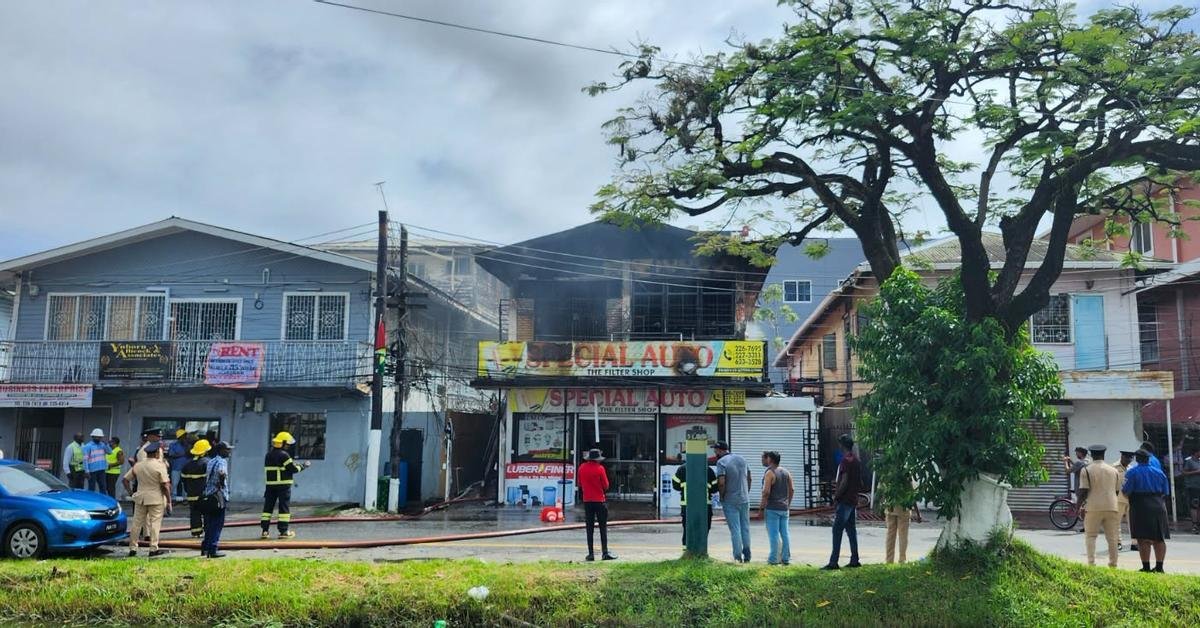
Havana/At least 12 Cubans residing in Guyana and another 20 Venezuelans have had to look for a new home after the fire that last Monday damaged the two-story building they lived in on South Road. “All occupants, including women and children, emerged unharmed,” the Fire Service stated.
The incident occurred at 9:15 a.m. in Lot 216 in the Lacytown neighborhood of Georgetown, and because the ground floor was made of wood and concrete, the fire soon spread to the second floor. On those ground floors there was a subsidiary of Special Auto, a car and spare parts dealership, while the second level had 11 rooms where the migrants lived.
Rajnarine Dyal, an employee of the business, told the local media NCN Guyana that the fire “started in one of the rooms before it quickly spread throughout the building.” One of the residents stated that it was due to a short circuit in some cables outside. However, the authorities still do not provide details of the causes.
“While the surrounding buildings suffered minor damage, the rapid response of the Guyana Fire Service prevented what could have been a much larger catastrophe,” he posted Guyana Times.

/ NCN Guyana
The Lacytown neighborhood is an area frequented by migrants, especially Cubans, due to its proximity to embassies and offices where immigration procedures are carried out.
The gold rush has attracted thousands of island nationals. According to Bloomberg, Guyana became a “rapidly growing petro-state” that needed labor. Hence the magnet for thousands of migrants.
Furthermore, the South American country is a mandatory step for Cubans who opt for the “southern route” – which reaches Brazil, Uruguay or Chile – and, according to what the agency specialized in economics reveals, the majority choose it as their final destination.
Last year more than 22,000 Cubans entered Uruguay, of which 14,900 stayed. Among them, “whole families, grandparents and children with malnutrition.” The networks of coyotes operating on the route from Cuba to Guyana and the move to Brazil have sophisticated their schemes.
According to the report Migrant trafficking in Brazil, an intelligence analysisprepared by the Brazilian Intelligence Agency (Abin) in collaboration with the International Organization for Migration (IOM), there are “coordinators, people whom the migrants never meet and who are in charge of defining the costs of the journeys, payments to intermediaries and bribes.”
These networks offer transfers from the Island to Brazil for $10,000 and the sum increases to $12,000 if it is to Uruguay. Although there are also crossings from Brazil to the US for $18,000.