Israel launches airstrikes on Iranian targets as blasts heard in several cities
Here’s a fuller account of the latest strikes, care of the Associated Press:
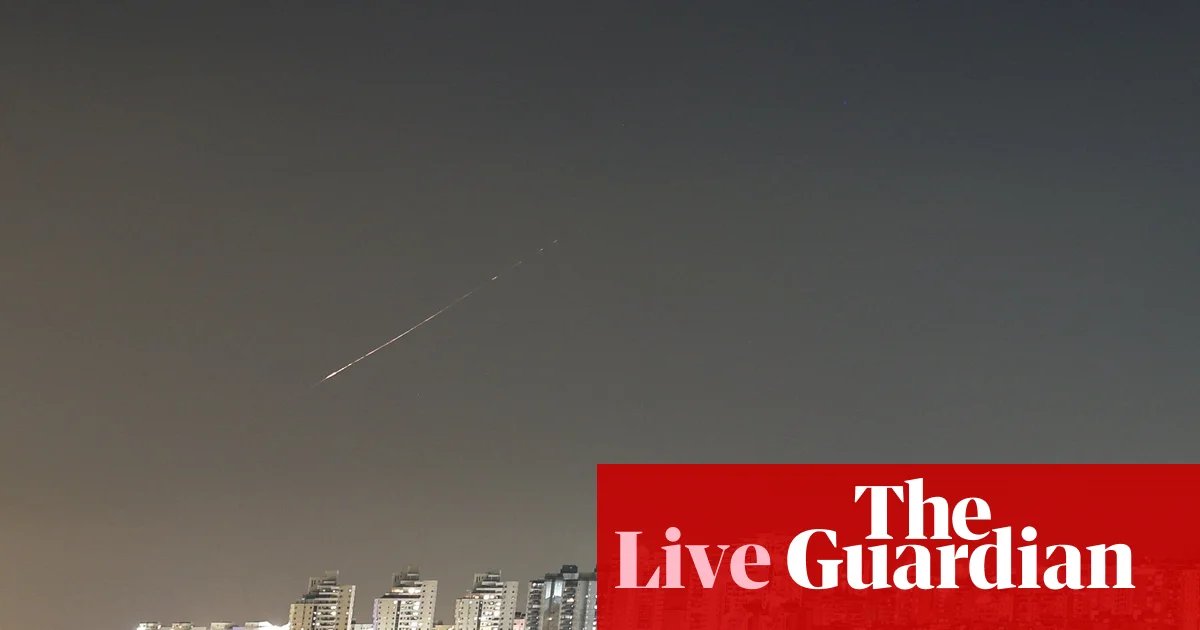
Israel launched airstrikes early on Monday targeting central and western Iran in response to missile fire from Tehran, attacks that threatened to drag the wider Middle East back into a regional war.
Iranian state TV reported the sound of explosions being heard in Isfahan, Karaj, Tabriz and Tehran, without immediately elaborating.
A witness in Tehran described hearing at least one large blast somewhere to the west of the country’s capital city.
Iran closed the airspace around Tehran’s Imam Khomeini International airport – the main airfield in the country – after the Israeli attack.
Iranian officials offered no details on what had been struck, nor any damage information.
Iran’s paramilitary Revolutionary Guard said Israel used air-launched ballistic missiles in its attack, without elaborating.
The Israeli military at dawn in Iran issued a short statement as the strikes started: “A short while ago, the Israeli Air Force struck military targets belonging to the Iranian terror regime in western and central Iran.” It did not elaborate.
The White House did not respond to messages about the strikes and whether they were done in coordination with the US.
As reported earlier, US officials said Donald Trump earlier spoke with Benjamin Netanyahu and urged the Israeli prime minister not to immediately retaliate over Iran’s missile launches against Israel, which upended the fragile ceasefire in place since April.
Key events
Saudi Arabia’s civil defence is saying an warning has been issued in the Al-Kharj governorate to alert of potential danger.
The area is home to the Prince Sultan air base that hosts US forces.
Israel launches airstrikes on Iranian targets as blasts heard in several cities
Here’s a fuller account of the latest strikes, care of the Associated Press:
Israel launched airstrikes early on Monday targeting central and western Iran in response to missile fire from Tehran, attacks that threatened to drag the wider Middle East back into a regional war.
Iranian state TV reported the sound of explosions being heard in Isfahan, Karaj, Tabriz and Tehran, without immediately elaborating.
A witness in Tehran described hearing at least one large blast somewhere to the west of the country’s capital city.
Iran closed the airspace around Tehran’s Imam Khomeini International airport – the main airfield in the country – after the Israeli attack.
Iranian officials offered no details on what had been struck, nor any damage information.
Iran’s paramilitary Revolutionary Guard said Israel used air-launched ballistic missiles in its attack, without elaborating.
The Israeli military at dawn in Iran issued a short statement as the strikes started: “A short while ago, the Israeli Air Force struck military targets belonging to the Iranian terror regime in western and central Iran.” It did not elaborate.
The White House did not respond to messages about the strikes and whether they were done in coordination with the US.
As reported earlier, US officials said Donald Trump earlier spoke with Benjamin Netanyahu and urged the Israeli prime minister not to immediately retaliate over Iran’s missile launches against Israel, which upended the fragile ceasefire in place since April.
Iran’s Revolutionary Guard is saying Israel has carried out attacks on targets in Iran using air-launched ballistic missiles, the offical Irna news agency is being quoted as saying.
Iranian state television is reporting the sound of explosions being heard in the cities of Tehran, Isfahan and Tabriz.
It came as the Israeli military said it carried out airstrikes early on Monday targeting western and central Iran after Tehran earlier launched missiles at Israel in apparent retaliation over attacks on Beirut.
Iran has reportedly closed the airspace around Tehran’s Khomeini international airport – the country’s main airfield – after the Israeli strikes.
Explosions have reportedly been heard in several Iranian cities including Karaj.
Israel strikes Iranian military targets, says IDF
The Israeli military is saying it has struck military targets of the Iranian regime in western and central Iran.
The strikes happened “a short while ago”, the Israel Defence Forces (IDF) posted on Telegram, adding that details would follow.
We’ll bring you more on this as it comes to light.
Just recapping now, Iran has long said that any peace deal with the US will depend on a ceasefire also holding in Lebanon, which Israel invaded in March in pursuit of Iran-backed Hezbollah fighters who fired rockets and drones across the border in solidarity with Tehran.
But on Sunday Israel launched strikes in the Beirut area for the first time since the US announced a truce plan for Lebanon last week – which Hezbollah firmly rejected.
Iran’s Revolutionary Guard said it later targeted Israel’s Ramat David air base, near Nazareth.
The Israeli military said it identified missiles launched from Iran and had intercepted them.
Donald Trump – who was spending the weekend at his golf club in Bedminster, New Jersey – spoke with Benjamin Netanyahu by phone for a little under half an hour, Reuters reports an Israeli official as saying, without giving further details.
The Israeli military issued a brief statement shortly after midnight local time citing chief of staff Eyal Zamir as saying his forces had not been directed to attack Iran so far but would do so “with determination” once given the order.
Donald Trump believes he has convinced Benjamin Netanyahu to hold off on retaliating against Iran after its missile attacks against Israel, according to a senior US official.
The Associated Press quotes the official as confirming Trump had called Netanyahu and urged him not to immediately retaliate over Iran’s launches against Israel, which have shattered the fragile ceasefire in place since April.
The official, who spoke on condition of anonymity, said Trump “got Bibi to hold off for the time being”, referring to Netanyahu’s nickname.
The official would not offer any other details of the call and there was no immediate comment from Netanyahu’s office, the report said.
Iran’s ballistic missile attack came soon after Israeli strikes on southern Beirut targeting infrastructure of the Tehran-backed Hezbollah.
Iran warned that strikes on the Lebanese capital would renew full-scale war across the Middle East, even as Pakistan and other mediators try to restart talks between Tehran and Washington.
Iran’s Revolutionary Guard has targeted the headquarters of “terrorist groups” in Iraqi Kurdistan, state media is reporting.
The Iranian government accuses the armed Kurdish parties – which have camps in neighbouring Iraq’s Kurdistan region – of serving western or Israeli interests and designates them as terrorist organisations.
Since the start of the Middle East war, and despite the ceasefire announced in April, Iran has repeatedly struck these groups, although their posts and camps have largely been evacuated, says Agence France-Presse.
Iran’s official Irna news agency posted on Telegram on Monday that the Islamic Revolutionary Guard Corps “targeted the headquarters of terrorist groups in Sulaymaniyah, Iraq”.
Trump tells Netanyahu not to retaliate against Iran – report
Donald Trump has told Benjamin Netanyahu not to retaliate against Iran’s missile attack and to allow more time for diplomacy, Axios is reporting.
The news site quotes a senior US official as saying the US president told the Israeli prime minister on a call to hold off on because “we are close to doing something good in terms of a deal”.
Netanyahu pushed back but ultimately “pseudo agreed” to stand down, according to the unnamed official.
Sunday’s call was calmer than last week’s heated exchange and Trump did not raise his voice at Netanyahu, Axios quotes the official as saying, adding:
We think the president bought a little bit of time. He is pretty adamant that we are close to a deal with Iran. I don’t think anything is imminent in terms of an Israeli strike.”
The US embassy in Jerusalem will be shut on Monday because of “the current security situation in Israel”.
The embassy said in a security alert posted on X that its branch office in Tel Aviv would also be closed and directed all American government employees and their families to “shelter in place” until further notice.
Oil prices jump after Iran strikes at Israel
Oil prices have climbed more than 3% amid the escalation in the Middle East war.
In early trading on Monday after the weekend, the price of Brent crude – the international benchmark – rose 3.29% to $96.15 a barrel.
Its US equivalent, West Texas Intermediate (WTI), was up 3.25% to $93.48 a barrel.
Iran fired missiles at Israel in apparent retaliation after Israel hit Beirut’s southern suburbs earlier in the day, with the Iranian barrage the first since the fragile truce took effect in early April.
Trump says Netanyahu will have to accept US deal with Iran because ‘I call the shots’ – report
Donald Trump has said Israeli prime minister Benjamin Netanyahu will have no choice but to accept whatever deal the US negotiates with Iran because “I call the shots”, according to a report.
“He won’t have any choice,” the Financial Times quoted Trump as saying. “I call the shots. I call all the shots. He [Netanyahu] doesn’t call the shots.”
The US president was speaking shortly after Iran launched missiles at Israel in the most serious escalation of the war since the April ceasefire.
Trump has reportedly said he will tell Netanhayu not to strike back against Iran so as not to jeopardise a possible peace deal with Tehran.
Trump told the Financial Times that Iran’s strikes had not changed his desire to conclude the US-Iran negotiations.
“It’s not going to have any impact on the deal,” he was quoted as saying.
We’ll see how it ends up. But they [the missile strikes on Israel] were attacks that did not kick at all. It’s one of those things that’s been going for 3,000 years, or 47 years, depending on how you count.”
He did not, however, sound upbeat about the prospects of an imminent deal, saying in the interview: “I think the deal is going on. We’ll see what happens.”
Asked what would happen if any such deal failed “on its merits”, Trump told the FT he would consider a commando raid on Iran:
It means [one of] two things. Number one, it would mean that possibly we would go in and take care of the rest of the place that we didn’t take care of militarily. Or it would just mean that we would keep the blockade on Iran because the blockade has been probably more powerful than any attack that was ever made on that country.”
Tehran suspends flights at international airport – reports
Tehran’s international airport has suspended all incoming flights after Iran’s missile strikes on Israel, according to local media.
“The civil aviation authority announced the suspension of all flights bound for the airport until further notice,” said the Iranian news agency Mehr said, cited by AFP.
It is the latest closure for Khomeini international airport, which is one of two serving the Iranian capital and re-opened only in April after being shut for weeks over the Middle East war.
The Israeli government’s Coordinator of Government Activities in the Territories (COGAT) said it is closing all crossings into Gaza after the missile attack by Iran.
“Following the missile attacks launched by Iran against the State of Israel, a number of necessary security measures have been implemented, including the closure of the crossings into the Gaza Strip, among them the Kerem Shalom Crossing and the Rafah Crossing, until further notice,” a statement posted on social media said.
Iran’s top diplomat Abbas Araghchi discussed the latest events in the region on Sunday night with his counterparts in Britain, France, and Turkey, as well as with Qatar’s leader and Pakistani mediators.
The separate conversations focused on Iran’s response to Israel’s “repeated violations of the ceasefire in Lebanon”, his ministry said in a brief statement to AFP.
The telephone calls, reported by the IRNA news agency citing the Iranian foreign ministry, came as Iran launched salvoes of missiles at Israel after an Israeli strike on Beirut’s southern suburbs.
Araghchi spoke to Qatar’s prime minister Mohammed bin Abdulrahman Al Thani, the French, British and Turkish foreign ministers, and members of the Pakistani team attempting to mediate an agreement between Tehran and Washington to end the Middle East war.
Summary of the day so far
-
Israel struck the southern suburbs of Beirut earlier today despite its ceasefire agreement with Lebanon. The Lebanon health ministry says this attack killed two people and wounded 20 others.
-
The Israeli military later said it identified missiles launched from Iran toward the state of Israel in an apparent retaliation. It was the first such bombardment since a fragile ceasefire took effect in early April. The Israeli military warned of a second barrage of missiles fired from Iran soon after the first.
-
The Iranian missiles came shortly after Iranian lawmaker Ebrahim Rezaei warned in a post on X that Tehran will give a “painful” response to Israel’s attack on Beirut’s Dahiyeh southern suburb, after the Israeli military said it struck Hezbollah infrastructure in the area.
-
Iran’s parliament speaker, Mohammad-Bagher Ghalibaf, issued a threat to US bases and assets in the region, claiming that the latest military action turned them into “legitimate targets.”
-
Iran’s Islamic Revolutionary Guard Corps (IRGC) said the Israeli military must stop its attacks on Lebanon and warned that if Israel escalates its offensives in Lebanon or responds to Iran’s actions, it will face “more crushing and regretful blows.”
-
Donald Trump told Fox News when asked about the incoming Iranian missiles that “It’s certainly not going to help negotiations.” He added: “What I would suggest to Iran: You’ve shot your missiles, that’s enough. Get back to the table and make a deal.” When asked about Israel striking Beirut earlier today, Trump replied: “I’m not happy about it.”