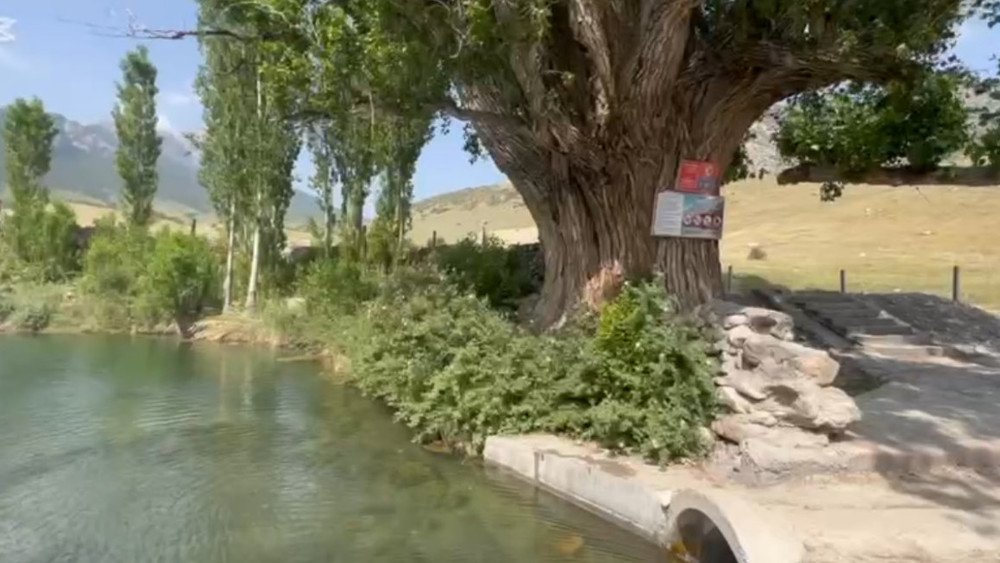
Turmush — In the village of Kara-Bulak, Batken region, there grows a large chynar (sycamore) tree, which requires eight people to grasp. From under the roots of this tree there flows a spring that supplies the entire village with water.
If previously the cool water of the spring, which never dried up in winter or spring, flowed all the way to the city of Batken, now, according to residents, it is barely enough for one village.
A resident of the village of Kara-Bulak, Abdillakim Abduraimov, said that this spring is called Suu-Bashy. “The water source is here because there is a jailoo above, but there is no water there. We also bring the cattle from the jailoo to this spring to water. It is unknown when and by whom the chynar growing next to the spring was planted. Until now, in the spring it opens buds and turns green. It takes eight people to wrap around it. The water coming out from under it is clean and cold all year round. Previously, residents of our villages Kara-Bulak, Buzhum, Batken and neighboring villages drank water from this spring. At that time there weren’t even canals; it was literally a deep river. The water was absorbed into the ground along the way, but there was still enough for everyone. Now there is a shortage of water in the village. This is a gift sent down to our people, and every year people come to this source, make sacrifices and pilgrimages,” said the villager.
Some residents suggest that the water from the spring comes from the jailoo Donmon (Donmon) in the Batken region, and even tried to prove it. They claim that when dye was added to the water in Dongmon, water of the same color actually flowed from the spring.
In this regard, attempts were made to increase the volume of water, but, unfortunately, the work has not been completed to date.
Historian Aitunuk Kazakova reported that this chynar has been growing for a long time in the Myktym-Gor area (this place is known for the fact that a mummy from the Historical Museum was buried there). “They say there was a spring there. If Myktym-Gor is a historical place dating back to the 2nd-4th centuries BC, then the tree has existed since then. At that time, a person who cut one branch of the chynar was given a death sentence. It was considered a sacred and miraculous tree, and people believed that if you hug it, life will be long,” says historian Kazakova.
According to her, in 2007, red water began to flow. “The reason is that the villagers Zhoro and Mamasharip added something to the water in Donmon. It was this water that flowed from there, and they learned that the water from the two sources was the same. For years they tried to open the spring and increase the volume of water. People also helped using the ashar method. But this problem, it seems, should be solved at the state level,” she says.
Not far from this spring, the Kara-Suu spring originates, which supplies the village with drinking water. A reservoir has been built there, and water is supplied to residents through pipes. This spring gave its name to the village, which is now called Kara-Bulak.
The village of Kara-Bulak belongs to the Suu-Bashi aiyl okmot of the Batken district and has 3,760 inhabitants. There are 7 mosques, 2 kindergartens and 2 secondary schools in the village.
The fact that Kara-Bulak is a historical village is confirmed by the territory of Myktym-Gory. A mummified woman, believed to be the wife of a pharaoh, was found in this historical area, as well as other historical finds. The territory has not yet been fully explored.
_________________
At the beginning of October 2017 in the area Myktym-Gor, Batken region, buried the mummy of a girl, which was kept in the National Historical Museum for about 60 years.
The mummy was discovered during excavations by Leningrad archaeologists led by Yuri Baruzdin in 1956. The body was found in a burial ground in the village of Kara-Bulak, Batken region, after which it was transferred to the historical museum of the capital. The mummy dates back to the 1st-5th centuries AD.