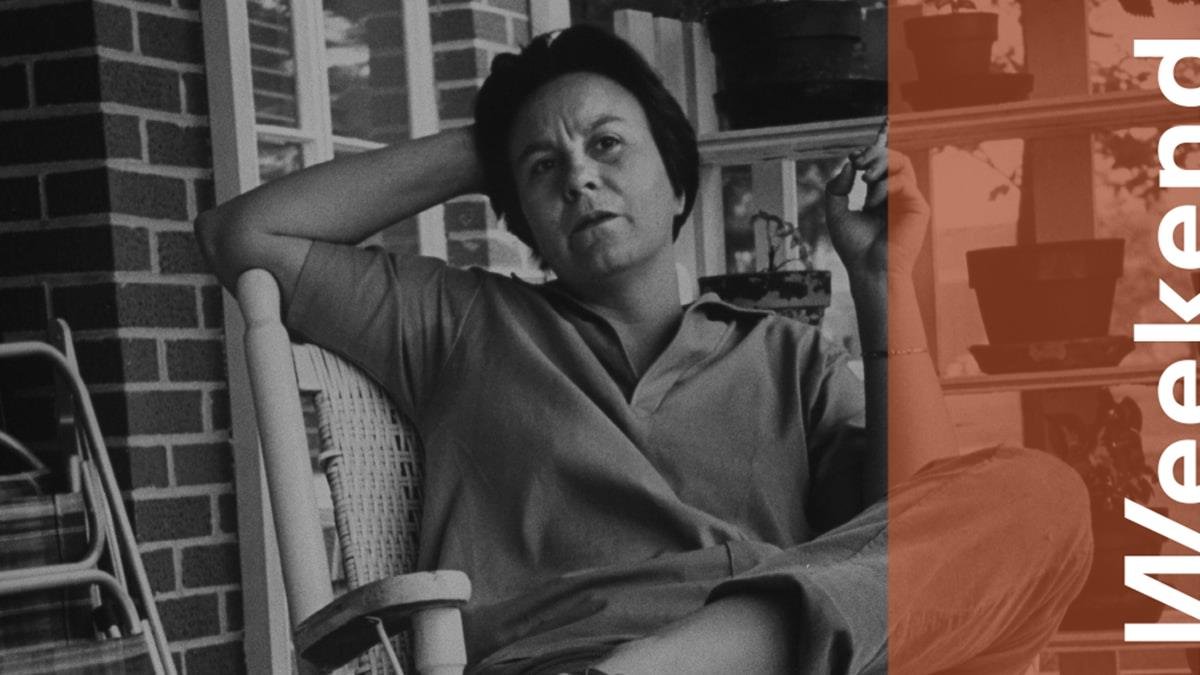
Harper Lee was born on April 28, 1926. She entered the history of world literature as the author of one, but very notable book – “To Kill a Mockingbird.” This novel went through an unusual path for the 20th century: from a ban in some American states to a textbook classic on a global scale. Weekend recalls the context in which To Kill a Mockingbird was released and cites the first, very polar reactions to it.
Of course, To Kill a Mockingbird owes its appearance to the influence of the so-called documentary detective story, the origins of which were Truman Capote, not only an outstanding writer, but also Harper Lee’s closest friend.
Capote reformed the detective story by emphasizing the social dimension in the motives of the crime. And this immediately transferred the genre, which was considered entertaining, into the register of “serious” literature. For Truman Capote, the crime is just an event that reflects a much deeper conflict in society. For it to happen, many circumstances must coincide, including psychological ones. This assumption sharply increased the scope of the investigation, drawing more and more people into its orbit. The structure of To Kill a Mockingbird is precisely this: the crime and its investigation are not valuable in themselves, but serve as an illustration of the characters and the situation of African Americans in the southern states of the United States.
There is another feature in the text of To Kill a Mockingbird that impressed critics in the 1960s. A detective story—and especially one involving a trial—has never been seen through the eyes of a child before. The story is told from the perspective of a girl named Jean Louise Finch, whom everyone calls Little Eye.
The technique itself—the text is in the first person, in the format of a memoir—also has a therapeutic dimension. In the novel, this creates a unique distance, that very “defamiliarization” when we see everything as if for the first time. And Harper Lee seems to remind: children, for all their naivety, can understand much more than adults. It is no coincidence that the views on decency and justice of the father of the main character, Atticus Finch, coincide with the simple but sincere views of his daughter.
All these innovations did not prevent professional readers from responding to the novel rather negatively. Here is a fragment of a review from African-American writer James Baldwin: “This is not the first time a white woman has written about us. This is not even the first time that a white woman has raised her voice in our defense—and done so with conviction. We are grateful to Harper Lee. But we’re not only grateful—and here’s why. The plot of her beautiful novel reveals the sublime soul of the main character. It’s just that it is based on an accusation that is both shameful and stupid. If a white person is accused of rape, it’s a detective. If it’s black – drama. Black men as rapists of white women is one of the most shameful myths in this country. And for some reason it seems not entirely worthy that Harper Lee uses it in her first (and, I hope, not last) book. There is no escaping the fact that skin color aggravates crime. It becomes doubly absurd. Not just because white mommies were scaring their sweet girls with black boys. But also because a modern black man would never really think of committing such a crime. I would like to say: let us have our own scoundrels and criminals. Do not impose them on us from the height of your moral principles. We will deal with them ourselves. And in life, and even more so in literature.”
Writer Ralph Ellison spoke even more radically: “This novel is unrealistic. It focuses not so much on the troubles and misfortunes of black people, but rather on showing the noble superiority of whites. It turns out that this is a metaphor. Isn’t it more honest to write about it directly?”
But there were also purely positive responses. 1960s literary authority William Oates wrote: “Harper Lee’s undoubted merit is that she showed the true Southern gentleman, Atticus Finch. Fortunately, not only his image has survived to this day – despite the attempt to reshape our South according to the standards of completely different people and their interests. Atticus is a wonderful father (who also worthily bears the memory of his deceased wife), but he seriously undertakes to defend, to put it mildly, a dubious client. Not everyone in his place would do the same, given the risk to their professional reputation, but the main thing is the possible consequences for their children. This is the embodiment of the honor of a southerner following his duty. Please note that a true Southern gentleman is in no way a racist, as he is unfortunately often portrayed by the critical public. Perhaps the most important thing about this figure is that it is not just time that has no power over it (as we know, it passes), but it is as if history itself is retreating in silent amazement. Because Atticus Finch seemed to have stepped out of the pages of our literature dedicated to American history of the 19th century. Isn’t this the phenomenon that Mr. William Faulkner recently wrote about so convincingly?”