Everything that could go wrong, went wrong. It is a good way to summarize what the more than 830 thousand Peruvians went through who on Sunday had to fulfill their civic duty as polling station members during the General Elections 2026.
“I arrived at the Catholic University at 5:55 am and when I approached my table I noticed that the numbering of the classrooms did not match what the ONPE had shared with us through the portal for table members,” he tells The Commerce Renato Blácido Hurtado, a 26-year-old resident of San Miguel who had been drawn as the sixth substitute.
ONPE staff told him that the numbering had been changed at the last minute, so his classroom was in another pavilion, “that ended up creating disorder for the voters as well,” says the young man.
As the clock ticked the problems continued to increase in his classroom. “As we well know, there was a delay in the arrival of the electoral material; it only arrived at our location around nine in the morning. Furthermore, only the table president was there. When we had to install the equipment, there were also delays because there were ONPE personnel assigned to two classrooms. If he was in one classroom, the other had to wait for him to open the laptop box, the printer box, install each piece of equipment, the ONPE program on the laptop, and then print out quite a few sheets to sign,” Blácido lists.

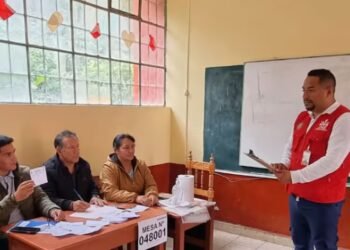
ONPE’s logistical failures caused huge queues at different electoral centers in the capital.
During all that time, hundreds of citizens were joining an increasingly larger line outside the university. It wasn’t until around 10:30 am that the doors of the establishment opened, even though some tables had not finished being set up. “That caused several lines to form outside the classrooms,” he recalls.
Blácido’s table was only ready at noon, six hours after his arrival at the center.
Just five kilometers away, at the IE Liceo Naval Capitán de Navío German Astete, located in La Perla, Callao, Carla Bernal also suffered from a day full of lack of coordination.
The 31-year-old girl had been drawn as the second substitute and when she arrived she only found the table president. “My father was the fifth substitute at the same table, but by order of the ONPE there cannot be two family members at the same table. So I don’t understand how the two of us were able to be drawn at the same table from the beginning,” Bernal questions.
Fortunately for her, the electoral material was already at her voting center, so around 7:40 am her table was already set up.
The rest of the day passed calmly, he recalls, until a representative of ONPE went on to announce the decision adopted by the JNE to extend the voting time until 6:00 p.m.

The incidents recorded during election day led to it being extended until 6:00 pm by order of the JNE.
/ Paul Vallejos / EFE
– Scrutiny: a long and repetitive process –
In both cases collected by The Commerce The extension of the hours was counterproductive, since around 5:00 pm the flow of voters was minimal, but it ended up lengthening the counting stage even more.
“At my table we finished counting just after midnight. But when we left we still saw that several tables remained to be finished. Fortunately, the three members of us were well organized and we were able to move forward at a good pace,” says Blácido.
According to the young man, the presidential vote counting was simple because it consisted of adding the votes for each candidate and then transferring them to the digital platform. “But for Andean senates, deputies and parliamentarians it was tremendous. If we did it as the ONPE wanted we would have gone until 3 or 4 in the morning but we found a more efficient way to do it,” he points out.
The process, Blácido details, basically consists of reviewing the voter registration book counting the party’s votes, then reviewing counting the preferential votes and then doing the entire count. “And also, of course, after each count you had to pass all the information to the system, vote by vote, the total amount and then double check that everything you passed was correct,” he specifies.

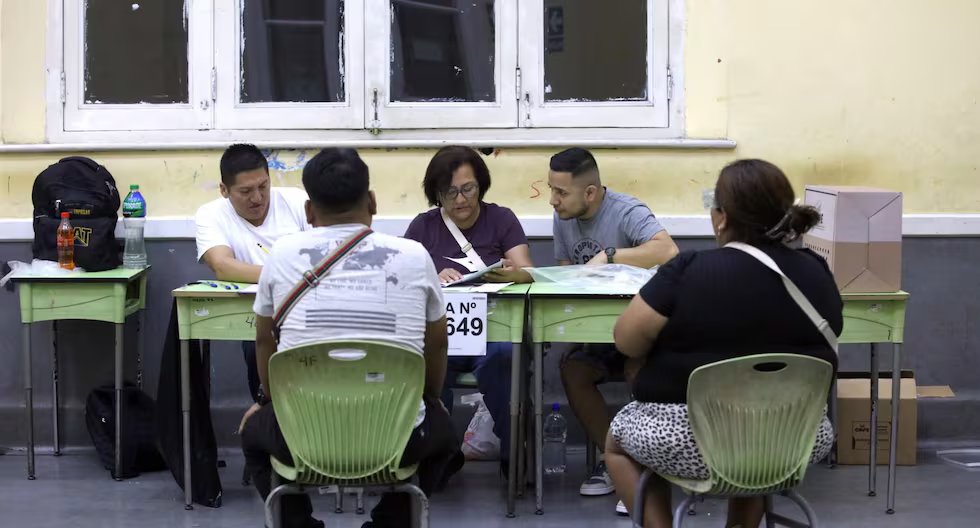
Polling station members continued to carry out the scrutiny process until the early hours of the morning due to what they describe as tedious and repetitive processes, in addition to logistical failures.
/ César Grados / El Comercio
This experience left the young man with the feeling that “the process could be much more efficient and leaves me a little dissatisfied with how things have been handled from above, especially starting with the issue of the delay of electoral material. And also in terms of the number of personnel assigned, the ideal would have been to have one ONPE staff per classroom, especially so that the process of installing the table does not take so long.”
Carla Bernal’s experience was not much better.
“It was quite heavy, you had to go column by column, in five elections at a time. The most tedious thing was the preferential vote: you had to mark the number in a box, then put that same vote next to the number in another list, after counting everything by hand you had to pass that data to the system and then print it and sign it,” explains the young woman.
“In the midst of all that you had problems with the system and on top of that the printers ran out of ink. Because of all those delays I ended up staying until one in the morning and when I left there were still tables counting,” he adds.
During a broadcast by América Televisión it could be seen that after seven in the morning today, Monday the 13th, polling station members and officials from the Jesús de Nazareth school, in Villa el Salvador, continued leaving the voting center.
“They brought us all the materials very late. Then we saw that the printers were not working, the ink ran out, the machine had no system. We had to do everything manually because there was no system,” claimed before cameras a woman who had spent all morning at the electoral center participating in the counting.
Despite having been inside the premises for 24 hours, the woman assured that ONPE staff “didn’t want us to even talk on the phone, order dinner, they didn’t want anything at all.”
– Poorly trained staff –
A citizen who asked to remain anonymous told The Commerce that the ONPE staff in charge of their voting station, in a location in the Center of Lima, showed that they were not trained to access the Technological Solution to Support Scrutiny (STAE) system implemented for this process.
“In my case, the material was there but the ONPE staff did not seem trained. The board members had to help her log in because she did not know how to enter the system from the laptop. The board members offered to help her so she left us her credentials, username and password, to log in and she went to the other classroom she was assigned to. She left me worried that we could all access the system and a password that only she should have,” she told this newspaper.
The citizen provided graphic evidence to The Commerce in which you can see both the ONPE staff password and a screen intended for “use by the table coordinator” which, among other functions, allowed him, for example, to control the attendance of table members.
On the other side of the city, at the Ricardo Palma University, the electoral material only arrived at 9:00 am, as detailed to The Commerce Alexandra Condori, 26 years old, who had to assume the presidency of her voting station after the two assigned members left the premises due to delays in the start of the process.
“I was in line and they started calling for volunteers. I had arrived at eight to vote, I had to stand in line outside the university until the material arrived, then another line inside and finally at 10:30 three girls volunteered to set up the table,” she says.
Condori points out that it was planned that electronic voting would be carried out in his classroom; However, none of the volunteers received instructions from ONPE in this regard, so they decided to follow the process manually.
“There was no laptop or printer at our table, everything was manual. At the time of the scrutiny we had problems because all the material they had brought was for electronic voting, in a smaller format, and we also did not have the sealed envelopes for the minutes. We had to use the sealed envelopes for observations to seal the minutes. We finished around midnight and there were still several tables processing data. We heard that in other classrooms there were problems because the system failed or had crashed,” he says.