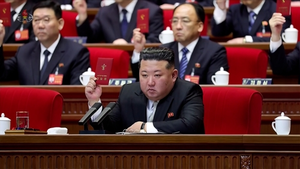
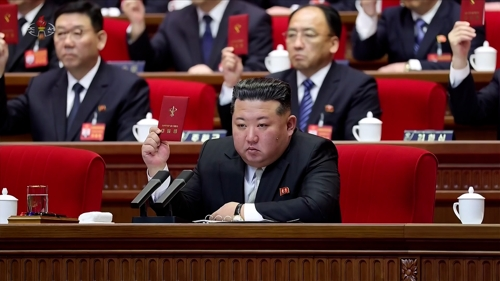
North Korea appears to have consolidated its foreign and inter-Korean policy into a unified chain of command centered on leader Kim Jong-un, a report showed Sunday.
In a report on the North’s external and inter-Korean strategy, Kim Il-ki, head of North Korea studies at the Institute for National Security Strategy, said the country has moved to streamline its foreign policy command structure under Kim Jong-un. The report follows the ruling Workers’ Party’s ninth congress and the first session of the 15th Supreme People’s Assembly, held on March 22 in Pyongyang.
Under the new structure, Kim Jong-un is expected to exercise closer control over foreign affairs, with his sister Kim Yo-jong overseeing external operations under his delegation.
Key officials are likely to divide responsibilities by region and function.
Kim Song-nam, the party’s international secretary and chair of the SPA Foreign Affairs Committee, is expected to handle ties with socialist countries such as China. Foreign Minister Choe Son-hui is projected to oversee relations with the United States, Russia and other nonsocialist states, while Jang Kum-chol is expected to take charge of inter-Korean affairs.
Kim Il-ki said the overlap of roles across party and state institutions reflects an effort to ensure consistency in policy execution.
“By having key officials concurrently hold positions in both party and state bodies, North Korea appears to be seeking to minimize discrepancies between strategic planning and policy implementation, while strengthening overall coherence in its external strategy,” he said.
The report highlighted a notable shift in Jang Kum-chol’s role. North Korea typically has not granted Foreign Ministry titles to officials overseeing inter-Korean affairs, but Jang is believed to be the first to hold such a dual role.
According to the report, Pyongyang may be redefining inter-Korean relations in more state-to-state terms, enabling a more unified approach to its broader diplomatic agenda.
The report also noted that it is uncommon for a party’s international secretary to concurrently serve as chair of the SPA’s Foreign Affairs Committee, with only a few precedents.
Kim Jong-un’s direct involvement in foreign policy has also been emphasized increasingly. In a recent policy report, references to the “party central committee” were repeatedly highlighted in the external strategy section, signaling strengthened centralized control.
“This suggests that Kim views the evolving international and regional environment as highly unpredictable, and sees external strategy as critical to the regime’s survival and development,” Kim Il-ki said.
The report also pointed to the roles of senior officials such as Jo Yong-won, chairman of the SPA Standing Committee, and Kim Tok-hun, newly appointed first vice premier.
Kim said Jo’s appointment should not be viewed as a demotion but rather as a reassignment reflecting Kim Jong-un’s closer oversight of diplomatic affairs. Kim Tok-hun is expected to take charge of external economic cooperation, particularly with China and Russia, while also serving as vice chair of the SPA Foreign Affairs Committee.
Looking ahead, the report suggested that North Korea may move away from linking inter-Korean relations with ties to the United States and instead pursue the two tracks separately.
This could limit progress in inter-Korean relations in the early stages of any renewed dialogue with Washington, while also constraining Seoul’s policy options, Kim said.
However, if US-North Korea negotiations advance over the longer term, the issue of compensation for denuclearization or improved relations could resurface, likely requiring South Korea’s involvement in bearing part of the costs, he added.
flylikekite@heraldcorp.com