A 7.5 magnitude earthquake struck off the north-east coast of Japan on Monday, triggering tsunami warnings across several prefectures and forcing authorities to order evacuations along the Pacific shoreline.
The Japan Meteorological Agency said the quake hit at 4:52pm local time in waters off Sanriku at a depth of 10km. The tremor registered an upper 5 on the national seismic intensity scale, strong enough to disrupt movement and damage structures.
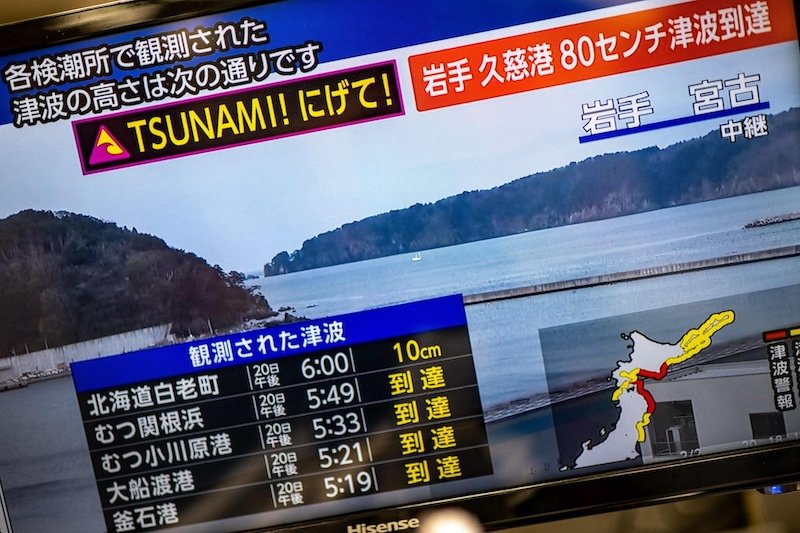
Tsunami waves reached parts of the coast within an hour. Officials recorded an initial wave of 40cm at Miyako port in Iwate prefecture. Authorities warned that later waves could rise to 3 metres and urged residents to move to higher ground without delay.
Public broadcaster NHK showed live footage from coastal areas in Iwate, Aomori and Hokkaido. Announcers repeated evacuation calls as warning messages appeared on screen. Ships left ports including Hachinohe to avoid damage from incoming waves.
Prime Minister Sanae Takaichi said the government had formed an emergency task force. “Possible damage and casualties are now being looked into,” she told reporters in Tokyo. She urged residents in affected regions to evacuate and stay away from coastal zones.
Evacuation orders covered towns such as Otsuchi and Kamaishi, both of which suffered heavy losses during the 2011 disaster. Local authorities directed thousands of residents to designated shelters on higher ground.
Rail services in Aomori were suspended following the quake. Transport operators halted bullet trains as a safety measure while inspections took place. Officials also warned of potential landslides and further seismic activity in the coming days.
The earthquake was felt far beyond the epicentre, with reports of shaking in Tokyo, hundreds of kilometres to the south. The Meteorological Agency said aftershocks remained likely and advised continued caution throughout the week.
Tsunami warnings covered Iwate prefecture, parts of Hokkaido’s Pacific coast and areas of Aomori. Advisories extended to Miyagi and Fukushima prefectures.
Officials said no abnormalities had been detected at nuclear facilities in the region. Operators at Fukushima Daini and other sites reported normal conditions. Checks continued at the Fukushima Daiichi plant, which suffered meltdowns after the 2011 earthquake and tsunami.
Energy companies confirmed that no nuclear plants were in operation in the affected areas. Inspections at idled facilities, including Onagawa, remained ongoing.
The quake struck in the Pacific Ocean along a zone known for seismic activity. Japan records frequent earthquakes due to its position along tectonic plate boundaries. The country accounts for a significant share of global earthquakes above magnitude 6.
Authorities said waves had also been observed about 50km offshore near Aomori shortly after the quake.
The current event comes 15 years after the March 2011 disaster, when a magnitude 9.0 earthquake triggered a tsunami that killed nearly 20,000 people and led to nuclear accidents in Fukushima. Large areas of the region remain affected by that event.
HT