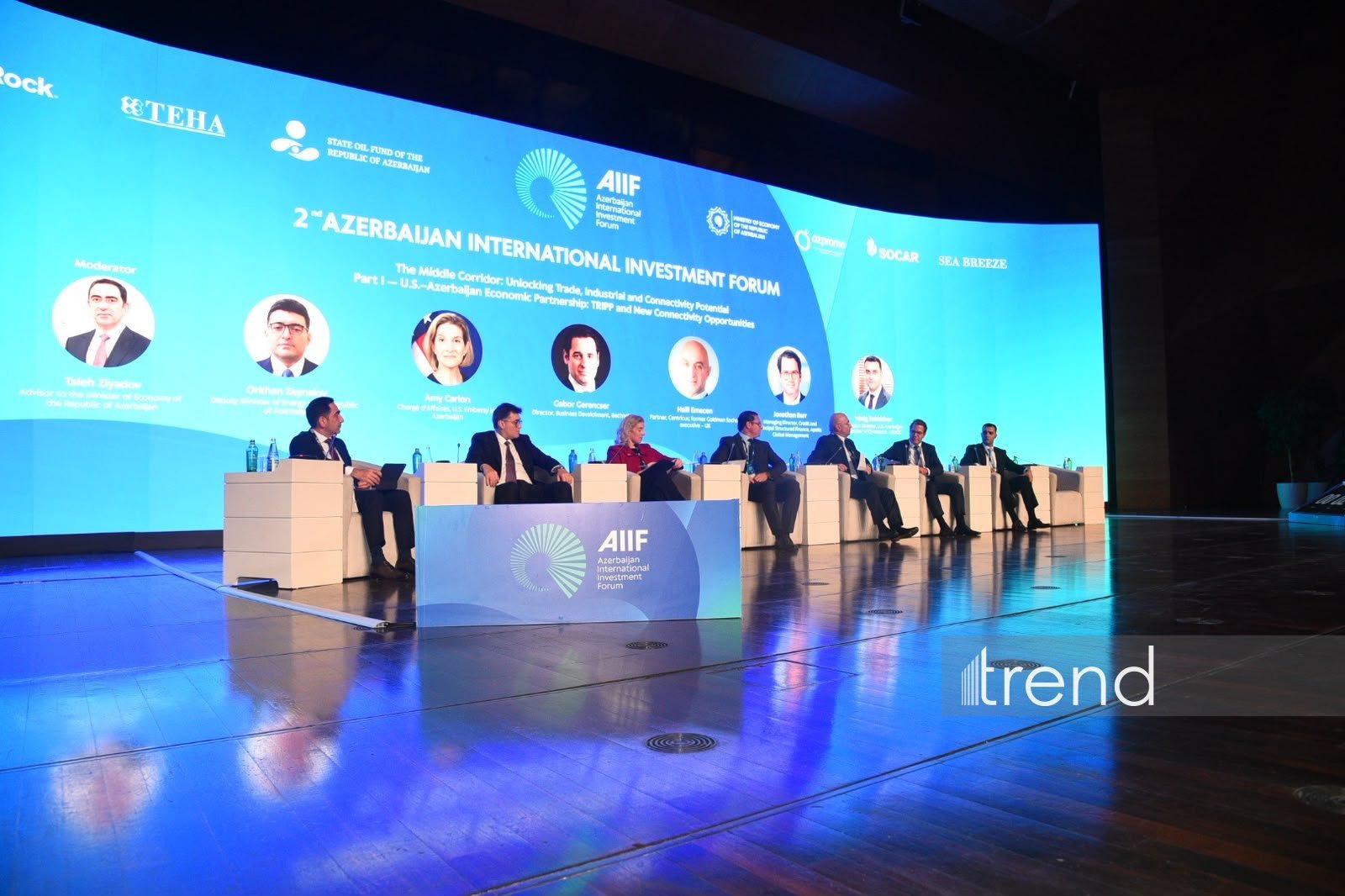
BAKU, Azerbaijan, September
25.The 2nd Azerbaijan International Investment
Forum opened today in Baku, bringing together leading international
investors, representatives of government agencies, financial
institutions and business circles. The two-day forum being held
under the patronage of the President of Azerbaijan Ilham Aliyev is
dedicated to the theme “Rebuilding Trust in a Fragmented World: The
South Caucasus as a Pillar of Global Connectivity and Investment
Stability”.
The scale of the forum reflects the level of interest in this
agenda. More than 3,000 participants registered for the event,
including 803 foreign representatives from 70 countries. Government
officials, representatives of international financial institutions,
investors, and heads of companies and think tanks gathered at the
venue.
Amid the restructuring of global supply chains, trade tensions,
and persistent geopolitical uncertainty, Azerbaijan aims to
establish itself not only as an attractive investment destination
but also as a regional platform facilitating the flow of capital,
technology, goods, and energy resources to markets in the South
Caucasus, Central Asia, and Europe.
In his address to the forum participants, President Ilham
Aliyev noted that macroeconomic stability, investments, and
favorable conditions for entrepreneurship in the country create a
solid foundation for long-term investor confidence.
“Azerbaijan’s strategic geographical location, transport and
logistics capabilities, well-developed infrastructure in economic
zones, tax and customs incentives, as well as public-private
partnership mechanisms and joint investment funds established with
partner countries, offer investors broad opportunities to
participate in sustainable projects and to build partnerships that
bring technology, capital and expertise to the whole region,” the
head of state said.
In this context, it is significant that 11 documents were signed
between Azerbaijan and foreign partners during the event, covering
areas such as construction and development, the digital economy,
renewable energy, high-tech manufacturing, agriculture, veterinary
medicine, pharmaceuticals, banking investments, water resource
management, and investment promotion. This composition indicates
that Azerbaijan’s investment agenda is becoming increasingly
diversified and gradually extending beyond traditional energy
projects.
Last year, investment agreements totaling over $10 billion were
signed at the inaugural Azerbaijan International Investment Forum,
with more than $7 billion of that amount allocated to the non-oil
and gas sector. The current agenda continues this trend.
The signed documents include a cooperation agreement on
construction and development between Azerbaijan’s Ministry of
Economy and ROX Group, a memorandum of cooperation with Microsoft
to develop Azerbaijan’s digital economy, and an agreement with ROX
Group regarding solar and wind energy projects.
A distinct area of focus involves the development of
manufacturing capabilities. Plans are in place for cooperation
within the Alat Free Economic Zone to produce silicon carbide,
silicon oxide, and silicon using new technologies. This is
particularly important for industrial diversification: the
objective is no longer merely to attract capital for existing
infrastructure but to establish production facilities targeting
more technologically advanced sectors.
Three additional documents pertain to the agricultural sector,
veterinary medicine, and pharmaceuticals. Specifically, these cover
the establishment of Azerbaijani-Swiss plantations and processing
facilities (ABAK-WASSERSTEIN), a project to build a poultry complex
in Aghdam, the production of veterinary vaccines, and the creation
of a pharmaceutical manufacturing plant. Thus, the investment
landscape is expanding in two directions simultaneously: moving
from large-scale infrastructure and energy projects toward
manufacturing and processing, and shifting from raw-material
industries to sectors with higher value-added potential.
The agreement regarding the Azerbaijan-Oman Direct Investment
Fund’s acquisition of a non-controlling stake in Azer-Turk Bank JSC
stands out as a distinct development. It demonstrates that
investment cooperation is viewed not merely as a means of financing
new enterprises but also as a way to participate in existing
economic infrastructure.
Another document outlines cooperation between Esyasoft, the
State Water Resources Agency of Azerbaijan, and SOCAR. This
initiative is significant for the technological transformation of
core infrastructure. Water, energy, and digital technologies
increasingly intersect in modern investment projects, while the
digitalization of resource management is emerging as a key driver
of economic efficiency. Finally, Azerbaijan and Ukraine signed an
agreement on investment promotion cooperation between AZPROMO and
UkraineInvest.
In this way, the forum simultaneously fosters new projects and
expands institutional channels for attracting further capital.
Why diversification becoming central
theme
This is of strategic importance to Azerbaijan. While the energy
sector remains a core competitive strength, the country’s
investment strategy is gradually evolving toward a broader
model—one in which energy is complemented by industry, transport,
logistics, digital technologies, agriculture, the financial sector,
and renewable energy.
Meanwhile, particular emphasis is placed on projects capable of
bringing in technology and capital, boosting labor productivity,
creating skilled jobs, and integrating Azerbaijan into regional and
global value chains. Indeed, the shift from simply attracting
capital to generating value-added output is a pivotal element of
the current investment agenda. Against this backdrop, Azerbaijan’s
geographical location takes on particular significance. CEO and
Managing Partner of the Italian TEHA Group, Valerio De Molli,
identified three areas that could serve as the foundation for the
country’s future competitiveness: the Middle Corridor and
logistics, the digital economy, and energy.
He specifically highlighted Azerbaijan’s advantages regarding
transport links between China and Europe. He noted that the route
via the Suez Canal takes about 30 days and the route around the
Cape takes approximately 40 days, whereas the Trans-Caspian route
can reduce this time to around 12 days.
For Azerbaijan, the value of this advantage lies in more than
just the potential increase in transit volumes. The development of
transport routes creates conditions for the emergence of new
manufacturing and logistics hubs around them, thereby enabling
transit to generate broader economic benefits.
It’s precisely here that investment policy and the development
of the Middle Corridor intersect.
Middle Corridor: next stage goes beyond
infrastructure
The Middle Corridor emerged as a central theme of the forum,
with discussions extending well beyond the construction of railways
and ports.
Rahman Hummatov, Deputy Minister of Digital Development and
Transport, announced that Azerbaijan’s transit freight volume is
expected to exceed 16 million tons by 2026. This is roughly three
times the pre-pandemic figure recorded in 2019. Specifically,
freight volume along the Middle Corridor could reach approximately
5.5 million tons by 2026, with the number of regular container
trains from China hitting around 600.
According to forecasts by international organizations, freight
volume along the Middle Corridor could approach 11 million tons by
2030, while container transit could reach 900,000 TEUs annually.
However, further growth in these figures will depend on more than
just physical infrastructure.
Deputy Minister of Finance and Economy of Turkmenistan, Perhat
Yagshiev, emphasized that enhancing the competitiveness of the
Middle Corridor requires a comprehensive approach. The first level
involves physical infrastructure: railways, road routes, ports,
terminals, and logistics centers. Ensuring sufficient throughput
capacity across all sections of the route is essential. The second
level concerns the speed and predictability of transport. For
businesses, the ability to accurately forecast timelines is just as
important as shipping costs. Consequently, the harmonization of
tariffs, schedules, cargo handling procedures, and operator
coordination becomes a critical factor.
The third level is digitalization. Electronic document
management, advance notification of customs authorities, and the
integration of information systems across ports, railways, and
other stakeholders can significantly reduce cargo transit times. It
is the combination of these three elements—infrastructure,
organizational coordination, and digital solutions—that will
determine the route’s future competitiveness.
Azerbaijan building not just corridor, but
economic ecosystem
For its part, Azerbaijan is already implementing a comprehensive
approach. The country identifies the Baku-Tbilisi-Kars railway, the
Baku International Sea Trade Port, and the under-construction
Horadiz-Aghband railway as key pillars of the Middle Corridor. At
the same time, a broader logistics and economic ecosystem is taking
shape around Alat. The cargo airport currently under construction
in Alat is set to complement the region’s multimodal capabilities
and support the development of the Alat Free Economic Zone.
A significant outcome of the forum was that the Middle Corridor
was viewed through a lens broader than just China-Europe transit.
Uzbekistan’s Minister of Investment, Industry and Trade, Laziz
Kudratov, said in an exclusive interview with Trend that the volume of freight transport between
Uzbekistan and Azerbaijan via the Middle Corridor has more than
doubled over the past few years. Uzbekistan aims to increase its
trade turnover with Azerbaijan to $2 billion within the next few
years.
Moreover, this involves more than just an increase in trade.
Uzbekistan is investing in Azerbaijan’s textile sector and
participating in joint automotive manufacturing projects.
Conversely, Azerbaijan is investing in Uzbekistan’s mining, energy,
and food sectors, as well as in real estate. New projects are also
being discussed in pharmaceuticals, construction materials,
agriculture, and food processing. Thus, the investments themselves
begin to generate additional freight flows.
Damirbek Bikulov, a representative of the National Investment
Agency of Kyrgyzstan, outlined a similar prospect. In an exclusive
interview with Trend, he said that Azerbaijan could serve as a
“gateway” to European markets for Kyrgyzstan, while Kyrgyzstan
could become a partner for Azerbaijan in Central Asia. He
specifically highlighted the potential of the Azerbaijan-Kyrgyzstan
Development Fund for projects in tourism, agriculture, and heavy
industry.
Consequently, the Middle Corridor is gradually taking on an
additional function: it is becoming a mechanism for expanding
investment ties between the countries.
Energy remains pillar, but changes
structure
The second major component of the new model is energy.
Azerbaijan remains a key energy partner for European markets;
however, the country’s energy strategy is gradually expanding to
include renewable energy. A document signed at the forum regarding
solar and wind energy projects in Azerbaijan demonstrates that this
transformation is already being reflected in the concrete
investment agenda.
In his address to the forum participants, President Ilham Aliyev
noted that Azerbaijan’s energy vision is increasingly extending
beyond mere energy supply to encompass the development of green
energy corridors.
“Azerbaijan is a reliable energy partner for a growing number of
countries. Our vision increasingly extends beyond energy supply to
the development of green energy corridors, enabling the integration
of renewable energy into regional markets and strengthening
connectivity between Azerbaijan, the wider South Caucasus, Central
Asia and Europe,” the head of state said.
This opens up the prospect of linking energy strategy with
transport and regional connectivity. In the long term, Azerbaijan
aims to simultaneously strengthen traditional energy ties with
Europe and develop renewable energy, which could serve as the
foundation for new regional energy routes.
Expanding geographic scope: from U.S. and Europe
to Middle East
The forum also highlighted the widening circle of Azerbaijan’s
potential partners. Natig Bakhishov, Executive Director of the
U.S.-Azerbaijan Chamber of Commerce (USACC), noted the heightened
interest among American companies in Azerbaijan and the broader
South Caucasus and Central Asia region. According to him, following
the August summit and the resumption of more active U.S. government
engagement with the region, American companies have shown greater
confidence, and the USACC is receiving numerous inquiries on a
weekly basis.
At the same time, the geographic scope of investment contacts is
extending to the Middle East. Syria has expressed interest in
expanding cooperation with Azerbaijan in trade, technology, energy,
agriculture, and industry.
In an interview with Trend, Syrian Minister of Economy and Industry
Mohammad Nidal Al-Shaar highlighted the existing experience of
cooperation in the gas sector and the positive impact of
Azerbaijani gas supplies on the country’s energy provision. He
stated that the establishment of a Joint Business Council between
the two countries should provide an additional mechanism for
exploring investment opportunities and developing business
ties.
Peace and regional integration as new investment
factor
The changing regional context is of particular significance.
In his address to the forum participants, President Ilham Aliyev
noted that the emerging peace in the South Caucasus creates new
opportunities for regional cooperation, transport connectivity,
trade, and investment, while fostering deeper economic integration
and diversification.
For the business community, this signifies a potential expansion
of the economic landscape, where infrastructure projects can
operate not in isolation, but as components of a unified regional
system. In this context, the Middle Corridor, new energy links, and
the growth of trade between the South Caucasus and Central Asia
mutually reinforce one another.
The more production and investment ties established between
countries, the greater the potential demand for transport
infrastructure. Conversely, more efficient infrastructure lowers
trade costs and enhances the economic appeal of new investment
projects. That is precisely why the continued development of the
Middle Corridor cannot be viewed solely as the responsibility of
transport authorities; it is simultaneously a matter of industrial
policy, trade, investment, digitalization, and regional
integration.
Thus, the 2nd Azerbaijan International Investment Forum
illustrates a gradual shift in Azerbaijan’s role within the
regional economy: moving from a nation offering investors isolated
projects to one providing access to an emerging economic system
that links energy, manufacturing, digital technologies, and
transport with the markets of Europe, the Caucasus, and Central
Asia.