“For us the innovation hub is a must,” says Kris Mok, the lab’s communications manager, adding that the ever-shifting matrix of challenges means that “in a few years we’ll have to work twice as hard”. The team is encouraged to test left-field ideas even if they fail – an unusual approach in Singapore’s often cautious work culture. Among the lab’s projects are a fleet of drones that hover in storms to deter ground lightning strikes that could shut down runways in one of the world’s most lightning-prone countries.
A national calling card
Changi’s obsession with efficiency is not new. It dates to the 1970s, when Singapore’s founding father and first prime minister, Lee Kuan Yew, decided that to grow, the small, trade-reliant nation needed a welcoming symbol of efficiency. It was a costly gamble, but it worked. Lee would eventually call Changi “the best S$1.5bn investment we ever made.”

 Getty Images
Half a century on, the investment is still paying off. “[Changi] is like Singapore in a nutshell: efficient, clean, organised, and you can trust everything works as expected,” says Alisha Rodrigo, who lives in Singapore and flies out frequently from the airport. Speaking shortly after a shutdown left American airports with four-hour wait-times at security and check-in, she adds that “sometimes predictable is a good thing”.
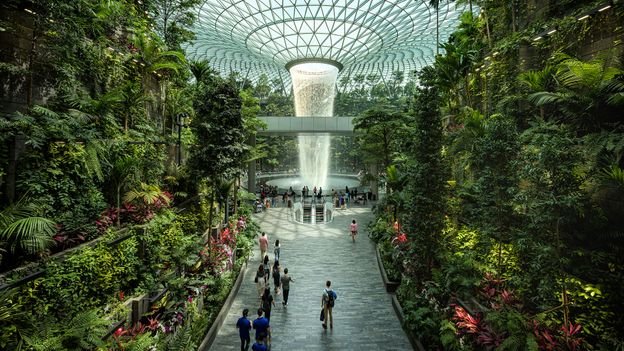
And that, in the end, is why Changi keeps winning. While the waterfall might be what travellers remember, the real achievement is that they reach it without getting lost or breaking stride.
—
If you liked this story, sign up for The Essential List newsletter – a handpicked selection of features, videos and can’t-miss news, delivered to your inbox twice a week.
For more Travel stories from the BBC, follow us on Facebook and Instagram.