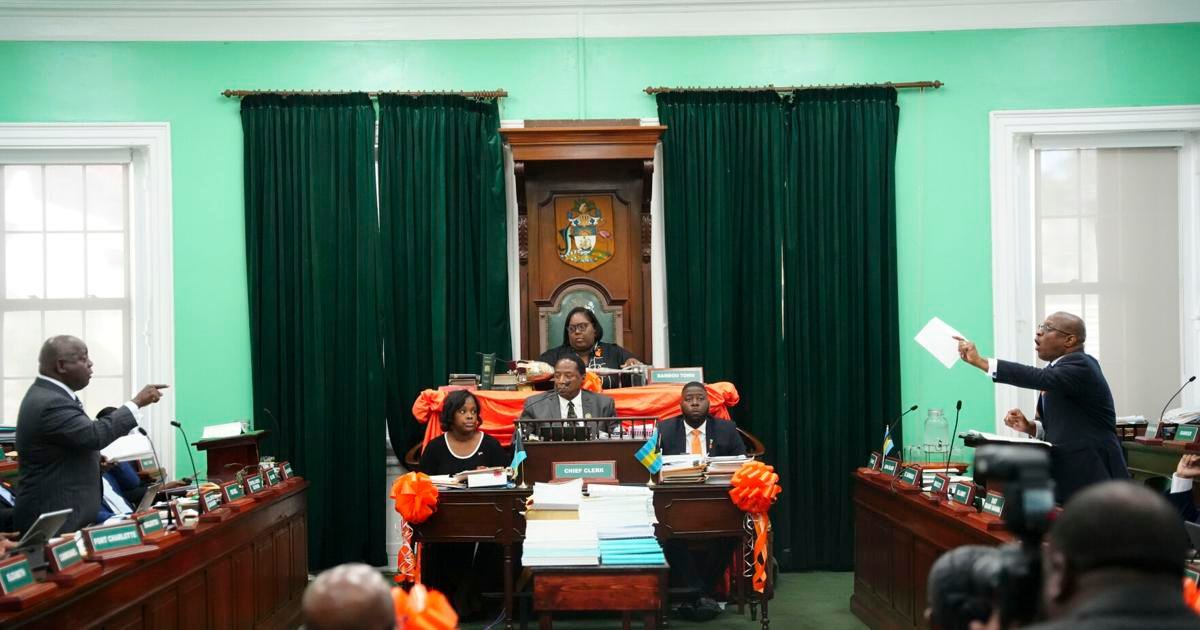
The total constituency capital grants allocated for members of Parliament this term amounted to more than $20 million, but taxpayers remain in the dark on what that money was used for as there is still no legal requirement for any public reporting on the spending, and still no established freedom of information regime.
This is not to be confused with the monthly constituency allowance of $3,500 intended to cover costs associated with keeping MPs’ constituency offices opened, including salaries, utilities, etc.
The constituency capital grant is allocated for each MP to undertake various projects in their constituency.
This term, allocations amounted to more than $500,000 per MP.
In the 2021/2022 fiscal year, $3.9 million was allocated for the constituency capital grants. That’s $100,000 for each of the 39 members of Parliament transferred to accounts they set up to receive the money for constituency projects.
If one subtracts the amount for the first quarter of that fiscal year (July — September, 2021) to account for what MPs received at the end of the Minnis term, the allocation amounts to roughly $2.9 million.
In 2022/2023, MPs collectively received $3.9 million in constituency capital grants.
In 2023/2024, $3.875 million was spent.
In the first nine months of the 2024/2025 fiscal year, $3.9 million was spent. There is no reporting as yet on the last quarter of that fiscal year.
The government allocated $5,850,000 for constituency capital grants in 2025/2026.
All grants payable under the Constituency Capital Grant Act are paid out of the Consolidated Fund.
In 2023, the government announced that the monthly constituency allowance was being raised from $2,500 to $3,500 and the capital grant was being increased from $100,000 per year to $150,000.
Under the act, a capital development project includes any works carried out for the overall or partial development of a constituency; the maintenance of any roads, parks or other public facility within a constituency; the beautification of the environment within a constituency or any other work the MP considers appropriate for the development, educational or cultural endeavors of his or her constituency.
The law prohibits MPs from using any portion of the grant for any political meeting or forum, any fundraising activity for any political party, or the payment, maintenance, upkeep, salaries and other expenses in respect of the constituency office.
That act states, “No member of Parliament shall award a contract for a capital development project to a member of his family or to any business or company for which the beneficial owners of that company are family members of the MP.”
The law permits the MP to determine which capital development projects are necessary in his or her constituency.
Each MP is mandated to keep proper accounts and reports, and the auditor general is required to audit such accounts at the end of each fiscal year.
But there have been no annual auditor general reports on how the MPs have been spending those grants.
They draw down on the funds quarterly after providing a report to the Ministry of Finance on the projects they have pursued.
In 2023, when the government announced that it was raising the grant amount from $100,000 to $150,000, Fox Hill MP Fred Mitchell, who is also the Progressive Liberal Party chairman and foreign affairs minister, said in Parliament even that is inadequate to meet the tremendous demands placed on MPs to carry out infrastructure projects and meet requests for social assistance from constituents.
Mitchell said if it were left up to him, the grant would be raised to $1 million as there is a need to “empower incumbents in their work”.
“The amount of discretionary spending that is required by members of Parliament, I’ve had a long time at this now, since 1992, and I think that I’ve never experienced, never experienced in my public life the level of demands from constituents with regard to discretionary spending [that I experience now]. I’ve never experienced this,” he said.
Mitchell added, “Members of Parliament have a very important job to do in trying to keep the government connected to the people who they govern, but also in making sure that the peace is kept in their communities and also making sure that the infrastructure in their communities is up to standard and up to scratch.
“And the citizens of the country, in terms of the level of public education, see no distinction, it appears, between public monies and your own personal monies.
“The attitude is that the MP can go in their pocket and fix it … but that’s not the case. Most of us are men and women of ordinary means, and you have to apply yourself in the judicious use of public funds to meet the greater demands of the Bahamian public.”
With no public access to the spending reports MPs are required to turn in to the Ministry of Finance, a cloud surrounds exactly what each has done with the allocation. The Nassau Guardian has had no luck in speaking with Financial Secretary Simon Wilson on whether the requirement to hand in those reports was being consistently met by all 39 MPs.
In 2023, a Nassau Guardian editorial questioned why the increases should be effected in the absence of full transparency on how MPs were already spending the $100,000 they were allocated every year for constituency projects or the $30,000 they were allocated to keep their constituency offices open.
That editorial questioned whether MPs were segregating funds or treating the accounts into which these funds are sent as accounts also for their private interests.
In the absence of any auditing on those accounts by the auditor general, the taxpayers do not know those answers.
A call for transparency
Speaking recently with The Nassau Guardian, Matt Aubry, executive director of the Organization for Responsible Governance (ORG), a non-partisan, non-profit organization that promotes the principles of good governance, highlighted the need for transparency over how the grants are being used.
He noted that access to information is critical for citizens to be able to determine whether government is operating in their best interests.
“We have a lot of financial information that comes at us from different sources, but it doesn’t go beyond a certain level of depth, and that’s challenging because it leads to these pockets where it can be accounted for; you look in the budget and it says ‘that was done’, but it doesn’t tell you how it was used, what the context was and what that means,” Aubry said.
“And so, when you’re talking about the constituency amounts that are available every year, that’s a crucial space where folks should see their direct interests.
“…We’ve talked a little at ORG about this concept of the quality of representation. What does that mean as people are trying to choose who represents me; we want to see and define what that really means.
“And one of those things is fundamentally about transparency, and one of those is around the financial implications within your own constituency and this $150,000 is a crucial way for folks to be able to do that.”
Former Prime Minister Dr. Hubert Minnis, who is running as an independent in Killarney, recently sought to dispel the “lies” that an independent member is at a disadvantage in representing his or her constituency, given that all members receive the same allowances.
“He can complete work that he started or commence new work,” Minnis said.
“The government is responsible for the infrastructure changes within the constituency or the country, and in many instances, the government may not do certain things and the independent [MP] would use the monies that he was given by the government to complete projects or sometimes go in his own pocket to complete the projects.”
Historically, not all MPs have made full use of their allocations.
Former Prime Minister Perry Christie faced criticisms for failing to spend the bulk of his allocation for Centreville.
At a rally in 2012, then-Prime Minister Hubert Ingraham said, “When we made available $100,000 to each MP to spend to improve their constituency, most MPs got to work for their people. In Centreville and Farm Road, during the height of the global recession, their MP, Perry Gladstone Christie, couldn’t get around to spending his full allocation of money.
“He left more than one half of that money unspent. His sad excuse is he was still planning a whole year after the money was made available. I tell you, he’s never ready.”
Christie and the Progressive Liberal Party, went on to win that 2012 election, but he led his party to defeat in 2017 and lost the Centreville race by a thin margin to the Free National Movement’s Reece Chipman.