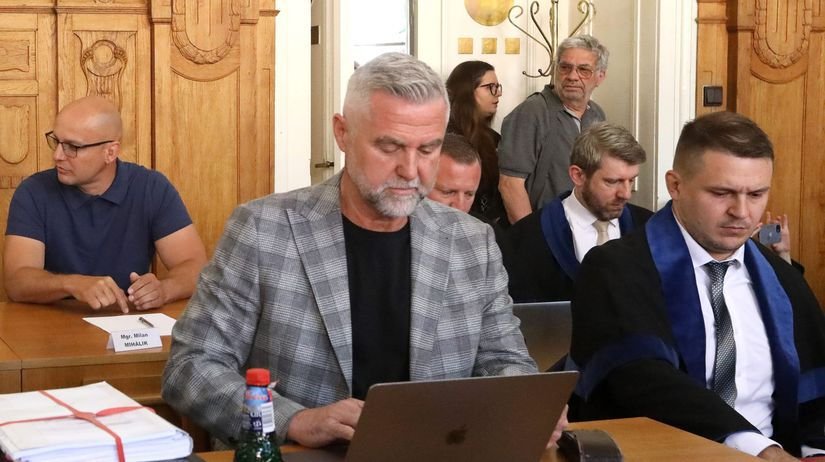
At the workplace of the Specialized Criminal Court in Banská Bystrica, on Monday, June 8, the main trial in the Purge case began for the second time, which reveals the operation of an alleged criminal group under the leadership of the police between 2012 and 2018. On this day, the indictment itself was heard before the senate led by Peter Pulman, the reading of which was prevented in May by procedural obstacles and the subsequent connection of the case of ex-police officer Roman Stahl. The extensive process currently has up to 32 scheduled dates and will last at least until February 2027.
Monday’s trial took place with the participation of almost all eleven defendants. On the bench sat the current deputy speaker of the parliament for Smer and former police chief Tibor Gašpar, Nitra businessman Norbert Bödör, former NAKA director Peter Hraško, former head of the National Financial Police Unit Bernard Slobodník, former president of the Financial Administration František Imrecze, former head of the NAKA anti-corruption unit Róbert Krajmer, as well as officials Milan Mihálik, Marián Zetocha and former special prosecutor Dušan Kováčik. Only businessman Boris Trantalič was missing, who gave his consent to the proceedings in his absence. All the defendants present at the beginning of Monday’s hearing refused to enter into a plea agreement.
Para talks about anomalies
After the indictment was dismissed and the hearing ended, defense attorney Marek Para, who represents Gašpar, Bödör, Zetocha, Mihálik and Krajmer, took the floor. The defense attorneys of the majority of the defendants called the indictment completely unfounded and illegal and asked the court to stop the prosecution.
Para criticized the prosecution’s mistakes, which he said were too extensive to spend half a day in court. “There is, for example, a lack of so-called powers that do not allow us to testify about those acts. We also pointed to an absurdly worded act – that engineer Krajmer was supposed to hand over a bribe for an unknown matter, at an unknown time and in an unknown place, and he certainly accepted it. These are the anomalies of this indictment,” emphasized the lawyer, and at the same time announced that his clients will not testify at this stage of the proceedings, since the prosecutor must first present the deeds themselves specify.
“We focused primarily on the actions of law enforcement agencies (LPOs) who are biased and had a preconceived intention,” continued Para. According to him, the most prominent problem, which was opened at Monday’s hearing, is very recently acquired. It is supposed to be about the manipulation of the statement of the cooperating accused Ľudovít Makó. “Its falsity was proven. Also Mr. Slobodník, who himself testified that the police prepared him in advance, and now the minutes of Mr. Makó’s interrogation were added. It was sent by e-mail between the members of the National Criminal Agency (NAKA), “says Para.
“Mr. Makó clearly said that it is incomplete, there is missing information about, for example, the ex-head of the Department of the Interior, Roman Mikulac. It was about him that the Čurillos said that they were “protected animals” and the minister is also dealing with it. There you can see on what political order this case was launched,” underlined Para, adding that it is clear that OCTK told Makó how to testify.
Gašpar himself has denied guilt from the beginning. “I’ve been saying from the beginning that biased authorities are acting. It was during the wiretaps in the office that Pavol Ďurka talked with Ján Čurilla about the fact that Michal Šúrek doesn’t know how to write the indictment and he has to write it for him. This is proof of the quality of how these things were investigated,” said the former police chief after leaving the courtroom. He would like to have the mentioned bias clarified. “Because bias does not mean that someone names you in a vulgar way in some office, but how they act. For example, when you submit motions for evidence and the court ignores them,” he added.
Gradually, other advocates also expressed their views. They described the procedure in this matter as contaminated by illegality, concealment of evidence and are surprised that the prosecution can even be in court. They consider the whole accusation to be unfounded. Kováčik’s lawyer Erik Magál also stated that the preliminary proceedings were illegal. According to him, it was not about the law or the truth, but about an ideological fight against selected persons.
However, prosecutor Bohdan Čeľovský evaluated the actions of the defense as a long-standing defense that has been presented since the beginning of this case. “It has even spilled over into the political dialogue – whether from one side or the other,” he pointed out. At the same time, he pointed out that the defense points to proceedings that have not yet been legally concluded. “The appellate judgment in the Kováčik case certainly played an important role, which strengthened these arguments even more. So it will be a matter of proof how the court will deal with these objections. I evaluate the filing of the indictment as reasonable,” concluded the prosecutor.
The defendants have pleaded not guilty
In the afternoon, it was the turn of the defendants’ own statements regarding the indictment filed directly in front of the senate. At the beginning of this section, lawyer Peter Kubina announced that the position of his client Bernard Slobodník is not changing. “We consider the indictment to be reasonably filed,” he pointed out.
All the defendants subsequently entered a plea of not guilty. Gašpar, Bödör, Krajmer, Zetocha, as well as Mihálik officially declared in front of the senate that they deny guilt. Hraško, Stahl, Imrecze and Kováčik also took the same position before the court.
With the exception of Slobodník – he, in the position of cooperating accused, responded to only one of the acts. He has pleaded not guilty to one of the six counts he is charged with, and has not entered a plea at this stage to the other five.
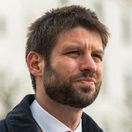
Slobodnik’s tactical move
It was this specific statement of the cooperating accused that provoked an immediate reaction from the other party. Marek Para later admitted that he was “disillusioned” with Slobodník’s attitude. “I was impressed by his conditional cooperation. I think it shows his unreliability, because if someone feels guilty for having committed an act, he simply declares it. Regardless of whether another person will be convicted for it. Saying that I don’t want to be convicted myself is something I have not yet encountered,” stated the well-known defense attorney.
However, Slobodník’s lawyer Peter Kubina justified this decision and his client’s strategic position with unstable laws. “If he were to plead guilty and then some law was passed that we don’t have to know about today, it could end up with him being found guilty and the others being acquitted,” Kubina explained.
After all the actions and declarations, the first day of the closely watched mega-trial ended in the afternoon, and the senate set the next hearing date for July 20. When leaving the courtroom, former special prosecutor Dušan Kováčik repeated that the actions were carried out by biased investigators.
“I find the lawsuit even more illegal now that it was also presented by a biased prosecutor. He himself said in front of the cameras that he is biased against me and they are forcing him to monitor all my things. What should I make of this?” asked Kováčik after turning off the microphones in the hall. “I don’t know what I’m actually doing here. What information should I have given, when and in what criminal matters,” concluded the accused ex-prosecutor before leaving the Banská Bystrica court.
According to the indictment, Bödör was at the top of the group
The indictment of the prosecutor’s office, which has 181 pages and is based on a file with more than 18,500 pages, describes in detail the structure of the group and accuses it of founding, organizing and supporting a criminal group, of bribing, accepting a bribe or abusing the authority of a public official. In the morning, prosecutor Čeľovský read the deeds, according to which a person outside the police structures – Norbert Bödör, a businessman from Nitra – stood at the highest level of the hierarchy. According to the indictment scenario, he was supposed to assign tasks and use information from live files to his advantage or to discredit political opponents of the then ruling Smer party.
The prosecutor also responded to the words of the defense about illegality by declaring that the proceedings were fully legal. “The most serious allegation is the establishment, planning of a criminal group, where a criminal group was actually supposed to be created within the structures of the police, which was managed by a de facto civilian, so it is really the ultimate abuse of the power of these police officers. They did not act in the interests of citizens, but in the interests of private individuals who gave them instructions and received some rewards for it,” declared Čeľovský.
Key meetings and group meetings were supposed to take place on the 6th floor of the Transpetrol building. According to the prosecutor’s office, the then special prosecutor Dušan Kováčik also carried unauthorized information from within the prosecutor’s office. “I believe in justice, in a fair decision, just like before,” responded Kováčik when he arrived at the court in the morning and emphasized that he was glad that the trial had finally started. According to the indictment, he should have known about the illegal activity, but instead of taking action, he actively participated in it.
 Read more Andruskó disappeared after testifying about Gašpar. Who decided if he gets a hood?
Millions in bribes
Details of the distribution of bribes were also part of the read indictment. An example is the case of the Interstore Group company, where the defendant Boris Trantalič had to pay 500,000 euros through intermediaries and the then head of tax criminal investigators Ľudovít Makó (who is today a key witness) to settle tax problems. This is the highest mentioned amount in the entire file. From this amount, 40,000 euros were shared by the Fleischer couple, who confessed to the crime. The remaining 360,000 euros were divided according to Bödör’s predetermined key: Makó and Slobodník each received 90,000 euros, and the remaining 180,000 euros were to be divided between Gašpar and Bödör, according to the prosecutor’s office. This is the only bribe in the file that should have ended up directly with the then police chief Gašpar.
“This is serious corruption, and its seriousness is increased by the positions these people held. These are the people the citizens relied on to actually protect them from the mafia, and not to act for the mafia,” prosecutor Čeľovský added, adding that all the defense’s objections will ultimately be independently evaluated by the court itself.
Even before the start of the hearing in the morning, the former head of Daniars, František Imrecze, also spoke to journalists about his role in the case. “I am ready for it to begin. The main line of the indictment does not concern me. And the part of the indictment that concerns me is not based on true content. I did not commit the deed, and if it happened, I didn’t even know about it,” Imrecze stated at the time, while formally repeating on the microphone in court in the afternoon that he feels innocent.
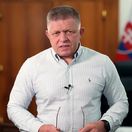
Tracking politicians
According to the prosecutor, the group used not only financial flows, but also repressive state forces. The lower-ranking policemen Milan Žáčik, Ivan Bobocký, Vladimír Bisták and Pavol Vorobjov, who had already been legally convicted, were ordered to follow the then opposition politicians, including Igor Matovič, Daniel Lipšic and Radoslav Procházka. They received rewards for collecting information, which were supposed to come directly from Bödör.
The process became complicated and prolonged due to the addition of the indictment to ex-police officer Roman Stahl (originally prosecuted in the Ezekiel 7 action). It was the procedural proposal to connect the indictment with his case that was the reason for the postponement of the main hearing on its first day, May 11. The connection itself took place at a closed meeting on May 13. Roman Stahl’s line in the Ochistec case concerns three separate acts of accepting bribes connected to the large economic cases of Doprastav, Váhostav and Technopol.
Several actors in the case have already been convicted in separate proceedings in the past based on plea agreements, such as Slobodník, Imrecze, or the mentioned quartet of ex-policemen from the commandos of followers.