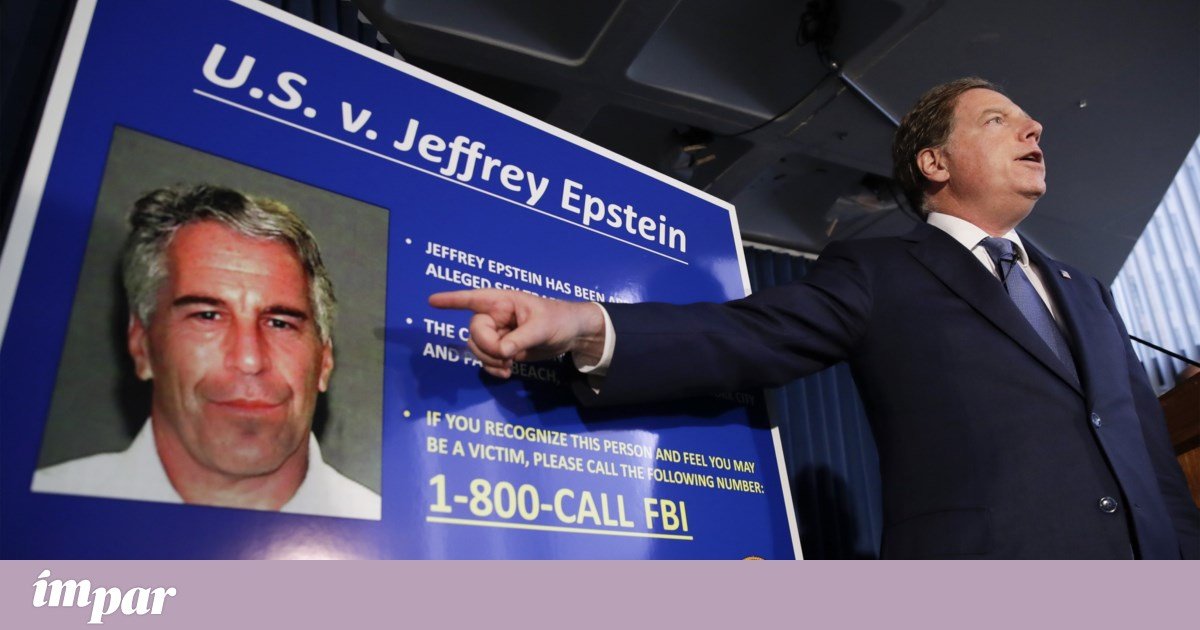
After months of analyzing the autopsy report on Jeffrey Epstein, found dead in his cell in a New York prison in 2019, three forensic experts ruled out the hypothesis of suicide and stated that the sexual offender was murdered.
In an interview with the BBC, American forensic expert Michael Freeman said he believed Epstein was strangledprobably from behind, with the intention to kill. For this investigation, he also worked with neuroscientist Itiel Dror and forensic pathologist Anders Eriksson.
Freeman has acted as an expert witness for US federal prosecutors in cases of deaths in police custody, including that of George Floydasphyxiated by a police officer on duty in 2020, in the US state of Minneapolis.
In the case of Epstein, he based his conclusions on the autopsy reports and photographs, which were given to him in November 2025 by Mark Epstein, who maintains the conviction that his brother, Jeffrey, was murdered. Freeman stressed that his analysis was done independently and that he did not receive any payment from Mark Epstein.
In 2008, Jeffrey Epstein He pleaded guilty to prostitution of minors, serving 13 months in semi-open prison, and in 2019 he was accused of sex trafficking of minors. He died at the age of 66, while awaiting trial, on August 10 of that year. The previous day, new revelations had emerged that the minors exploited by Epstein had been instructed to have sexual relations with other men, including several prominent figures, such as Britain’s Prince Andrew, Duke of York, former New Mexico governor Bill Richardson and former US senator George Mitchell.
At the time, the medical examiner responsible for the autopsy, Kristin Roman, concluded that the injuries on Epstein’s body were compatible with suicide by hanging, without reporting signs of defensive injuries. But Freeman noticed in autopsy photographs that the mark on Epstein’s neck did not resemble the usual marks in suicides. It was deeper, more irregular.
Furthermore, he states that the injuries on the body — namely, on the face and left shoulder — suggest a physical confrontation before death. “The pattern, distribution and quantity of injuries cannot be explained as a result of suicide by hanging”, he argued, during a presentation of his study, in London, on Monday. “The injuries and the way the body was found do not add up. There is only one explanation left: that the death was the result of a homicide.”
Other coroners cited by the The New York Times agree that the mark on Epstein’s neck is atypical, but warn that a set of institutional failures make it difficult to understand what really happened on August 10, 2019.
Contrary to what would normally happen, New York state medical examiners were not allowed to inspect the cell by Epstein. There were also no photographs of the former financier still with fabric around his neck. They were then given a piece of fabric, but it did not correspond to what had been used by Epstein. At that time, the employee who had found the body in the cell also refused to make a statement to the authorities.
The investigation by Michael Freeman, PhD in Epidemiology and Forensic Medicine, developed together with Itiel Dror and Anders Eriksson, has not yet been subject to peer review. Other investigations carried out previously failed to provide evidence of another person’s involvement in Epstein’s death.
The photographs that form part of the autopsy report were released on Monday online by Mark Epstein. “You can see for yourself, so that this stops being an issue where one person makes a statement and then everyone has to believe them,” said Freeman, as he finished presenting his conclusions.