How can a person who comes from the small village called Eitweg in the Lavanttal have any idea about the Viennese song? According to Wikipedia, the town has just 676 inhabitants and is filled with folk music all around.
Helmut Stippich, who chose a T. as the initial for his name because his musician father had the same name as him, certainly has more than just a little idea of the old idiom. “I think it is possible that certain elements of Viennese music can also be found in other parts of Austria,” he says. “I discovered that there were Schrammel quartets in the Lavanttal sixty or seventy years ago. My former religion teacher introduced me to it. It was simply in.”
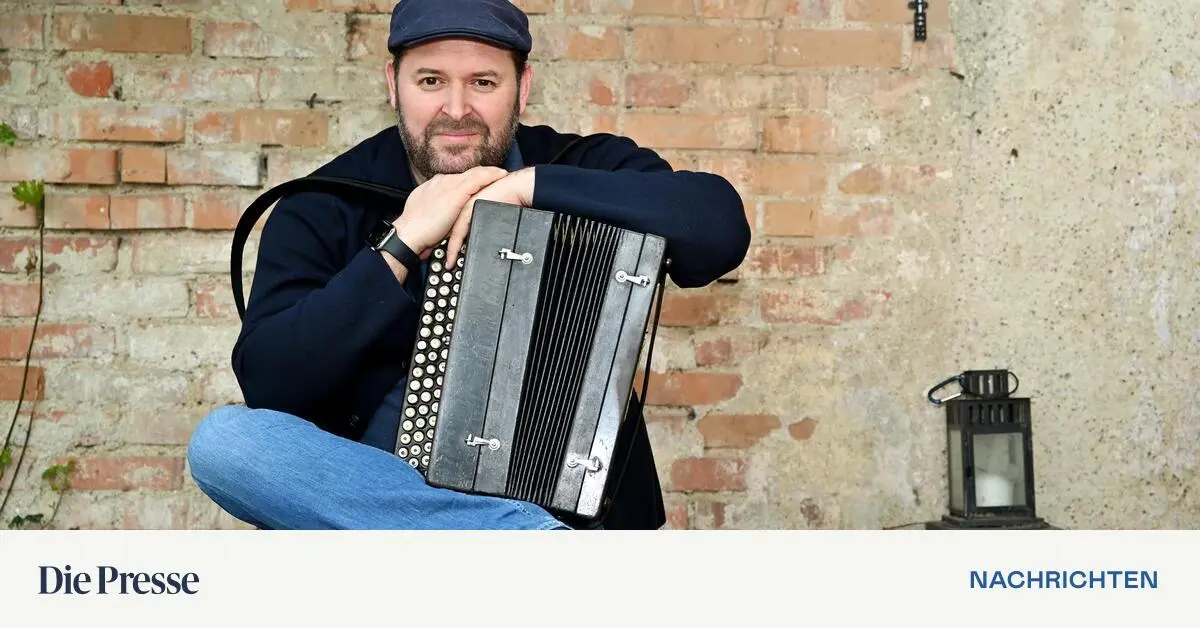
Coming from a musical family – his father ran a folk music trio – a small accordion was Stippich’s first instrument. He soon gave up because his sisters preferred the piano, which he soon began playing. The unexpected return to the accordion happened in 2010. “I saw Walther Soyka, who unfortunately died so early, live and had him show me his instrument. Pleased with my interest, he said he had something for me.” It was nothing less than a Schrammel harmonica that he gave him as a gift.
Stippich had its public premiere at a Tannhäuser production. Richard Wagner? “But where,” he waves, amused. It was a production of the Nestroy future farce “Tannhäuser or the Brawl at the Wartburg” in the Vienna Volkstheater. From now on he never put the instrument down. Things got really hot, for example at the Reichenau Festival.
Stippich, who sees himself as a composer and instrumentalist, has a soft spot for Viennese theater music. He completely misses something that is considered a basic requirement of Viennese life: the grant. He can only laugh at Nestroy’s bad temper. “I don’t have the time to fuss around. That’s the un-Viennese thing I have left.” And so it ultimately surprised him that he ended up in the Viennese song.
It was only in 2017, after a long stay in Graz, that he moved to Vienna. He is now the designated new director of the Vienna Volksliedwerk and therefore also the maître of the popular Wean Hean festival, which is taking place for the 26th time this year. He designed it together with the collective that has been responsible for it for years. In the same, as primus inter pares, Herbert Zotti acted from the Liebhartstaler Bockkeller for 35 years – a curiosity in that the house on Gallitzinstrasse does not have a basement and the Bockkeller venue is on the first floor. “Zotti achieved an incredible amount during this time. It took a lot of talent to turn the club into something great. The archive that he built up is simply incredible. There is a sheet music collection of 70,000 Viennese songs.”
As a musician who follows his own path, does he have the panoramic view to handle this task? The 47-year-old is sure of this, although of course he also wants to set priorities. Viennese instrumental music is particularly important to him. For some time now he has been celebrating this once a month on the so-called Schrammel Monday with his wife Maria, a subtly playing double guitarist, and the violin couple Monika and Peter Uhler. The collective calls itself Bravour Schrammeln and invites guests. Young guests too. Although he does note that “Viennese music needs a certain maturity”. But yes, there was already an electro evening with Viennese melodies. “The Viennese song can withstand a lot of craziness and has a lot to offer.”
What does it take to survive vitally? “Types, real characters. I worked with Robert Reinagl, who unfortunately died far too early, and he was the ideal mix of actor and singer.” Stippich, who enjoys working in the theater, for example in André Heller’s “Remassuri”, knows what is important so that you never get bored. “You have to reinvent the music every time in the moment. That’s a certain challenge. I’m very happy to take on it.”
To person
Helmut T. Stippich is a native of Carinthia. He is an accordionist and pianist, composer and instrumentalist and now leads the Viennese folk song work and thus the Wean Hean Festival. The festival will take place from April 21st to May 12th this year. The program can be found at under weanhean.at