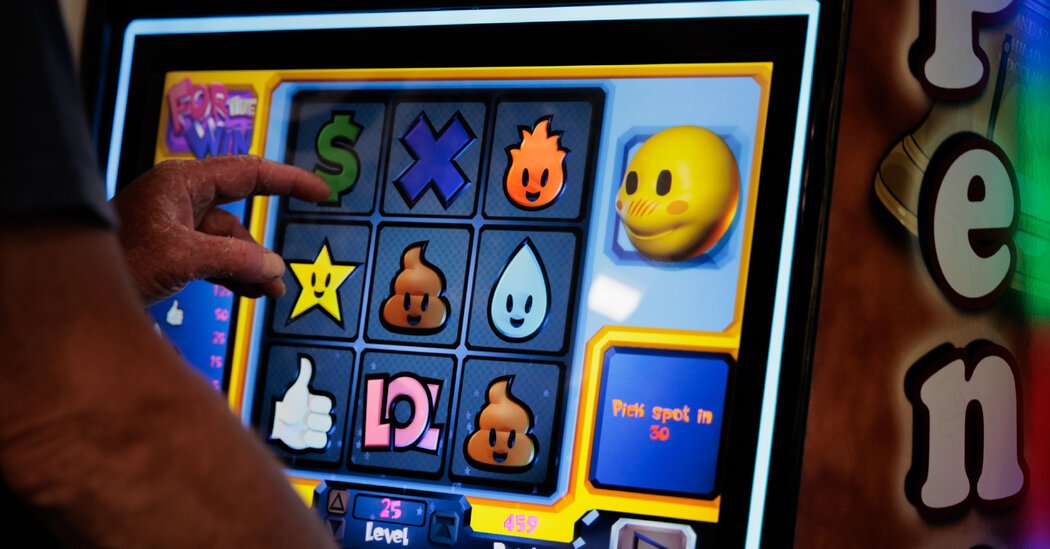
In June, the Pennsylvania Supreme Court ruled that skill games could not be distinguished from slot machines, and so could no longer be set up anywhere without a gambling license. But the court gave a 120-day grace period before the ban takes effect, and both Democrats and Republicans in the state Legislature are racing to pass laws that would save them.
The conundrum now facing Pennsylvania is part of the rapid expansion of legal gambling and gambling-like behavior across the country, from sports betting to prediction markets. The state now has an estimated 70,000 skill game terminals scattered around grocery stores, V.F.W. halls, pizza shops, bowling alleys, tanning salons, cigar lounges, hotel lobbies, barber shops, farmers markets, strip clubs and car towing garages.
Does the state let the court decision stand, leading to the removal of what will now be illegal gambling machines? Or does it fully legalize and regulate them, boosting tax revenue — and the state budget — while preserving valuable income for thousands of small businesses?
‘You keep saying “skill games”’
Pennsylvania’s skill game boom started in 2014 when Pace-O-Matic introduced its first machine to include the optional memory mini-game. The machines survived several lawsuits and seizures when lower courts ruled that the memorization aspect made them predominantly games of skill. Other manufacturers soon came up with their own copycat versions.
Kris Allan runs a vending machine company that installs and maintains the machines at no upfront cost in exchange for a split of the revenue. He says the highest-performing businesses are restaurants or bars, which often gross as much as $5,000 a month from the skill games. He also leases machines to laundromats, which generally don’t make as much, according to Mr. Allan, though he said he knows one that grosses about $8,000 a month from the games.
In Allentown, we visited five laundromats, all of which had skill games. We talked to several customers playing them while they waited for their clothes to dry. Most had never played the memorization portion of the skill game and assumed it was called a “skill” game because it takes skill to know when a machine is “hot” and ready to dispense a jackpot.
We also went to Big Valley Game Room, a strip-mall business in Allentown offering solely skill games. Dan Blount, a 71-year-old customer, said he did not know the distinction between slot machines and skill games.
“When you keep saying ‘skill games,’ it’s throwing me off,” he said. Though he plays the machines “every other day,” he didn’t know the memory game existed. “I lose 40, 50 bucks and then I’m gone,” he said.
Josh Ercole, executive director of the Council on Compulsive Gambling of Pennsylvania, said it’s hard to gauge the scope of skill-game addiction because many people who call the council’s hotline may refer to skill games as slot machines. Still, his agency’s data lists a ninefold increase between 2019 and 2025 of people who specifically reported skill games as their primary addictive gambling behavior.
“Regardless of what the legal system decides to assign as far as a name, there’s a lot of people that are struggling,” he said.
A ‘godsend’ to small businesses
Cherelle Parker, mayor of Philadelphia, applauded the court decision classifying skill games as gambling devices. She said in a statement that skill games were “predatory” and that they should be allowed only in private clubs and casinos.
But state politicians have been much more reluctant to favor a ban. Gov. Josh Shapiro has come out against an outright ban, saying the games should be regulated and taxed. (Profits from ordinary slot machines in Pennsylvania, located in regulated casinos, are taxed at 33 percent or more.)
Gene Yaw, a Republican state senator, is co-sponsor of bipartisan legislation to regulate and tax the games. He said legalizing them would also help protect jobs manufacturing the games, including those of a large game maker in his district.
Mr. Yaw’s regulation would add age minimums to the machine and permit them only in stores that already have age-check procedures for products (a bar would be allowed to have them, but not a carwash). The bill would also ban businesses that operate exclusively to offer skill games (several call themselves “Skill-sinos”).