Birdsong in the morning feels peaceful. Bird droppings, however, are usually treated as nothing more than an unpleasant mess. But on one tiny island in the Pacific Ocean, millions of years of accumulated bird waste created a natural treasure that transformed an entire country.
That country was Nauru.
At its peak, Nauru was one of the wealthiest nations on Earth. Its citizens paid almost no taxes, healthcare and education were free, and the government funded overseas medical treatment, university education and international travel.
For a brief period, this tiny island appeared to have discovered an endless source of prosperity.
But the same resource that made Nauru extraordinarily rich eventually destroyed much of its land, weakened its economy and left the country dependent on foreign assistance.
This is the remarkable story of the country often described as “the nation that ate itself.”
A Tiny Island Hiding an Enormous Fortune
Nauru is located in the Pacific Ocean, slightly south of the Equator. It is one of the smallest independent countries in the world, covering an area of only around 21 square kilometres.
For generations, the local population lived a relatively simple island life. Fishing, coconuts and the surrounding ocean provided most of what people needed.
There were no enormous cities, industrial centres or powerful monarchies. What the islanders did not know was that they were living above one of the richest phosphate deposits ever discovered.
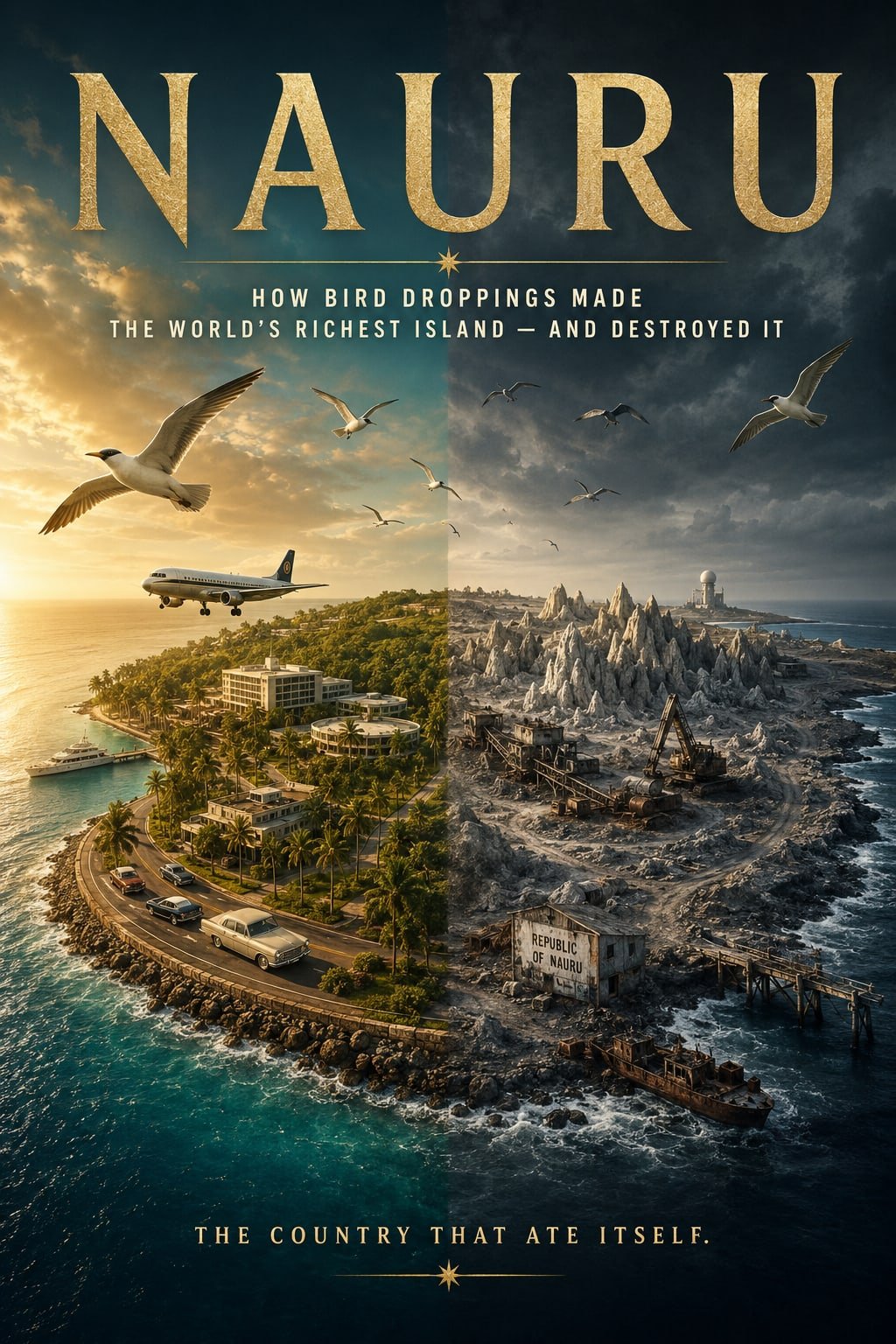
For millions of years, seabirds had stopped on the island during their long journeys across the Pacific. Their droppings accumulated and gradually transformed into deposits rich in phosphate.
Phosphate was extremely valuable because it could be used to produce powerful agricultural fertiliser. Before synthetic fertilisers became widely available, high-quality natural phosphate was considered an incredibly valuable resource.
To the people of Nauru, the pale rocks covering parts of the island appeared ordinary. To foreign companies, they would eventually look like mountains of money.
The Arrival of Foreign Powers
In 1798, British sea captain John Fearn sailed past the island. Impressed by its green landscape and the friendly behaviour of the inhabitants, he called it Pleasant Island.
European traders and settlers gradually began visiting the region. Along with commercial opportunities, they introduced alcohol, firearms and new forms of conflict.
During the late nineteenth century, tensions between local groups contributed to a destructive tribal conflict. Nauru was later annexed by Germany and incorporated into German New Guinea.
However, the island’s greatest transformation began around the start of the twentieth century.
A chemist named Albert Ellis reportedly examined a rock believed to have come from Nauru. After testing it, he discovered that it was not simply fossilised wood, as some had assumed. It was extremely high-grade phosphate.
Ellis travelled to Nauru and confirmed that the island contained enormous deposits of the valuable mineral.
Large-scale mining soon followed.
Nauru’s Land Becomes an Industrial Treasure
In 1906, the Pacific Phosphate Company began mining operations on the island. Forests were cleared, machinery was installed and enormous sections of land were excavated.
During the First World War, Australian forces took control of Nauru from Germany. The island was later administered by Australia, Britain and New Zealand.
These countries formed the British Phosphate Commission, which continued extracting Nauru’s resources.
For decades, foreign powers earned huge amounts of money from the island’s phosphate. The people of Nauru received only a relatively small share through royalties.
The situation temporarily changed during the Second World War when Japan occupied the island. Hundreds of Nauruans were deported, and many suffered severe hardship.
After Japan’s defeat, Australian administration returned and phosphate mining resumed.
However, Nauruans were no longer willing to accept limited control over their own natural wealth.
Independence and Sudden Wealth
During the 1950s and 1960s, a political leader named Hammer DeRoburt became one of the strongest voices demanding independence and control over Nauru’s phosphate industry.
Nauru finally became an independent country in 1968.
The newly independent nation gained control over phosphate production through the Nauru Phosphate Corporation. Instead of most profits leaving the country, a much larger share now went to the government and citizens of Nauru.
The transformation was astonishing.
During the 1970s and early 1980s, Nauru reportedly had one of the highest per-capita incomes in the world. For a country with a population of only a few thousand people, the money arriving from phosphate exports seemed almost unlimited.
Taxes were extremely low or nonexistent. The government provided housing assistance, free healthcare and free education. Students could receive scholarships to study in countries such as Australia.
When specialised medical treatment was unavailable on the island, the government could pay for patients to travel overseas.
Many residents purchased expensive cars, travelled internationally and enjoyed lifestyles that appeared impossible only a generation earlier.
In a 1982 article, journalist Robert Trumbull famously described Nauru as one of the world’s richest little islands.
However, beneath the luxury was a dangerous reality.
Nauru Was Digging Away Its Own Future
Phosphate was not a renewable resource. The deposits had taken millions of years to form, but they were being removed within a few decades.
Mining damaged much of Nauru’s interior, leaving behind sharp limestone formations and an almost unusable landscape.
Approximately two-thirds of the island was eventually affected by mining. Land that might once have supported vegetation or agriculture became difficult to restore.
The country was earning billions from its natural resource, but the resource was also destroying the ground beneath its feet.
Nauru’s leaders understood that phosphate would eventually run out. The government invested money overseas in real estate, businesses and other projects.
Unfortunately, many investments performed badly. Some were affected by poor management, questionable advice and excessive spending.
The government also supported expensive national projects, including an airline that struggled with debt.
Instead of building a stable economy that could survive after phosphate, the country remained heavily dependent on mining revenue.
The Collapse Begins
By the 1990s, Nauru’s most accessible phosphate deposits were becoming exhausted. At the same time, cheaper sources of phosphate were available elsewhere, including North Africa.
Revenue fell, but public spending remained high.
The government borrowed money to meet its obligations. Overseas investments failed to produce the returns that had been expected. Expensive imported goods continued to drain foreign currency from the country.
Nauru attempted to obtain compensation for the environmental destruction caused during the period of foreign administration. Australia later agreed to provide money for rehabilitation.
However, the damage was enormous, and no payment could easily restore land that had been mined for generations.
By the beginning of the twenty-first century, Nauru was close to financial collapse.
From Wealthy Island to Tax Haven
Desperate for new income, Nauru turned to controversial financial activities.
Thousands of foreign companies were reportedly registered on the island. Its banking system became associated with shell companies, secretive transactions and allegations of money laundering.
International pressure eventually forced Nauru to tighten its financial rules and abandon much of its tax-haven model.
The country then faced an even more difficult problem.
Its damaged land made large-scale agriculture nearly impossible. Much of its food had to be imported, making fresh produce expensive.
Processed and packaged foods became common. Combined with increasingly inactive lifestyles, this contributed to serious public-health challenges, including high levels of obesity and related illnesses.
The country that had once paid for overseas medical treatment now struggled to maintain adequate services at home.
Australia’s Offshore Processing Deal
In search of financial stability, Nauru entered agreements with Australia involving offshore processing facilities for asylum seekers.
Under these arrangements, some people attempting to reach Australia were transferred to Nauru while their immigration cases were considered.
In exchange, Nauru received substantial financial support.
The facilities became an important source of income and employment, but they were also surrounded by controversy. Human-rights organisations raised concerns about living conditions, mental health problems and the treatment of people held in offshore detention.
For Nauru, the arrangement reflected the country’s limited economic choices. After phosphate mining destroyed much of its productive land, foreign aid and Australian-funded programmes became central to the economy.
A Country That Consumed Its Own Foundation
Nauru’s story is not simply about people wasting money.
The island was exploited by foreign powers long before it gained independence. For decades, outside governments and companies removed valuable resources while local people received only a fraction of the profits.
When Nauru finally controlled its wealth, the country had limited time to prepare for the future. The resource was already being rapidly depleted, while the environmental damage was becoming almost impossible to reverse.
Still, poor investments, uncontrolled spending and weak long-term planning made the eventual crisis much worse.
Nauru converted its natural environment into temporary wealth. Once the phosphate disappeared, the country was left with damaged land, debt, dependence and few economic alternatives.
Final Thoughts
The rise and fall of Nauru is one of the clearest examples of the resource curse—a situation in which natural wealth brings short-term prosperity but creates long-term economic and political problems.
Bird droppings made Nauru extraordinarily rich.
Foreign powers exploited that wealth. Independence allowed Nauruans to finally benefit from their own resources, but the money was not invested successfully enough to secure the country’s future.
Today, Nauru remains an independent nation, but the physical and economic scars of phosphate mining are still visible.
Its story carries a warning for every resource-rich country:
Natural wealth is not the same as permanent prosperity. When a nation destroys the foundation beneath its economy without building a replacement, even an enormous fortune can disappear surprisingly quickly.