From Shpiragu to EastMed-Poseidon, from the Trump-Soros lobbies to the symbolism of the “Flamingo”, the clash for the south of Albania is seen as part of a much bigger geopolitical, energy and financial game than it appears on the surface.
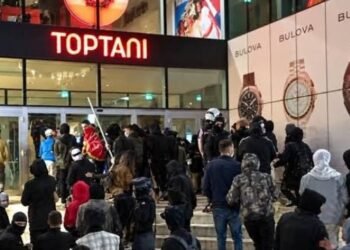
The protest that has been taking place in Tirana for more than a month has already left behind its initial cause. Some of the people involved in it are increasingly dealing with personal ambitions, coming to the fore and trying to win what they have dreamed of as a political career.
The parties that support him, starting from Sali Berisha to other factors that have invested people, structures and financial resources, aim to receive the political reward they have sought, either from their big supporters, or from Edi Rama himself, as has usually happened in Albanian politics.
Meanwhile, the main issue, the cause that shocked public opinion and placed Albania for several days at the center of international developments, has been left in the shadows. However, in all likelihood, she is expected to come back much stronger in the fall.
It is about Zvrnec and the plan for a mysterious investment, which is said to be worth more than 4 billion dollars. A figure that exceeds even the annual budget of the Albanian state a decade ago.
It is here that the symbols and codes that connect finance, power and organized crime are hidden.
A trio that in modern history has coexisted continuously, sometimes producing winners and losers, sometimes only changing roles.
To understand this clash one must look behind the scenes.
Everything leads to one conclusion: huge financial interests are behind it.
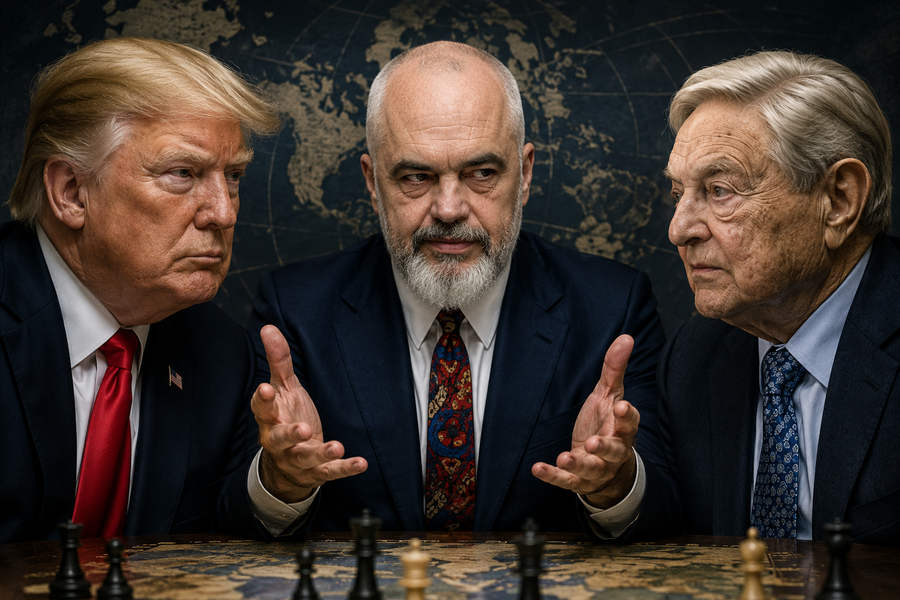
On one side stand two of the most powerful centers of influence in the world.
The Trump family lobby.
And the lobby associated with George Soros.
Two gravitational centers of economic and political power, which today strongly influence the international right and left, respectively.
And, ironically, their common point of collision seems to be Albania.
Namely Edi Rama.
If you follow this background carefully, you realize that the story is much deeper than it seems.
It starts at the foot of Mount Shpirag.
In the summer of 2024, the energy giant Shell officially announced that very large reserves of high-quality oil were located in the area.
The declaration created tremendous euphoria.
Edi Rama started talking about sovereign funds and projecting Albania as a big energy producing country.
But very soon everything changed.
Shell withdrew, stating that the project was no longer economically viable.
However, the oil did not disappear.
She continues to be there.
Like in Basilicata, Italy, where oil of the same quality has been extracted for years.
This makes the conviction even stronger that behind this development are not only technical reasons.
At that time, in the districts near Sali Berisha and Ilir Meta, there were rumors that networks connected to George Soros were behind the interest in Shpirag.
Voices that did not receive much public attention.
But the developments that followed made it even more interesting.
Precisely in the period when the potential of Shpirag was being talked about, the US Secretary of State, Antony Blinken, paid a visit to Albania.
After the meeting with Edi Rama, he also had a meeting with Erion Veliaj, in the presence of Ambassador Yuri Kim.
A few months later, Jared Kushner, Ivanka Trump and Richard Grenell arrived in Albania and held meetings with Edi Rama.
Three important developments then occurred.
Shell withdrew.
The project for Zvrnec and Sazan was announced.
And the political and criminal attack on Erion Veliaj began.
In the same period, Yuri Kim moved into the private sector, taking a management position with ExxonMobil.
In diplomatic circles, there was talk of a strong battle between major energy interests around Shpirag.
According to these interpretations, Shell’s withdrawal was not just an economic decision.
It was connected to much larger geopolitical clashes.
In this logic, Donald Trump’s lobby is seen as the main supporter of the traditional American oil and gas industry.
An orientation that became even more visible after his approach to the neoconservative wing of the Republican Party.
In this context, the EastMed-Poseidon project was also reactivated, the pipeline that aims to transport Israeli gas to Europe.
Its line passes by the Channel of Otranto, very close to the Gulf of Vlora, Sazan and Zvrnec.
Exactly where the flamingo symbol was born.
For most people, the flamingo is associated with the characteristic bird of the lagoon.
But the metaphor can also be read differently.
The Flamingo was the name of the legendary Las Vegas hotel, inaugurated in 1946.
The hotel was run by Bugsy Siegel, while behind it stood Meyer Lansky, one of the most famous figures of the American mafia.
Later, Lansky and Lucky Luciano cooperated with American authorities during World War II in operations against Nazi Germany and the landings in Sicily.
According to this interpretation, the metaphor of “Flamingos” in Zvrnec e Sazan is related to the project for the construction of a tourist and financial center of international proportions, where global capital, legal and that of dubious origin, would circulate together, as it once happened in Las Vegas.
If the EastMed-Poseidon energy corridor, which passes by the Bay of Vlora, is added to this mosaic, then the whole area takes on an extraordinary strategic importance.
A territory where the interests of major powers, energy companies and the world’s most important intelligence services would intersect.
And maybe that is where the true meaning of the “Flamingo” metaphor is hidden.
A metaphor that many use.
But very few explain it./ PamphletThe