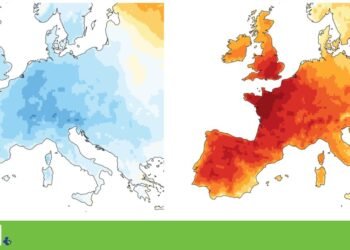
There are games that can be won with technique, others with tactics, some with endurance. The 2026 World Cup could also be decided by a less controllable factor: the heat. In a tournament extended to 48 teams and 104 games, distributed between Canada, the United States and Mexico, extreme temperatures are no longer a detail but a persistent protagonist and, more importantly, a danger. A danger for those on the field, but also for the fans. Portugal, scientists warn, is the team in its group most exposed to the risk of excessive heat.
One study from Climate Central, released this month, concludes that “the climate change are increasing the likelihood of heat capable of reducing players’ performance in 97 of the 104 games in the 2026 World Cup”, putting not only performance on the field at risk, but also the safety of fans.
The Portuguese team deserves emphasis in this study. In case of Portugalthe first scheduled game “presents a 96% probability of heat occurrence capable of affecting the players’ performance — a value five percentage points higher due to climate change”.
This game will take place at Houston stadiumwhich is air-conditioned, but Climate Central researchers still consider the risk of thermal stress to be high. Even if the game is played in an air-conditioned environment, the body may already be under accumulated thermal stress, the experts justify, adding that “players and fans in several 2026 World Cup venues, including Dallas, Houston, Miami and Monterrey, regularly face levels of humid heat in June and July that put players at risk, with wet bulb temperatures of 28°C or higher”. The first three games have a greater than 95% probability of “risk of performance-damaging heat.”
According to Climate Central, the This trend continues throughout the group stage and “all of Portugal’s games have a probability of greater than 50% of performance-limiting heat”, with the team being “more exposed within its group, with an average probability of 96% in these matches”.
If, even so, Portugal defeats this invisible opponent and reaches the final, there is one more confrontation waiting: “If Portugal reaches the final, they will play six games in which there is more than a 50% chance that the heat will affect performance. And three games in which climate change is increasing that probability by at least ten percentage points”, refer to the predictions from Climate Central researchers.
Games in dangerous conditions
According to the same analysis, “researchers assessed the likelihood of temperatures exceeding 28°C — a threshold associated with reduced performance — and found that virtually all games now face an increased risk of these conditions.”
This indicator confirms a concern already known in high-performance football: temperatures above 28°C reduce the frequency of sprintsthe total distance covered and recovery time, directly affecting the pace of play, tactical options and style of matches.
The data from the Climate Central study also details the degree of exposure: “Ninety-seven of the 104 games are more likely to face performance-limiting heat due to climate change” and “almost half of the games have at least a 50% chance of taking place in these conditions”. In 26 games, this risk “increases at least ten percentage points due to the effect of global warming”.
According to one another study from the World Weather Attribution (WWA) collective of scientists, around a quarter of the games — 26 matches — will, in fact, be played in conditions considered dangerous according to the Globe Temperature and Wet Bulb index (Wet Bulb Globe TemperatureWBGT, its acronym in English), the global reference measure for assessing human thermal stress in extreme heat environments, which combines temperature, humidity, solar radiation and wind. Therefore, these are not simply “hot” days, but rather levels of thermal stress capable of affecting performance and threaten health.
This indicator reveals a less intuitive reality: a seemingly moderate air temperature can actually become unbearably hot or even deadly when combined with humidity. A value of 28°C WBGT, for example, can be equivalent, in practice, to 38°C in a dry environment.
The climate crisis and football sponsored by oil companies
The climate crisis is clearly affecting many of the conditions on which we depend to (sur)live, but also other dimensions of collective life that many value, such as football.
Since 1994, when the United States last hosted the competition, “the risk of a heat wave has doubled” due to climate change, warns Simon Stiell, UN responsible for climatecalling for “faster action to protect the sport we love”.
“It’s hot for the players, for the fans, for everyone. It’s hot and it’s getting hotter. It’s no coincidence. It’s climate change. The planet is warming up after more than a century of burning fossil fuelssuch as coal, oil and gas. This traps heat in the atmosphere. And now we’re feeling it — everywhere,” says Simon Stiell in a video statement.
In this case, we are not facing a probability, but a scientific consensus. “Our investigation shows that climate change has a real and measurable effect on the feasibility of hosting summer world championships in the Northern Hemisphere”, says Friederike Otto, climatologist at Imperial College London, regarding the WWA study.
It is still unusual that, so affected by the climate crisis, the 2026 World Cup counts among its main sponsors Saudi Aramco, the largest oil company in the world, responsible for more than 4% of all global greenhouse gas emissions since 1965, according to the initiative’s estimates. Carbon Majors. In Portugal, the national oil company, Galp, is also one of the main sponsors of the national team. In addition to this fact, it is also impossible to ignore the contribution of this competition to the high CO2 emissions it brings with it.
More heat, less football
On the ground, the impact will be visible: the intensity drops, the pace slows down, effort management becomes central. In simple terms, heat is a game changer. Less sprintsless pressure, more breaks — formal and informal. We will therefore have a high probability of watching less intense games, with muffled and slower football due to the heat.
As Stiell describes, “that means more extreme heat, more fatigue, more difficult decisions and slower reactions”, affecting players and fans. Researchers report that heat stress and heatstroke affect athletes’ cardiovascular, muscular and central nervous systems, particularly their ability to make decisions.
Players know this from their own experience. In an open letter, they warn that heat stress “can cause a feeling of fainting, dizziness, fatigue, muscle cramps and even more serious problems”, stressing that “we are able to run less and it becomes impossible to play with the same intensity”.
The institutional response, for now, involves adaptation. FIFA introduced mandatory three-minute hydration breaks in each half, “regardless of weather conditions”. The calendar was adjusted, favoring, whenever possible, covered stadiums and less exposed times. Still, the limitations are evident.
Some games will be played in particularly vulnerable cities, such as Miami or Kansas City, in open stadiums. And there is a fact that worsens the equation: around five matches could exceed 28°C WBGT — a threshold that the players’ union considers unsafe to the point of recommending postponement. For some researchers, this red line is even a little lower, at 26°C.
Protective measures?
If within the four lines there are medical teams, breaks and constant monitoring, outside of them the scenario is more uncertain. “Players are protected by medical teams. Fans are often not.”
Fans will express their enthusiasm in open-air stadiums, open spaces, queues, transport and other moments of prolonged exposure to risk, especially for the elderly, children and people with chronic illnesses.
All fans will be permitted to bring in one, soft, plastic, 20 ounces (590ml), factory sealed disposable water bottle into any FIFA World Cup 2026 match in the USA and Canada. ?
As FIFA World Cup 2026 Chief Operating Officer, Heimo Schirgi, explains, fans will not be permitted… pic.twitter.com/ePEHq9oalJ
— FIFA (@FIFAcom) June 5, 2026
In fact, for fans, FIFA reserved a last-minute surprise, announcing, without much explanation, that it would be prohibited to bring bottles of water into the stadiums. Faced with criticism, he ended up changing his mind and announced on his social networks that fans can take a disposable water bottle, made of soft plastic, with a capacity of 590ml, sealed, to any game.
The 2026 World Cup appears as a turning point, not just for elite football, but for the entire world. ecosystem sporty. This is a structural trend that makes heat more frequent, more intense and more dangerous.
Simon Stiell reminds us that the heat problem goes beyond sport: “It’s not just the things we love, like football, that are at risk — it’s also the living conditions we all depend on.”
The answer is clear: “We know how to solve the climate crisis — abandon fossil fuels and accelerate the transition to clean energy.”
Football adapts: adjusts schedules, creates breaks, reviews protocols. But the idea repeats itself: adaptation is not enough. As long as emissions continue to warm the planet, heat will continue to be an adversary. And there is also an appeal: “If those who love football mobilize to protect it, this could change the game”, recalls Simon Stiell.
In 2026, he will be on the field in every game. Invisible, impartial, ruthless — and impossible to replace or send off with a red card. It is the planet that shows us the serious collective misconduct card.