Loading Text-to-Speech…
When grandma started to forget, I was gradually entering puberty. Me in a universe of alertness and constant discovery. She on the threshold of a new uncharted spiritual weakness. “More cars from people,” she would say with a smile every time we went for a ride in the car. The humorous find was admittedly successful and somewhat prophetic. Except that in every alley, at every turn, every two minutes it was repeated.
Can we describe dementia if we don’t experience it? Many times in everyday life, the day-to-day leads us astray, we waste time on nonsense or forget the names of favorite movies, to the point where we wonder how it is possible to miss something so obvious. We will make the well-known joke about “Alzheimer’s principles”, but we are immediately starting the reconstruction procedures. We remember the movie whose title tormented us, we organize our time, we limit our binge-watching. We remain “safe”, there is still a “map” in our thinking, in our senses, in our memory.
When does the end begin?
The beginning of dementia for the grandmother Eleni-Efimia Andronidouborn in Polis in 1924, appeared about two decades ago and seemed indeed uncharted. And it was, at least for us who in this eleven-year journey of hers to the end experienced her as caregivers-observers. As for her, we will never know how, at what precise point in time, and ultimately if the compass of thought, of consciousness, of connection with the outside world was completely lost.
As a child in the four of us I tried to stretch the rope of her memory, having the illusion that I was accomplishing something, that “there is improvement.” It didn’t exist. But the attempts were not always in vain. At noon at her house in Agia Varvara, watching sports, I would ask her what team she was on, eliciting the answer. “My Perea, my Perea with your Saronic,” he would sing. She grew up in Piraeus after coming from the city in 1925. Her customs officer father had just died and the whole family moved to Greece. “Well, since you were born in Istanbul, aren’t you AEK?”, I insisted, even though I was satisfied with our identification as fans. She was answering in the affirmative – in hindsight – probably because she didn’t want to upset me for asking, not because she harbored any secret yellow-and-black feelings.

Dementia, they say, can cause hallucinations, dysthymia, violence and aggression. In her case it multiplied laughter, kindness, positive thinking. In fact, the family’s recent in-depth look back at her journey with dementia began as an attempt to recall just those rants – the fragments of speech that the illness brought to the surface. Somewhat paradoxically, but after all her repetitions, which often bore us, have taken root as a common code of domestic communication, even nearly a decade after she has passed away.
“Voodoovarseni, voodoobarbeni”, she used to monologue in her little cul-de-sacs, or so I was mistakenly impressed by this saying as a child. He wanted to say in Turkish: “On which wall should I hit my head?” During the -many and repeated- toasts on the tables, he wished “to the health of the one who drinks it and does not leave a knot”, while at an unsuspecting time, when there was some silence, some daylessness, some blurriness would find a way out: “This is what Karas said and the foukaras shook it”, commenting afterwards “let him not say it, let him not shake it”.
The withdrawal
Of course, dementia wasn’t all sayings and rhymes. In the first period, it was missed calls, which signaled the alarm, and my father’s emergency and distressed routes to her house to see if everything was okay. He usually found her in a state of bliss on the balcony gazing out, while all the shutters in the house were open. Lavish political meals were replaced by pre-cooked food and frozen pies. The will weakened, the crossword was neglected, canaries were no longer accommodated in her yard. No more birthday presents, no more visits.
Painful Visits – Visits to the nursing home seemed awkward to me. As if we had to do a forced exercise once a week to reinforce that old age is painful, that human decay can even resemble a horror movie.
The last time she went on vacation alone, the psychiatrist son would have realized that this cycle had closed. It was also the only time he got angry with her when he was packing his return bags, maybe because he was also coming face to face with reality. He would undertake it medically, personally and exclusively. “It was just me and her in it,” he told me, years later, moved.
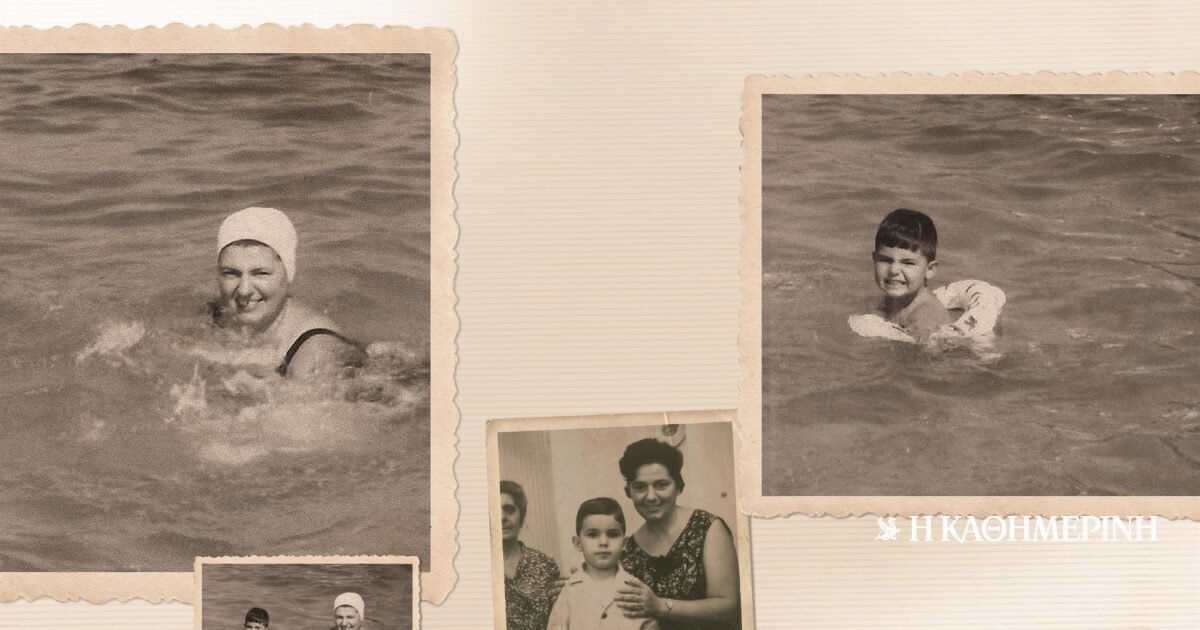
For most of our life together, Grandma Eleni was oblivious. After a point, he was oblivious to almost everything except us. I put up with it and her dementia became normalcy for the grandchildren. For him, however, the memories that “faded” in her own mind overemphasized her pre-dementia identity: she was his mother. The childhood holidays in Loutraki with the inflatable fish that never parted, the radio days where they listened together to the AEK basketball saga in 1968 and the Polytechnic station a few years later.
The stories from the battles of the Decembrians and from his visit Tyrone Power in Athens during the Civil War. Her inexhaustible knowledge of old cinema: Gary Cooper, her lover Clark Gablehim Fred Astaire and the Marlene Diedrich. The theater, the favorite of Vassilis Logothetidis, the “controversy” between Kostas Kakkava and to Andreas Barkoulis – she was “barculic”.
In the nursing home
Three years after dementia first knocked on her door, excruciating lower back pain worsened. The nursing home was initially a somewhat temporary solution. Until it became permanent. Her daily desire to return home turned into a tacit acceptance of the new condition, and the “nursing home” was transformed through her positive outlook into a chic hotel that hosted her – now – endless vacations. The paper calendar in her home would long point to the same day – the day she said goodbye and was never seen again.

The visits to her new “home” seemed awkward to me. For my little sister they were rather unbearable. As if we had to do a forced exercise once a week to reinforce that old age is painful, that we won’t be young forever, that human decay can even resemble a horror movie.
During those visits I noticed the grandmother’s gaze disappearing into nowhere. Sometimes she became sad or tearful when she looked back at the fragments of memory from the past that were still clumsily saved. To her mother, to her family from Polis, to the corners of Piraeus where she spent her youth. However, she quickly mobilized when we surrounded her.
The awareness of loss – “I have lost power,” she would say to my father in an unexpected moment of self-awareness, peace and sobriety. This phrase probably sums up dementia as a condition: loss of power,
initiative and will. Life empowered.
The new recurring pattern as I got older was “which girl is going to pick you up”. I often thought: “Does he know where he is, what he is experiencing?” A tease, a playful quip overshadowed any sad thought, before her gaze was lost again in a sight and a calculation unknown to us.
In the last months of her life, the deterioration of the mind was accompanied by the incurable deterioration of the body. Even so, less vividly, with her voice struggling to come out, some other line from the past “awakened” and formed an indistinct smile on her suffering face as she uttered it. “I have lost power,” he would say to my father in an unexpected moment of self-awareness, peace and sobriety, amidst the bedridden and pain. This phrase probably sums up dementia as a condition: loss of power, autonomy and will. Life empowered.
In the last stanza before the end, he would recall more and more often, without occasion, without context, a verse-celebration of life and hymn to love. “My dark face, if you wear red, you bring the dead and the dead from Hades.” The degeneration of the disease and its deforming power did not completely “contaminate” her. And that was her goodbye.