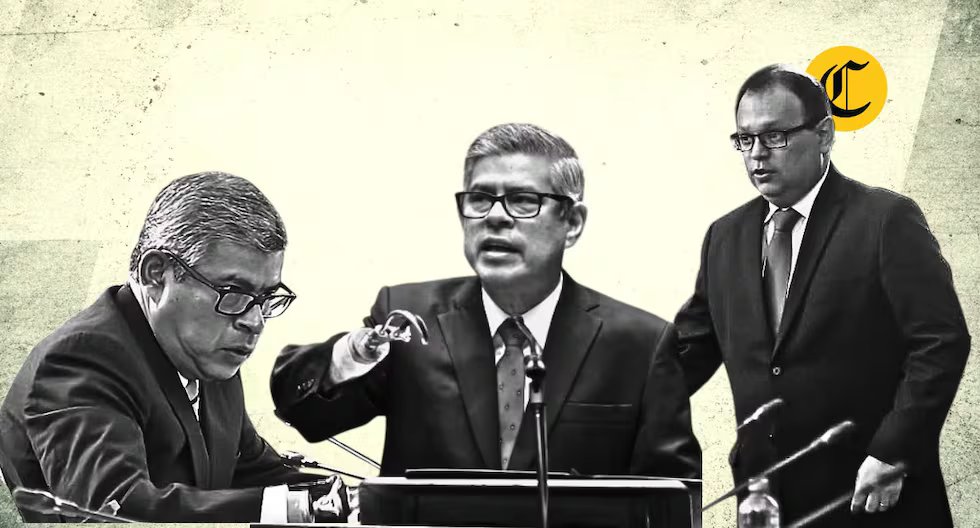
After 73 days of management, the president of the Council of Ministers, Luis Galarretawent yesterday to the Senate Constitution Commission to present and request the incorporation of legislative powers that were excluded from the opinion approved by the plenary session of Deputies.
He head of the Ministerial Cabinet He explained to the members of the working group the need to have measures such as strengthening the intelligence system and declaring groups hostile to criminal gangs.
The first proposal seeks to restore the operational capacity of the National Intelligence Directorate (DINI), while the second proposes specifying the legal criteria so that the Armed Forces can act directly against criminal organizations.
Galarreta made it clear that the Government will act against crime with or without the powers, although he highlighted that the delegation would allow actions to be accelerated against insecurity.
“Of the eight matters, in the opinion approved in the Chamber of Deputies (…) for us it is not enough as an Executive,” he said.

During the first part of his presentation, Galarreta stated that only 20 faculties were approved, distributed in six subjects, and not in the eight that the Executive’s original project contemplated.
“Can things be done without powers? Yes, and they are done from day one regarding security and the El Niño phenomenon,” he highlighted.
The prime minister explained that strengthening intelligence would reduce the risks for police and military personnel who act directly against criminal gangs, with the aim of killing or arresting their members.
“We would not run the risk of our police and military falling. Intelligence allows us to have zero external problems,” he said.
He also defended the designation of hostile groups for criminal gangs, considering that this would allow the Armed Forces to act against them “because we are at war.”
According to the explanatory memorandum of the legislative proposal, this declaration would allow the Armed Forces to intervene in cases of illicit drug trafficking, terrorism and illegal mining, as well as in the protection of strategic facilities for the functioning of the country, among other cases.
In turn, Minister Marco Vinelli detailed the powers that were left out of the opinion approved by the Chamber of Deputies. In criminal matters, 12 of the requests were approved; in productive development, six of 19; and in tax matters, one of five.
In structural reform, one of the nine requests was approved, while in housing and sanitation, four of the seven requested powers were included.
Vinelli explained the need to modify the legislation to speed up the titling processes, which currently take more than 400 days and which, with the proposed changes, could be reduced to 90.
He also proposed modifying the Seed Law to benefit small farmers, as well as introducing changes to the Agrarian Cooperative Law and the regulations on agricultural health and agri-food safety. Added to this was the strengthening of surveillance against pests.
“These mechanisms that have been withdrawn from deputies, we believe that it is important that the Senate Constitution can evaluate them not only to confront the El Niño phenomenon, but to give more effectiveness to agricultural public policies,” he said.
The presence of Galarreta and the ministers also generated questions from left-wing legislators, who sought to focus the discussion on the scope of the powers that the Senate can modify.
One of them was Humberto Morales, from Together for Peru, who assured that his “democratic patience” was running out.
“The opinion only says that there are two issues that we must debate,” he indicated.
The same parliamentarian later starred in a tense moment with Senator Lourdes Alcorta, who described him as “false and spoiled” in the middle of the exchange of words.
Morales asked the president of the Constitution Commission, Carlos Mesía, for Alcorta to withdraw the expression. The senator, however, responded: “What has been said is finally said.”
Later, Morales distinguished between the functions of senators and those of ministers, remembering that the latter are not elected by popular vote. Alcorta responded again: “You feel above the world. This is not like that. (…) Do not feel like the king of the square because it is not like that.”