Cross-cultural educational training ended in Dushanbe festival “New Day” – an event that has become more than just a program for schoolchildren. For several days, the festival transformed the city into a living educational environment where children could explore, create, ask questions, try out new roles and look at the future in a new way.
The festival was implemented by Teach For Tajikistan together with the Ministry of Education and Science of Tajikistan and the Center for Additional Education of Children and Adolescents under the Ministry of Education and Science of the country. The general sponsor and co-organizer of the festival was NERU company.

Help your child see possibilities
The main idea of the festival is simple and very important: education should help a child see his or her possibilities more broadly. Not only learn from a textbook, but also understand the city, technology, culture, profession, teamwork and your own role in the future of the country.
For Teach For Tajikistan, the New Day festival is a continuation of the approach in which the child is at the center of the educational process. The organizers note that modern educational formats should give children not only knowledge, but also experience. Experience creating, communicating, researching, presenting your ideas publicly, and interacting with real professionals.

This is why the festival was built around workshops rather than lectures. During the program, children chose directions, worked with masters, tried themselves in different fields and learned to look at the world around them as a space of possibilities.
For some it was their first experience in media or theater, for others it was an acquaintance with artificial intelligenceVR, robotics, design, urban environments or visual arts. But for all participants, it was an experience in which they could feel that their ideas matter, their voice is heard, and the future can not only be expected, but also created.
The NERU company played a special role in the implementation of the festival. NERU’s support was not just a financial contribution to the event. The company acted as the general sponsor and co-organizer of the festival, and its participation became a meaningful part of the conversation about the city of the future, safety, technology and responsibility to the new generation.
A safe city is not an abstract concept
Today NERU is associated with topics that are directly related to the development of the modern urban environment: safe city, technological solutions, urban infrastructure, digital services, electric filling stations, parking systems. This is why the partnership between NERU and the New Day festival turned out to be so organic.

Through the festival, children got the opportunity to see that a safe and modern city is not an abstract concept. It is a system of decisions, technologies, ideas and human responsibility. This is a city where not only roads and buildings are important, but also safety, sustainability, accessibility, convenience, digital tools and attention to people.
One of the most powerful parts of the festival was connected with this. Participants got acquainted with the Smart City, saw how the concept of a safe city can work, and were able to look at Dushanbe not only as residents, but also as future creators, researchers and participants in urban change.
This became an important educational experience for the children: they saw that technology can not be complex, but understandable and useful. Cameras, digital services, smart parking, electric gas stations, urban mobility, safe infrastructure – all this has become part of the conversation about what Dushanbe could be like tomorrow.
Connect children’s creativity with real urban agenda
This theme received a creative continuation in technology workshops. The children discussed how the city can be made more convenient and safer, how artificial intelligence can help people, how VR allows us to imagine future spaces, how robotics can be connected to everyday life, home, parking, roads and the urban environment.
This is how children’s ideas related to a smart city, safe spaces, green technologies, urban infrastructure and services for residents appeared.
It is important that ready-made answers were not imposed on the children. They were given the opportunity to see real examples, get inspired and try to come up with their own solutions. This is precisely the value of such educational formats: the child not only learns new things, but begins to think like an author.

NERU has become more than just a partner in this process. The company became part of the semantic framework of the festival. Her participation helped connect children’s creativity with the real urban agenda: safety, technology, green mobility and a responsible attitude towards the future of Dushanbe.
Of particular importance was the excursion to NERU electric filling stations. For the participants, this was an introduction to how modern city services work, why electric transport and green technologies are becoming an important part of urban development, and how business can participate in creating a more environmentally friendly and modern infrastructure.
This experience is especially important for teenagers. At this age, an idea of the profession, society, one’s own capabilities and the future is formed. When a child sees real companies, real technologies and real city solutions, he begins to understand that the development of a country is not something distant. This is something in which he himself may one day participate.
In this sense, NERU’s participation in the festival became an example of modern corporate social responsibility. Not formal, not one-time, but connected with real meanings: children, the city, technology, safety, education and the future.
“So that children feel like the authors of ideas”
By supporting the New Day festival, NERU helped create a space where schoolchildren could touch the topics that shape the future of Dushanbe. This is a contribution not only to the event, but also to the formation of a generation that will better understand the city, technology and their responsibility for the environment in which they live.

As co-founder and CEO of Teach For Tajikistan Matluba Salikhova notes, it was important for the team that the festival become not just a bright event, but an experience that changes a child’s view of himself and the city.
“We wanted the children to feel like they were the authors of the ideas. So that they can see: the city is not only a space for adult decisions. This is a place where every child’s perspective, his question, his dream and his ability to create are important. NERU’s support made it possible to connect education with the real urban agenda – a safe city, technology, green mobility and the future of Dushanbe,” she noted.
But the strength of the festival was not only in the technological part. “New Day” brought together ten workshops, each of which revealed children in their own way. Urban studies helped me look at the city more carefully. The media taught us to ask questions and tell stories. Cinema made it possible to see the world through the frame.
Theater helped me work with my voice, body and confidence. Design and merch turned ideas into real objects. Urban sculpture gave shape to the collective imagination. Digital, VR, robotics and artificial intelligence have shown that technology can be a tool for creativity and change.

Each workshop was important because every child is different. One needs to go on stage to believe in himself. Another is to take an interview to learn how to talk to people. The third is to assemble the object with your hands. The fourth is to see the city through VR or come up with a digital solution. The festival gave children a space of choice – and this was precisely its main educational result.
The live voice of the festival
Separately, it is worth noting the media workshop, which has become a kind of living voice of the festival. Participants interviewed craftsmen, children and guests, collecting emotions, impressions, questions and feedback. Through their work, the festival told about itself – not dryly and formally, but vividly, through the faces, reactions and stories of the participants.
In the design workshop, children created products with the integration of the general partner: T-shirts and shopping bags with NERU logos. It was not just souvenir products, but the result of children’s work – from the idea to the visual solution. The finished products were released and donated to the festival partners, becoming a symbol of how children’s creativity can turn into a real product.
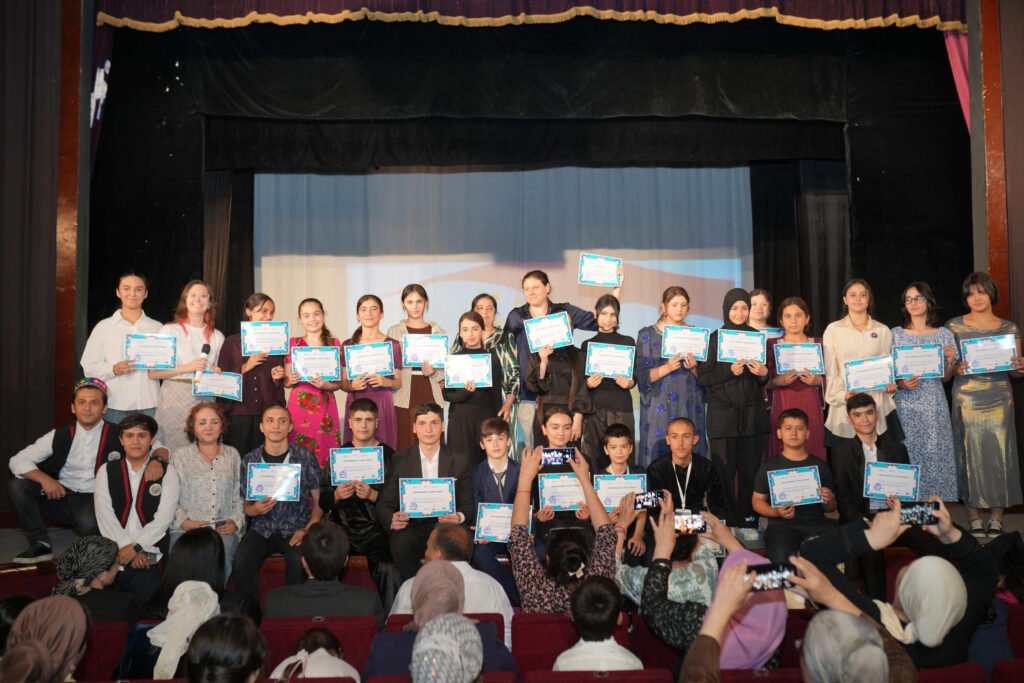
The final day of the festival took place on May 10 at the Lukhtak Puppet Theater. This space became an important and symbolic platform for the end of the festival. It was there that the children presented their works, ideas, visual materials, stage formats and the results of the week-long educational process.

The final festival-exhibition became a moment of recognition. The children saw that their work matters. Parents, partners, guests and masters saw how seriously schoolchildren can work if they are given trust, space and support. And the city saw children not only as students, but also as authors, researchers and participants in the cultural life of Dushanbe.
The common goal of the partners is the development of children
The festival was made possible thanks to the collaboration of many parties. In addition to the general sponsor and co-organizer NERU, important contributions to the implementation of the festival were made by the companies Marmari, Siyoma, AKIA Avesto, BOXSTORE, the Lukhtak Puppet Theater, as well as UNDP in Tajikistan with the support of Russian trust funds.
BOXSTORE provided the workshops with half a ton of cardboard, which became an important material for creating objects, models and installations. Marmari, Siyoma and AKIA Avesto supported the festival and helped create conditions for its implementation. The Lukhtak Theater hosted the final day of the festival, becoming a platform where children’s ideas were presented to a wide audience. UNDP participation in Tajikistan, with the support of Russian trust funds, increased the educational and social significance of the project.

This circle of partners shows that the development of children is a common task. The state, educational initiatives, business, international organizations, cultural venues and professional communities can together create an environment for children in which they grow not only as students, but also as future citizens, specialists and leaders.
For Teach For Tajikistan, the New Day festival was proof that Tajikistan has enormous potential for new educational formats. Formats that do not replace school, but strengthen it. Formats that return children’s interest in learning through practice, creativity, the city, technology and live communication with professionals.
For NERU, this festival became an example of how business can be a participant in the development of the city not only through infrastructure, but also through investments in children. A safe and modern city begins not only with cameras, parking, services and charging stations. It starts with a generation that understands why all this is needed, knows how to think about the city and feels responsible for its future.

The New Day Festival has ended, but its significance extends far beyond just one week. He showed that children are willing to talk about serious topics if you talk to them seriously. They are ready to create if you trust them. They are ready to think about the future if they are given the opportunity to see themselves as part of it.
And perhaps this is precisely the main result of the festival: a new day begins when a child first understands that he can not only live in the city, but also one day change it for the better.