Pacific advocacy is sharpening that distinction. At a roundtable (Opens in new window) at the Australian Pavilion on 14 November, the Pacific Political Champions called for accessible, grant-based finance, stronger community resilience and action to keep 1.5°C within reach. Marshall Islands minister Jess Gasper Jr, the group’s adaptation champion, drew on his Bikini Island heritage when discussing displacement. The historical causes are different, but the point holds: losing access to home involves identity, belonging and political rights, not simply the replacement cost of buildings.
My assessment, informed by work on development and financing questions in the Pacific, is that adaptation should be judged by how well it preserves people’s choices. Can a community remain safely where it is? Can essential services continue during disruption? If movement becomes necessary, can people influence its timing and terms? These questions offer a more demanding measure of resilience than counting completed infrastructure.
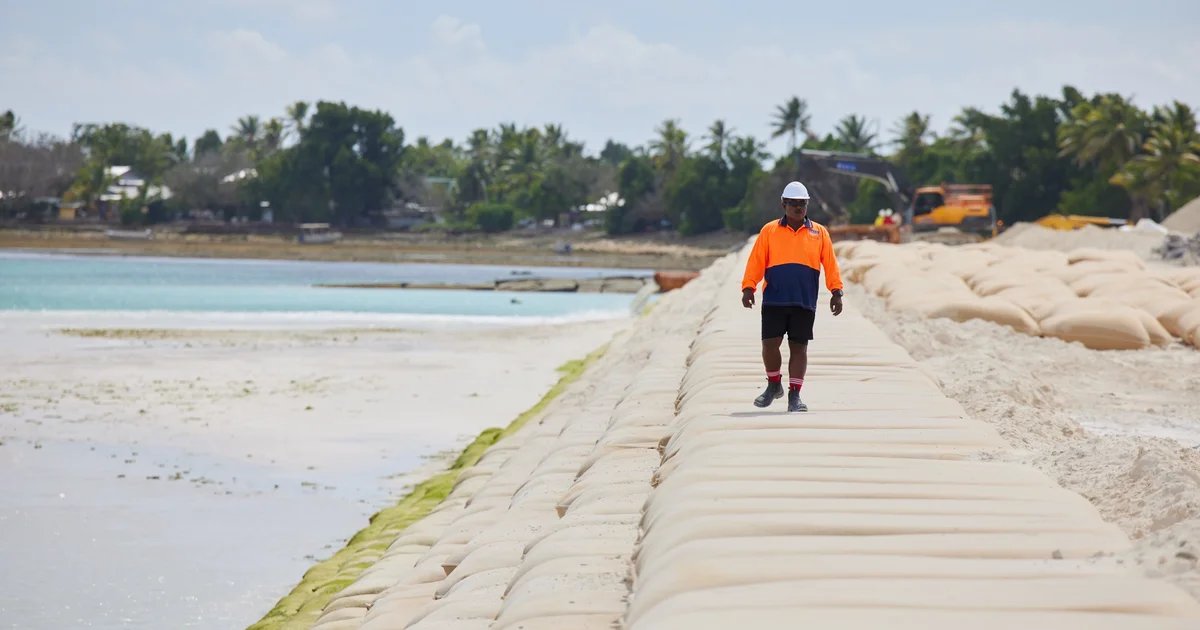
Tuvalu provides a concrete example. In October 2025, the government and its partners marked the completion (Opens in new window) of eight hectares of elevated land under a further phase of the Tuvalu Coastal Adaptation Project. The $17.5 million project, financed by Australia, New Zealand and the United States and implemented by UNDP, followed an earlier 7.3-hectare reclamation supported by the Green Climate Fund. This is a pre-COP31 achievement, not a new Antalya announcement, but it gives substance to the adaptation debate now under way.
Elevated land can create room for housing and essential infrastructure, expanding the options available to an exceptionally land-constrained country. Its longer-term value depends on drainage, water, utilities, maintenance and decisions about access. Reclaimed hectares are therefore an important output, but an incomplete measure of success. The deeper outcome is whether safer land supports a viable community over time. Engineering can buy space and time; it cannot make the global emissions trajectory irrelevant.
A less prominent item in the Pacific program exposes another essential issue. A 12 November session (Opens in new window) at the Moana Blue Pacific Pavilion in Antalya was dedicated to exploring a maintenance-financing facility for hydro-meteorological infrastructure and multi-hazard early-warning systems. Its program identified persistent gaps in operation, calibration, replacement and maintenance, and proposed discussions towards a coordinated financing arrangement. That was an agenda for developing a facility, not evidence that a funded mechanism had already been established.

The emphasis nevertheless deserves attention. Weather stations and forecasting systems are attractive investments when inaugurated; their recurrent costs are less visible. Yet a warning service depends on technicians, communications, replacement parts and trusted local channels. A forecast that never reaches an outer-island community, or reaches people without a workable evacuation plan, offers limited protection. The UN Secretary-General’s call (Opens in new window) at COP31 to make early warnings a lasting public service speaks directly to this problem.
This suggests a practical test for adaptation finance: does it pay for a service to remain dependable, or primarily for equipment to be delivered? In dispersed island settings, maintenance is central to the investment case. Treating it as an expense to be absorbed later by a small national budget risks undermining the original investment.
The Pacific program is also pressing the question of who controls implementation. “Locally led” should imply more than consultation before an externally designed project begins. Communities need meaningful influence over priorities, implementation and subsequent adjustments. National institutions remain essential for technical standards and accountability, but support should strengthen their relationships with communities rather than establish parallel systems that disappear when funding ends.
The Pacific Resilience Facility addresses a related mismatch. A 17 November pavilion program features (Opens in new window) community interventions often costing less than $20,000 – small needs confronting international funding systems designed for much larger transactions. The facility’s Pacific-owned approach offers a potentially workable route to more proportionate access. The test will be dependable capitalisation, workable application requirements and accountable delivery, rather than visibility at the conference alone.
Pacific governments should leave Antalya with progress that can be translated into budgets and operating plans. That requires adaptation finance with a clear baseline and delivery pathway, grants suited to essential public services, and funding that includes maintenance and local implementation capacity. It also requires continued pressure on mitigation: each increment of warming makes protection more difficult and reduces future choices. COP31 will matter to the Pacific if it helps communities sustain safe, functioning lives in their own countries – and gives them greater authority over the decisions that shape those lives.