Guillaume St-Gelais Dubé trembled and wiped away tears, his voice breaking, as he told a Senate committee earlier this week what it was like to learn last year he’d been stripped of his Indian status by the federal government.
“It’s difficult to have that trust in the government after a situation like that,” St-Gelais Dubé told senators.
“It’s like your skin is being ripped from your body,” he said.
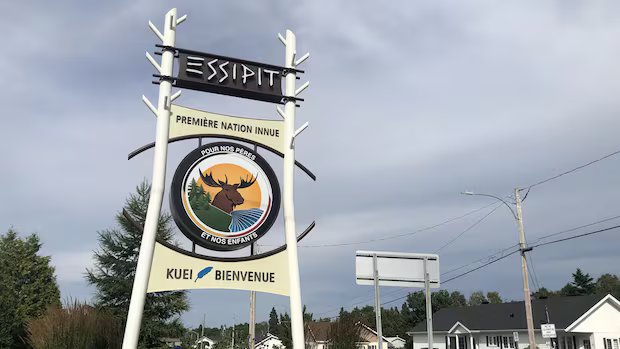
St-Gelais Dubé is among over 700 members of the Innu First Nation of Essipit who lost their status after a decision by the federal Office of the Indian Registrar.

Guillaume St-Gelais Dubé trembled and wiped away tears as he testified before a Senate committee about being stripped of his Indian status. (Senate of Canada)
The Senate hearing Tuesday was the first time federal bureaucrats from Indigenous Services Canada publicly explained their decision, which was puzzling and devastating for many in the community — located in the Côte-Nord region, about 150 kilometres east of Saguenay, Que.
Indian status entitles community members to land for houses and fishing camps, as well as health and other social benefits.
Now 700 people are at risk of losing their homes and benefits, as well as their very sense of identity.
“Come to our community, you’ll see who I am, what my identity is,” St-Gelais Dubé told senators.
“An identity is not a piece of paper.”
Long journey to status
The 738 people affected are all descendants of Christine Kichera and Adelaïde Matshiragan — two Innu women who lived in the 1700s.
For years, they and their descendants were not considered Innu in the eyes of the government because Kichera and Mathshirigan had married non-Indigenous men.
Under earlier provisions of the Indian Act, Indigenous women who married non-Indigenous men lost their status and could not pass it on to their children.
St-Gelais Dubé and many others in the community grew up without status, even though they were raised with Innu culture and traditions.
That changed in 2019 when amendments to the law addressed the long-standing gender-based discrimination.
St-Gelais Dubé and other descendants could then apply for status, which he received in 2023.
“When my status was recognized, it was an enormous relief. I felt liberated to finally have my own identity,” he said.
He was given land by the band council to achieve his dream of building his own house with money he’d saved for years.
But all that came crashing down a year later.
In 2024, he and other descendants of the two women received registered letters informing them their status was under review and that they had 120 days to provide historical proof of their eligibility.
A final decision issued Nov. 5, 2025, revoked the status of the two women and their descendants, effective immediately.
For now, the Essipit Innu band council does not intend to evict those affected and has given them three years to regularize their status.
An ‘obligation’ to take action, registrar says
Defending the federal government’s decision during the hearing were Lori Doran, director general of individual affairs for Indigenous Services Canada, and Claire Thie, the Indian Registrar.
Thie’s job is to validate and review Indian status requests.
Doran told senators the review process began in this case when someone applying for status contacted the Office of the Indian Registrar about the status of their application.
“Through the course of reviewing and preparing a response to that applicant, the source evidence was called into question,” Doran said.

Federal bureaucrats Lori Doran and Claire Thie defended their decision to revoke status from more than 700 Innu before a Senate committee in Ottawa this week. (Senate of Canada)
That source evidence was a late 18th-century record cited known as the Catalogue général de toute la nation montagnaise.
Compiled by a missionary, the document lists members of the Innu community at the time, including Kichera and Matshiragan — but its validity has been called into question.
The Office of the Indian Registrar considered that document to be legitimate when it initially granted status to St-Gelais Dubé and the other Innu in 2023.
But Doran said that was an error.
“The individual that made the initial entitlement decision ought to have escalated this particular application for the registrar to get involved directly,” she said.
Thie said when this situation was brought to her attention she had doubts, and was required by law to investigate further.
“We have a strong team of genealogists, researchers as well as subject matter experts, and we don’t take these decisions lightly,” she said.
“We worked on this family for a year before we notified individuals. And we were unable to find any additional primary, very solid evidence that would help us ensure that the registration was sufficient under the Indian Act,” she testified.
She said in the absence of that evidence, she had no choice but to revoke the descendants’ status.
“I have an obligation. I have a duty. I have no choice but to make corrective actions when they’re brought to my attention,” Thie testified.
“It may sound cold. It may sound unsympathetic, which I’m not. That’s the reality of working in this role,” she said.
Court challenge
Lawyers working for St-Gelais-Dubé and other community members told senators that the people affected were being asked to prove something that was almost impossible.
Lawyer Audrey Mayrand told senators that the reserve in that area was only created after Kichera and Matshiragan died, so their names wouldn’t appear on any official government list.
Another lawyer who’s worked on such cases, Ryan Beaton, said he still didn’t understand why the position of the registrar had changed.
“You have people in this situation who’ve gone through the process, have given the documents, they’ve been assessed by one registrar as sufficient, they get registered, they remake their lives,” Beaton said.
“And then for reasons that are extremely unclear, we have this kind of new burden imposed on them and they have seemingly no opportunity to possibly meet it,” he said.
Mayrand and other laywers are challenging the decision in Federal Court and the case is ongoing.