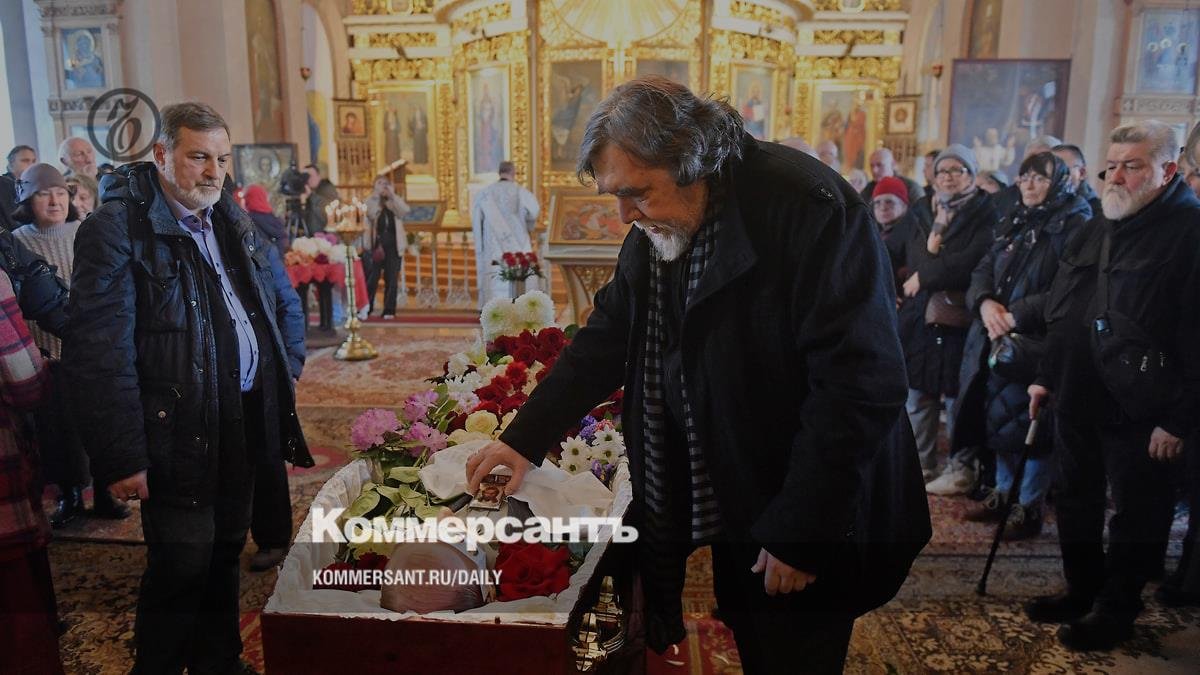
The artist, writer and man who invented Mitkov, Vladimir Shinkarev, was buried in St. Petersburg. The ideologist of the culture of unshaven, drinking and good-natured Leningrad eccentrics died on April 19 at the age of 73 from heart failure. Leningrad bohemia accompanied the chief Mitka on his final journey.
By midday, at the Church of the Savior of the Image Not Made by Hands on Konyushennaya Square, an audience had gathered that in any other city would have been mistaken for the film crew of a film about a Leningrad rock club. Gray pigtails, berets, leather jackets, hippie paraphernalia – several dozen people who have known each other for more than thirty years from kitchens, boiler rooms and unofficial exhibitions. The farewell to Vladimir Shinkarev, the founder and main ideologist of Mitki, brought together several dozen relatives, friends and admirers and, as befits in this circle, there were no official speeches or government telegrams.
According to the poetess and artist Irina Dudina, bohemian St. Petersburg gathered to see off her friend.
Among those who came were the co-founder of “Mitkov” Dmitry Shagin, the founder of the “TaMtAm” club, musician Vsevolod Gakkel, rock musician Andrei Kagadeev, artists Viktor Tikhomirov, Kirill Miller and Vasily Golubev, writer Sergei Nosov, philosopher Alexander Sekatsky, journalist and producer Andrei Burlaka, chief photographer of the Hermitage Yuri Molodkovets, film director Sergei Debizhev, artists Larisa Golubeva and Alexey Kiryanov, art historian Ekaterina Andreeva.
It was assumed that a funeral service would first be held in the temple, after which everyone would be able to say goodbye to the artist. But when the coffin was opened in the church, loved ones surrounded him, hugging and supporting each other. The Church of the Savior Not Made by Hands was not chosen by chance: later the priest would call Shinkarev a regular at this place. According to his colleagues, he really saw some kind of divine meaning in his work, so at some point he became an active parishioner.
The churchmen came out, and deep silence reigned in the temple. The funeral service began around noon. People helped each other light candles and passed flowers directly over their heads to be placed at the coffin. The rector called the artist and writer an improviser: “He knew Leningrad, he knew St. Petersburg, how the city breathes. He knew that the city was on prayer. Honor and glory to this man, he is truly an improviser in his genre. He lived by business and love for people.” The artist lived his life as a “hard worker,” as the priest put it, and was himself a “messenger” who brought light to people in his works.
As soon as the coffin was carried out of the church to light applause, snowflakes began to fall to the ground. St. Petersburg bohemia unanimously recognized this as a good sign: they say, Shinkarev himself winks, confirming that everything is correct. Immediately one of the ministers, trying to cheer up those who came, reminded that Orthodox Easter was still underway. So in response to his cry “Christ is Risen!” the crowd responded “Indeed,” and then continued to discuss what Vladimir Shinkarev had managed to do in his life. As Dmitry Shagin shared, his friend became a figure who influenced not only the Leningrad underground and rock club, but also the entire Soviet and Russian culture.
People got to the Smolensk cemetery through the power of friendship and connections: those who did not fit into the ordered bus jumped into the car of one of the musicians and artists, all of them.
When the coffin was lowered into the grave, the priest delivered a short sermon, which sounded almost like an epilogue to the entire philosophy of “Mitkov”. “Vladimir was one of those about whom the Gospel speaks,” he began. “These are people who have nothing. People who don’t want to achieve anything. People who don’t want to make waves all over the world. People who want to remain small both in their minds and in the life of society. And it turns out that this search for something small turns out to be very important for many. And this strange peasant position – to achieve nothing, and at the same time achieve, is well transmitted through the hearts of people.”
The grave was covered with earth and fir branches, after which applause sounded again. A single wreath was installed nearby – “To Vladimir from the DDT group.” Fine snow was still swirling over the Smolensk cemetery. People brought flowers and lit candles on the fresh grave. They remembered Shinkarev as a writer, artist and mischief maker, and they were sad. Someone, lighting a cigarette, sadly noted that friends were leaving one by one. And some of the friends who could have seen the creator off on his last journey cannot be there because of their departure from Russia.