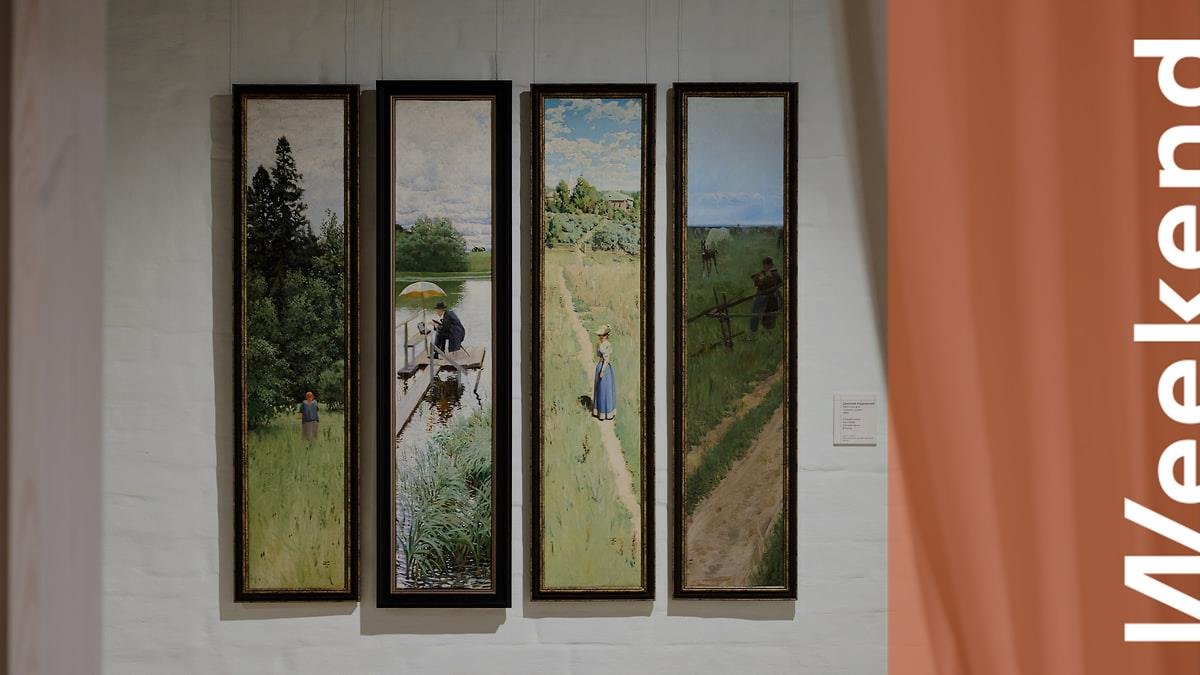
The Museum of Russian Impressionism celebrates its tenth anniversary this year, and among the series of festive events is the opening of the exhibition “Metropolitan Jam” in the Rostov Kremlin, on the shores of Lake Nero. The Moscow institution, which has already become a model of modern museum work, is now exporting its experience to the regions. Weekend checked to see if it works.
The first exhibition of the Museum of Russian Impressionism, organized outside of Moscow, started on June 13 in the Stable Yard of the Rostov Kremlin. Among other things, the local fortress is notable for the Metropolitan Garden – “the earthly embodiment of the heavenly paradise,” conceived at the end of the 17th century by Metropolitan Jonah Sysoevich. It was this rare example of the gardening art of pre-Petrine Russia, where dozens of types of berries, fruits and healthy herbs were grown, that became the main character of the new exhibition.
The prologue to the exhibition is a section dedicated to Rostov the Great as a polis: general plans of the patriarchal Old Russian corner, written by Boris Kustodiev, Yakov Kalinichenko and Konstantin Yuon. The latter, a guest in Rostov, wrote: “I feel good now. Sunday; the sun is shining strong and bright; the ringing is thick; I love it.” The first hall tries to set the guests in the same mood, in order to then demonstrate individual aspects of this beauty, in the center of which, of course, is the garden – paradise and monastery.
Further, the exhibition presents both a scientific view of gardening – for example, the picturesque herbariums of Nikolai Sobolev, who described the flora of the middle zone, and aesthetic experiments of the early 20th century, where garden bushes gravitate towards the naive manner of Alexander Kuprin or the fragmentary painting of the “peaceful Vrubel” – Roman Babichev.
But even in an exhibition dedicated to the garden, people remain in the center: merchants’ women drinking tea by Alexander Makovsky, Apple Spas by Nikolai Pimonenko, the market atmosphere of Ivan Kulikov and other scenes from the life of small towns. These works are differentiated according to the different manifestations of “Russian hygge,” as expressed by the general director of the Rostov Kremlin, Sergei Mostovoy. In the main hall of the exhibition, sections are devoted to jam from gooseberry leaves, Rostov chicory, tea ceremonies and more.
The team of the Museum of Russian Impressionism diversified the classic format of the exhibition with aromas that convey the mood of each section and each corner of the garden. And you can learn more about the context of the works with the help of an audio guide recorded by journalist Fekla Tolstaya.
A logical continuation of the exhibition could be a walk through the Kremlin territory. By the way, the Metropolitan Garden is open to visitors today. Of course, this is a reconstruction, but a carefully designed one – here you can see lavender thickets, watermelon melons and other herbs and fruit plants atypical for the monastery.
“Metropolitan Jam” – the first regional project of the Museum of Russian Impressionism, is approaching two more: in Veliky Novgorod and Vladivostok.
The exhibition is open until September 20.