BAKU, Azerbaijan, September
21. The Center for the Analysis of International
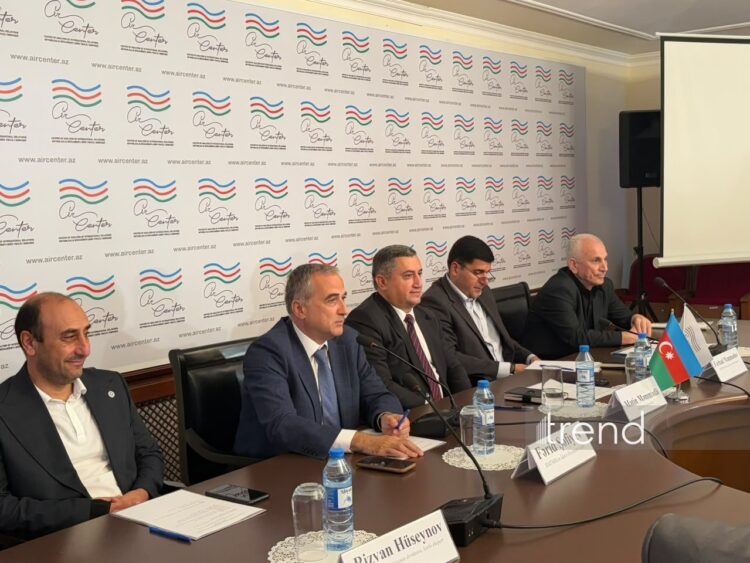
Relations and Multiculturalism (AIR Center) has held an event on
the topic “The Legacy of Caucasian Albania in Azerbaijan’s history
of statehood,” Trend’s correspondent
reports from the event.
The primary objective was to conduct academic discussions
centering on the views regarding the heritage of Caucasian Albania
expressed by the President of the Republic of Azerbaijan, Ilham
Aliyev, on September 15, while receiving a delegation comprising
members and observers of the Council of Heads of Muslim Religious
Authorities of the Organization of Turkic States, co-organizers of
the Yahya Bakuvi International Conference, and members of the
Supreme Religious Board of the Caucasian Peoples.
The event also addressed issues regarding the systematic study
of the Caucasian Albanian heritage, the scholarly examination of
its place and role in the history of Azerbaijani statehood, and the
research of primary sources and archival materials related to this
heritage.
Azerbaijani MPs, representatives of think tanks, researchers,
and media representatives participated in the event, which was
moderated by Matin Mammadli, a department head at the AIR
Center.
In his remarks, AIR Center Board Chairman Farid Shafiyev
emphasized the importance of presenting scientific findings
regarding historical heritage to the international community in a
consistent, objective, and well-substantiated manner.
“Denying the history of Caucasian Albania is one of the attempts
to substantiate the idea of ‘Great Armenia.’ As for the peace
process, it appears that radical views exist in Armenia not only
within the opposition but also within the state apparatus itself.
Accepting the outcome of the war while intending to revisit
strategic issues in 10–15 years runs counter to peace. Azerbaijan’s
course is clear: peace, normalization, and the promotion of trade.
Yes, we must not become hostages to history, but, as the President
has emphasized—we cannot forget history either,” added
Shafiyev.
In his address, Head of Department at the Institute of History
and Ethnology of Azerbaijan National Academy of Sciences (ANAS) and
Ph.D. in History Ramil Aghayev spoke about the history, territory,
and statehood traditions of Caucasian Albania. Noting the unique
traditions of the Albanian Church, Aghayev emphasized that the
heritage of Caucasian Albania represents a crucial aspect of the
study of Azerbaijani history.
“Historical sources reflect the fact that Christianity spread in
Albania as early as the 1st century. Even a number of Armenian
sources acknowledge this; we encounter this fact in Moses
Kalankatuatsi’s work, ‘History of Albania’ as well. Attempts to
appropriate the material-cultural heritage of Caucasian Albania and
present it to the international community as Armenian heritage must
be viewed within the context of the territorial claims Armenia has
advanced against Azerbaijan,” he said.
Rizvan Huseynov, director of the Caucasus Historical Center and
a military expert, noted that He spoke about the historical and
religious heritage of Caucasian Albania, as well as the historical
significance for the Christian world, of the Ganjasar, Khudavang,
and Amaras churches located in the Karabakh region.
Huseynov also touched upon the historical events of 1836, when,
by decree of the Russian Empire, the independent operations of the
Albanian Church were curtailed, and it was placed under the
administration of the Armenian Apostolic Church. He emphasized the
importance of scientifically investigating instances where the
heritage of Caucasian Albania was damaged or altered over various
periods, incorporating archival documents into scholarly discourse,
and studying the monuments using modern scientific methods.
“During filming conducted in the area following the anti-terror
measures, we obtained footage showing that certain graves and
skeletal remains had been exhumed. This matter must be investigated
and brought to the attention of the international Christian
community,” Huseynov explained.
Deputy Chairman of the Board of the AIR Center, Farhad Mammadov,
highlighted the issue of utilizing historical heritage within the
political and ideological spheres. He emphasized the importance of
expanding scholarly research on the heritage of Caucasian Albania,
systematically studying historical sources, and more widely
presenting the resulting scientific findings in the international
information space.
“The Armenian Church is the greatest revanchist force in
Armenian society. While various political mechanisms can be
employed to alter the stances of political parties and
socio-political organizations, the Armenian Church, and the recent
documents it has adopted, demonstrate that one of the primary
pillars of revanchist sentiment in Armenian society is linked
precisely to this institution.”
The event continued with discussions centered on the topic.