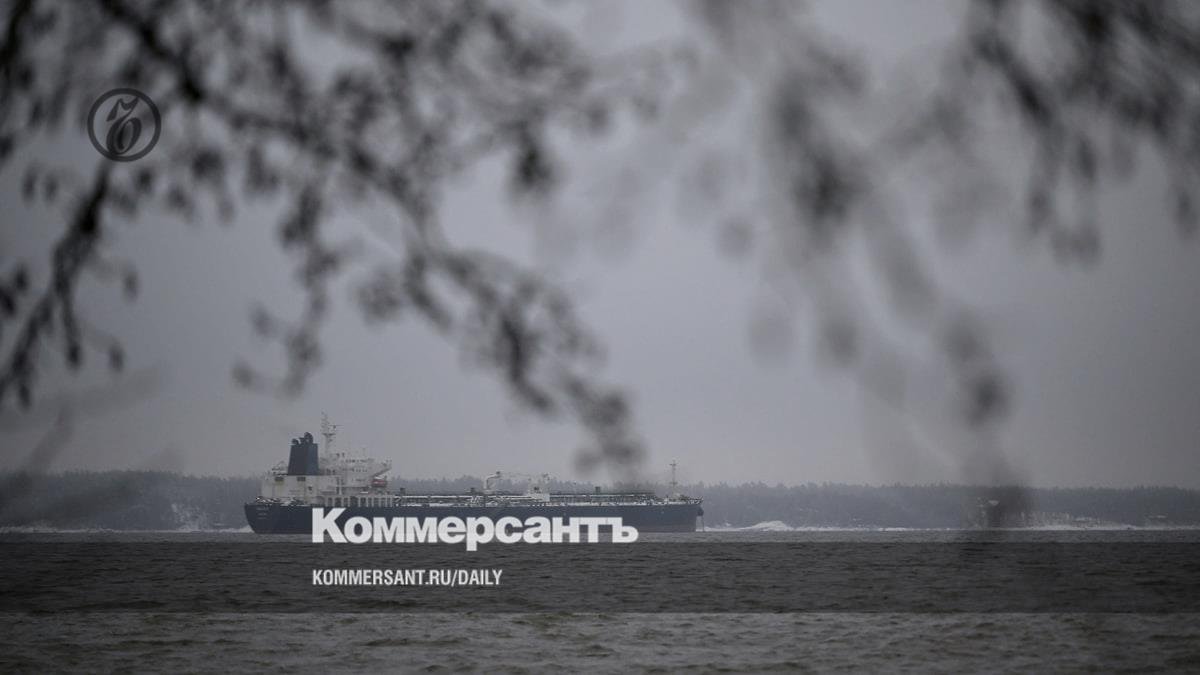
Tankers associated with Western companies began to reduce activity in the market for transporting Russian petroleum products after the adoption of the 20th package of EU sanctions. The Baltic is already experiencing a reduction in available tonnage and a sharp increase in freight rates, to record levels in some directions. So far, only weak export rates are holding back the rise in transportation costs.
Greek shipowners, who provided a significant portion of the transportation of Russian petroleum products, began to reduce activity in the Russian market, as follows from a review by the Price Index Center (PIC). Market participants cited by analysts attribute this to increased risks after the introduction of the 20th package of EU sanctions and a review of strategies for working with Russian volumes.
The 20th EU sanctions package adopted at the end of April included a “framework” for introducing a ban on the provision of Russian oil transport services, which will be carried out in coordination with the G7. As stated in the regulations, it is advisable to make changes to the price ceiling for Russian oil and petroleum products. Also subject to EU sanctions were Bashneft, Slavneft, the ports of Primorsk and Tuapse, the Karimun terminal in Indonesia, and so on (see. “Kommersant” dated April 25).
The reduction in activity of Greek carriers has led to a decrease in available tonnage, especially in the Baltic Basin.
According to CCI, by the end of the week of April 20–26, the number of tankers transporting light oil products in the waters of the Baltic ports decreased to eight or nine, the minimum since the beginning of February.
CCI Director Roman Sokolov notes that the 20th package of EU sanctions has increased geopolitical pressure on European carriers who are operating in the conditions of the crisis in the Strait of Hormuz and are forced to reduce operations in the Russian oil products market. According to him, the decrease in the availability of the product tanker fleet in the North-West (primarily Greek) coincided with pent-up demand due to repairs in the Baltic ports. This has increased pressure on freight rates for petroleum products, which, unlike oil, continue to grow, Mr. Sokolov adds.
According to CCI, transportation of light oil products from the Baltic ports by Handysize tankers with a deadweight of 30 thousand tons on April 20-26 increased in price by an average of 4-6%, to $140-183 per ton. Freight rates to Latin America and West Africa hit new records, rising to $183 per ton and $147 per ton, respectively. A Kommersant source in the industry admits that supplies to Africa may be intended for resale to Europe in transit through one of the African countries. In the Black Sea, freight of Handysize vessels to Turkey remained stable; on other routes, rates increased by 1–3%, to $175–190 per ton.
Open Oil Market CEO Sergei Tereshkin estimates the share of tankers flying the Greek flag in the transportation of Russian volumes at 10–20%. However, according to him, the short-term effect of the departure of some shipowners is smoothed out by the license extended by the United States until mid-May, which allows shipments involving vessels of the shadow fleet.
Rate increases are limited by weak export activity. According to CCI estimates, from April 20 to 26, six shipments of light oil products with a total volume of about 190 thousand tons were shipped from Primorsk, Ust-Luga and Vysotsk – 72% below the 2025 level.
In the Black Sea, maritime exports are under pressure situation in the port of Tuapse. After a series of attacks in April, Russian Railways limited the transportation of goods to the port from April 18 to 24, the Center for Information Center indicates.
On April 28, Governor of the Krasnodar Territory Veniamin Kondratiev reported on another attack that caused a “large-scale fire” at the Tuapse Oil Refinery. From April 28, a regional-level emergency regime will be introduced throughout the entire Tuapse municipal district, the operational headquarters of the Krasnodar Territory reported.
The TsCI expects a reduction in fuel oil exports from Tuapse, which previously showed a noticeable increase: according to tanker tracking systems, from April 16-23, three ships with a total volume of about 190 thousand tons were sent from the port – 2.5 times more than in the first half of the month. Logistics in the Black Sea are also becoming more complicated due to changes in routes. According to analysts, some ships prefer to move along the east coast, which increases the duration of the voyage by about two days. In April, according to CCI, the routes of about seven to eight tankers were adjusted in this way.