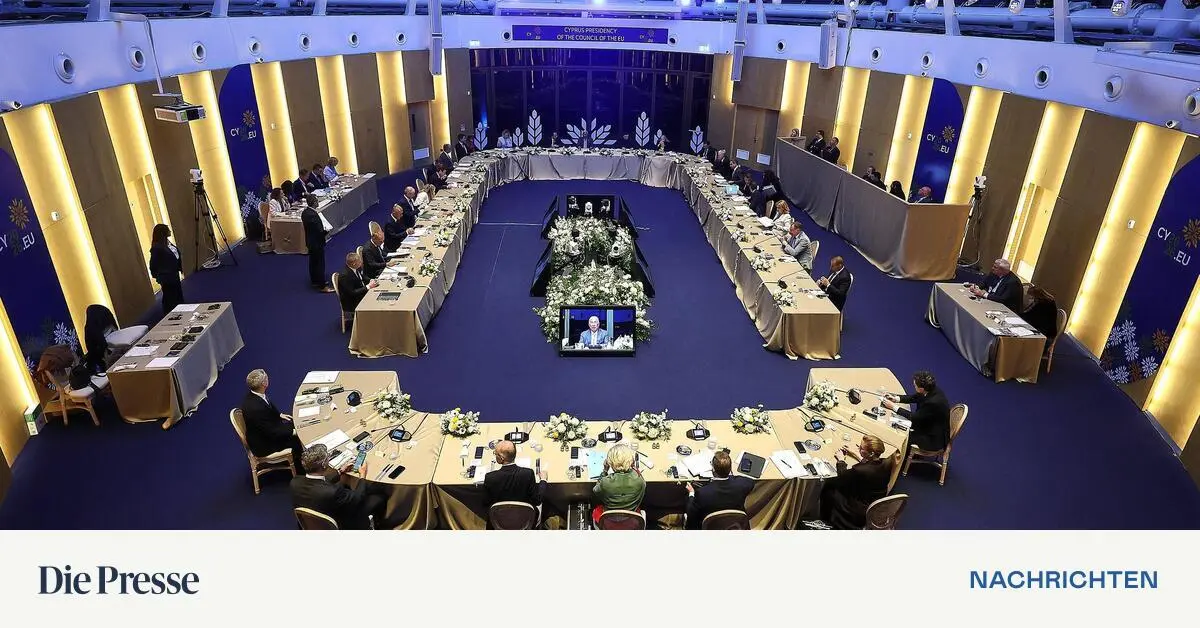
The first meeting of EU heads of state and government began with Polish Prime Minister Tusk taking a swipe at his outgoing Hungarian counterpart.
At the first meeting of EU heads of state and government after the parliamentary elections in Hungary, Polish Prime Minister Donald Tusk took the liberty of taking a swipe at Hungary’s outgoing pro-Russian head of government Viktor Orbán. “For the first time in years there were no Russians in the room, if you know what I mean,” Tusk told reporters in Nicosia on the second day of the summit on Friday.
Orbán, who has been in power since 2010, was for years considered Russian President Vladimir Putin’s most important ally in the EU. Orbán’s Fidesz party clearly lost the parliamentary election on April 12 to opposition leader Péter Magyar’s TISZA party. Orbán will remain in office as head of government until the new government is inaugurated in May. However, he does not take part in the meeting in Cyprus.
The Hungarian government’s pro-Russian stance had repeatedly caused disputes with other EU countries. In particular, the Hungarian blockades in decisions about support for Ukraine or sanctions against Russia regularly caused trouble.
Media reports about Hungarian Foreign Minister Peter Szijjártó caused additional outrage in March. He is said to have passed on confidential conversation content within the EU to his Russian colleague Sergei Lavrov. According to the reports, Szijjártó regularly called Lavrov on the phone during breaks in EU meetings to share “live” information. Tusk’s Foreign Minister Radosław Sikorski commented on the revelations at the time: “That would explain a lot, Péter.”
However, not everyone at the meeting in Cyprus shared Tusk’s joy at Orbán’s departure. Belgian Prime Minister Bart De Wever said there was “a bit too much euphoria” that the long-time Hungarian leader was no longer there. Orbán was “of course a difficult partner,” “but never an impossible partner.”
After talks about Ukraine the evening before, the heads of state and government will discuss the next EU financial framework and the Iran war in Cyprus on Thursday. Representatives from the Middle East and the Gulf States are also invited. (APA/AFP)