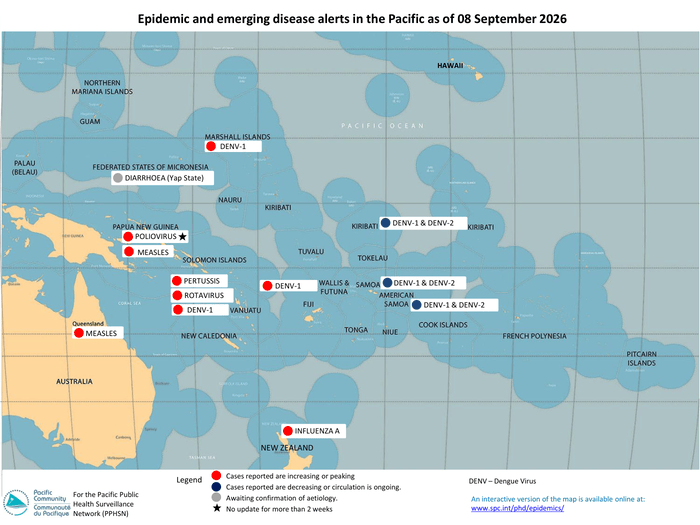
Highlights/updates since the last map was sent on PacNet on 1st September 2026:
Acute watery diarrhoea
• Federated States of Micronesia: Yap State Public Health Surveillance is reporting a diarrhoeal outbreak across mainland Yap and the Outer Islands. The alert was triggered in EpiWeek 34 with 21 diarrhoea cases across sentinel sites, followed by a threefold rise in EpiWeek 35 to 69 cases against an alert threshold of seven. Situation Report #3, covering data up to 6 September 2026, reports 54 new cases and a cumulative total of 141 clinically diagnosed cases. Of these, 85 were seen at the Main Hospital outpatient department, 46 in Ifalik, six in Lamotrek, three in Faraulap and one in Fais, which is newly affected. Five paediatric patients have been admitted, none required hydration and no deaths have been reported. The number of indeterminate Outer Island cases falls only from 57 (from Situation Report #2) to 39, so further undocumented cases have appeared over the same period. Vomiting is the most frequent co-symptom (78 cases), followed by fever (29) and abdominal pain (23). Laboratory testing identified rotavirus, sapovirus, Escherichia coli, Giardia lamblia and Salmonella, often as co-infections. The cause of the overall increase has not yet been established. A grey alert for diarrhoea is issued for the Federated States of Micronesia (Yap State) awaiting confirmation of aetiology. – Sources: Yap State Diarrhoeal Outbreak Situation Reports #1 to #3, the latest with data as at 6 September 2026, and Yap State Communicable Disease Report, EpiWeek 35 (24–30 August 2026), Yap State Public Health Surveillance, shared with the PPHSN Coordinating Body Focal point on 7 and 8 September 2026.
Dengue
• Marshall Islands: The Outbreak Situation Report on dengue in Majuro dated 1 September 2026, covering 15 August to 1st September, records 109 specimens tested at Majuro Hospital Laboratory, 46 confirmed positive, 63 negative and no deaths. That is six more laboratory-confirmed cases than the 40 reported three days earlier on 29 August, an average of six cases a day over the period. The attack rate for Majuro Atoll (population 23,158, 2021 census) is 4.7 per 1,000 for suspected cases and 2.0 per 1,000 for confirmed cases. Confirmatory serotyping at the Hawaii State Laboratories Division identifies DENV-1 only. Among the 46 confirmed cases the commonest symptoms were fever (74%), headache (63%), muscle ache (48%) and joint pain (35%). Most positive cases were identified in Rita (10/23 tested), Delap (10/19), Uliga (7/16), and Rairok (7/21). Village of residence was recorded for only 38 of the 46 positive cases. The red alert for dengue (DENV-1) remains in effect. – Sources: RMI Ministry of Health and Human Services, Dengue Outbreak Update Situation Reports of 1 September 2026 accessed on 08 September 2026.
• Samoa: During EpiWeeks 33-35 (10-30 August 2026), Samoa reported 19, 17, and 22 new dengue cases, respectively. Cases increased by 29% in EpiWeek 35 following two weeks of decline. One laboratory-confirmed case was reported in both EpiWeeks 34 and 35, while none were reported in EpiWeek 33. There were no new hospital admissions, no intensive care admissions and no deaths across the three weeks. Since 1st January 2025 a cumulative 20,215 clinically diagnosed with 5,538 laboratory-confirmed cases have been reported, with the dengue-related death toll unchanged at nine. Both serotypes continue to circulate, with DENV-1 (52%) and DENV-2 (48%) detected in similar proportions. Children under 15 years account for 73% of cases. The geographic distribution remains unchanged, with 92% of cases reported on Upolu, 7% on Savai’i, and 1% on Manono and Apolima. The blue alert for dengue (DENV-1 & DENV-2) remains in effect. – Source: Samoa Ministry of Health, Health Security and Disease Surveillance Division, Dengue Outbreak and Syndromic Surveillance Update, EpiWeeks 33–35, shared with the PPHSN Coordinating Body Focal point on 7 September 2026.
• Vanuatu: Situation Report #12 on the dengue outbreak on South-West Efate Island, Shefa Province, dated 7 September 2026, covers EpiWeeks 33 to 36. Twelve new laboratory-confirmed cases were reported between 31 August and 6 September (EpiWeek 36), bringing the cumulative total to 134 confirmed cases since EpiWeek 14. Weekly counts have remained above the outbreak alert threshold of four confirmed cases per week since EpiWeek 24 and peaked at 15 cases in EpiWeek 33, while dengue-like illness reported from the six Shefa sentinel sites peaked at 40 cases in EpiWeek 34. Fourteen dengue-related hospitalisations (10% of confirmed cases) have been reported to date, all recovered and discharged, with no severe dengue and no deaths. Between EpiWeeks 14 and 35, 536 samples were tested at Vila Central Hospital laboratory with an overall positivity of 20%, and all five samples referred for serotyping were confirmed as DENV-1. Cases are spread across seven Area Councils, led by Erakor (37%), Port Vila (21%), Eratap (21%) and Pango (14%). Malorua is newly affected this week, taking the count from six Area Councils to seven. Sixty per cent of cases are male, 75% are aged under 26 years and 45% are children aged 5 to 15 years. Investigations indicate sustained local transmission, with most recent cases reporting no history of international travel and being epidemiologically linked to affected areas on Efate. The red alert for dengue (DENV-1) remains in effect for Vanuatu. – Source: Dengue Outbreak Situation Report #12, South-West Efate Island, Shefa Province, Vanuatu National Surveillance Unit, shared with the PPHSN Coordinating Body Focal point on 08 September 2026.
Pertussis/Whooping cough
• Vanuatu: Situation Report 2 on the pertussis outbreak on Ambae Island, Penama Province, dated 7 September 2026, covers EpiWeeks 33 to 36. Situation Report 1 recorded four laboratory-confirmed cases across EpiWeeks 31 to 34. Situation Report 2 records 265 new cases between 24 August and 6 September (EpiWeeks 35 and 36), bringing the cumulative outbreak total to 276 cases, of which 272 are clinically diagnosed and four laboratory confirmed. Two cases required hospitalisation and both have been discharged. No deaths have been reported. Females account for 54% of cases. Among the total cases, 57% of cases are aged 15 years and over, followed by children aged 5 to 9 years. Vaccination status is unknown for 93% of cases, and among those with a known status only 13 had completed all three doses and three were partially vaccinated. Geographically, 89% of cases are in South Ambae, 11% in North Ambae and one case in East Ambae. One laboratory-confirmed case in North Ambae had recent travel to Santo Island and remains under investigation. The response includes enhanced surveillance, active case finding, contact tracing, verification of vaccination status and specimen collection, with work under way to strengthen routine immunisation and identify people eligible for catch-up vaccination. The red alert for pertussis remains in effect for Vanuatu. – Source: Penama Province Pertussis Outbreak Situation Report 2, Vanuatu National Surveillance Unit, shared with the PPHSN Coordinating Body Focal point on 08 September 2026.
Respiratory diseases
• New Zealand: The weekly all-cause hospitalisation rate for severe acute respiratory infection (SARI) in the Auckland region has increased again and is in the very high activity band for a third consecutive week. It is the highest weekly rate recorded in any season from 2015 to 2025. Influenza was the most commonly detected virus, and influenza test positivity among SARI hospitalisations rose from 49.7% to 58.7% while positivity among sentinel general practice influenza-like illness cases fell from 40.8% to 35.8%, so the community indicator is easing while the severe end continues to climb. Both A/H1 and A/H3 are circulating, A/H3 predominates in general practice, and antigenic typing places the circulating viruses as a match for the 2026 Southern Hemisphere vaccine. Year to date, community sentinel surveillance records 161 laboratory-confirmed influenza detections from 930 samples, 70.2% of them A/H3. Fourteen respiratory illness outbreaks were reported in the week ending 30 August, down from 26 the previous week, twelve of them in aged residential care facilities. Pacific peoples have experienced the highest cumulative rates of influenza-, RSV- and SARS-CoV-2-positive SARI hospitalisation and the highest rates of influenza- and RSV-positive intensive care admission of any ethnic group in 2026, and children aged 0–4 years carry the highest SARI hospitalisation rate. The red alert for influenza A remains in effect for New Zealand. – Sources: New Zealand acute respiratory illness dashboard week ending 30 August 2026 PHF Science accessed on 08 September 2026.
Rotavirus
• Vanuatu: Rotavirus has been confirmed as the cause of the watery diarrhoea outbreak on Tanna Island, Tafea Province, on three stool specimens tested at Vila Central Hospital laboratory. Situation Report No. 3, dated 7 September 2026 and covering EpiWeeks 33 to 36, records 236 cases between 31 August and 6 September (EpiWeek 36) from eight health facilities, bringing the cumulative total to 499 cases, of which 496 are clinically diagnosed and three laboratory confirmed. That is 236 cases in a single week against 153 the week before, and the outbreak alert threshold of 34 cases per week has been exceeded since EpiWeek 33 with numbers still rising. The outbreak has also moved: Southwest Tanna Area Council now accounts for 46% of all reported cases, followed by West Tanna and Middle Bush Tanna, whereas West Tanna carried 73% of cases a week ago. Twenty-eight cases have been hospitalised across EpiWeeks 33 to 36, 24 have recovered and been discharged and three remain in hospital. One death has been reported, a one-year-old child, associated with severe dehydration and underlying malnutrition. Children under five years account for most cases and 84% of cases are children under two years. Among cases with known vaccination status, 40% had received one dose of rotavirus vaccine, 23% had completed the schedule and 10% had received two doses. Rotavirus vaccine is given at six and ten weeks of age in Vanuatu. Water quality testing has now detected Escherichia coli, indicating possible faecal contamination of water sources, and WASH interventions have been added to the response. The red alert for Vanuatu remains in effect and is renamed from diarrhoea to rotavirus, now that the aetiology is confirmed. – Sources: Rotavirus Outbreak in Tanna Island, Tafea Province, Situation Report No. 3, Vanuatu Ministry of Health, 7 September 2026, shared with the PPHSN Coordinating Body Focal point on 8 September 2026, and the Ministry of Health public health alert of 30 August 2026 accessed on 08 September 2026.
Other Information:
Dengue
• Hawaii: The Hawaii State Department of Health reports that dengue virus has been detected in a wastewater sample from the Hilo treatment plant on Hawaii Island. The sample was collected on 24 August 2026, and the Department was notified on 31 August. A follow-up sample taken on 31 August is pending and no serotype has been identified. The Department states that it is not currently tracking any active dengue case in Hawaii County, and that a wastewater detection neither confirms a clinical case nor indicates community transmission. All seven dengue cases reported statewide in 2026 were travel-associated, and dengue is not endemic in Hawaii although competent vectors are present. Sampling is weekly, by digital PCR with sequencing, and can pick up virus shed by people without symptoms. – Source: Hawaii State Department of Health new release accessed on 08 September 2026.
Highly pathogenic avian influenza
• Australia: The national H5 bird flu wildlife dashboard records 484 confirmed positive events on 4 September 2026 against 421 events on 30 August. By jurisdiction: South Australia 271, Victoria 150, Tasmania 29, New South Wales 22, Western Australia 10 and Queensland 2, with none in the Australian Capital Territory or the Northern Territory. The epizootic remains overwhelmingly one of seabirds: greater crested tern 326, silver gull 55, black-faced cormorant 11, Pacific gull 9, giant petrel 8, little penguin 8, southern giant petrel 8, white-fronted tern 6 and fluttering shearwater 3. However, mammals are now on the list, with three long-nosed fur seals, three red foxes and a common dolphin sampled at Arno Bay, South Australia, on 30 August. New South Wales reported H5 events at Port Kembla, Warriewood and Coffs Harbour on 4 September, including the first confirmed detection in a shearwater in the state. No mass mortality has been observed in the areas concerned, H5 has not been detected in commercial poultry or captive birds in New South Wales, and no human case has been reported in Australia. H5 has not been detected in any Pacific Island country or territory to date. – Sources: Australian Government H5 bird flu events in wildlife dashboard and New South Wales Department of Primary Industries and Regional Development media release accessed on 08 September 2026.
Respiratory diseases
• Pacific Island countries and territories: Influenza and influenza-like illness are rising in six Pacific Island countries and territories in the same week, at a point in the year when the southern season would normally be easing. The Cook Islands report a surge in flu-like illnesses with children under five years at the highest risk of hospitalisation, and health authorities are urging immediate vaccination. The Fiji Ministry of Health and Medical Services has issued a health warning after seasonal influenza cases rose sharply over three weeks, confirmed by the National Public Health Laboratory, and states that the rise is starting earlier than the equivalent wave in 2025. In French Polynesia, acute respiratory infection consultations rose across the territory in EpiWeek 35, a second consecutive week of increase after the Marquesas carried the first, with two laboratory-confirmed influenza A cases in the week, one of them subtyped A/H3, and at least one hospitalisation. The Niue Public Health Division has posted a public alert that influenza A cases are rising. Niue Public Health has recorded 11 new confirmed cases of Influenza A between the 31st August – 07 September 2026. Samoa reported 18 severe acute respiratory infection (SARI) cases in EpiWeek 35, compared with seven the previous week, a 157% increase. Three of 12 samples tested positive for influenza A. Influenza-like illness (ILI) activity also increased to 641 cases, up 10% from the previous week but remaining below the national alert threshold. Three of 18 nasopharyngeal swabs were positive for influenza A. In Tonga, influenza-like illness doubled from 14 to 29 cases in EpiWeek 35, a 52% increase after two flat weeks at 11, on 92% reporting completeness. Most of these signals are still syndromic and unconfirmed, and countries and territories are encouraged to reinforce respiratory specimen collection. – Sources: Te Marae Ora Cook Islands Ministry of Health; Fiji Ministry of Health and Medical Services health warning; Bulletin de surveillance sanitaire No. 31, Direction de la santé de Polynésie française; Niue Public Health Division public alert accessed on 08 September 2026; Samoa Ministry of Health Dengue Outbreak and Syndromic Surveillance Update, EpiWeeks 33–35 shared with the PPHSN Coordinating Body Focal point on 7 September 2026 and Tonga Ministry of Health Weekly Communicable Diseases Syndromic Surveillance, EpiWeek 35, shared with the PPHSN Coordinating Body Focal point on 03 September 2026.
• Regional neighbours: Australia, Hawaii, Hong Kong, Singapore and Japan are all recording rising respiratory activity. In Australia the season is late and sharp. Queensland recorded 2,930 notifications in the latest week, up 27% on a week that was itself up 44% between 17 and 24 August and 20,800 cases year to date. New South Wales reports influenza at a high level of activity in EpiWeek 35. Victoria reports influenza moderate and increasing after remaining low throughout early winter and the Northern Territory has recorded 808 laboratory-confirmed cases and 223 hospitalisations so far in 2026. Australian surveillance data suggest the national influenza peak in 2026 is yet to occur. In Hawaii, acute respiratory illnesses account for 17.2% of emergency department visits and three of the four state indicators are rising, although overall activity as low. Japan entered its influenza season in late August, the second-earliest onset since systematic surveillance began in 1999, and its acute respiratory infection sentinel rate reached 36.30 per site in EpiWeek 34, up on the previous week and rising in 44 of the 47 prefectures. Further north and west, Hong Kong reports overall influenza activity at a high level in week 35. Singapore reports influenza positivity at 36.6% for 16 to 22 August, up from 24.0% the week before, still below the January 2025 peak of 43.9%. Influenza circulates year-round in Singapore, with activity typically higher from May to August and from December to March, so this rise sits at the tail of the usual mid-year period rather than outside it. – Sources: Australian Respiratory Surveillance Report, Australian Centre for Disease Control, with the New South Wales Respiratory Surveillance Report for epidemiological week 35 ending 29 August 2026, the Victorian Respiratory Surveillance Report, the Northern Territory Centre for Disease Control surveillance update of August 2026 and Queensland Health notifiable conditions weekly totals; Hawai’i Statewide Respiratory Disease Data; Japan Institute for Health Security, Acute Respiratory Infection Surveillance Weekly Report; Hong Kong Centre for Health Protection COVID-19 & Flu Express, week 35; and Singapore Communicable Diseases Agency and Ministry of Health updates accessed on 08 September 2026.