On Wednesday, June 10, in Elista they said goodbye to Hero of Russia Naran Ochir-Goryaev, who commanded a company during the capture of Seversk. The whole country learned about him when, in December 2025, he personally reported the success of the operation to Vladimir Putin. On June 4, Naran Ochir-Goryaev died in the combat zone. At the funeral he was remembered as a “true warrior”, “a worthy son of his people” and a “Kalmyk hero” who remained on the front line until the last.
On the morning of June 10, almost all the central streets of Elista were cordoned off by traffic police officers. At this time, in a small brick house in the private sector, the clergy of the Central Khural “Golden Abode of Buddha Shakyamuni” performed a prayer service over the body of Naran Ochir-Goryaev. Only the relatives and friends of the deceased were present at the closed ceremony, but a whole crowd gathered on the street near the house. Military personnel, security officials, employees of the city administration and government of Kalmykia, and ordinary local residents patiently waited for the end of the prayer service, hiding in the shade of trees and neighboring houses.
The men discussed the circumstances of the death of the serviceman and his military achievements, the women sympathized with the relatives of the deceased and wiped their tears with handkerchiefs. All those present called Naran Ochir-Goryaev a hero. “He was a simple, good-natured man,” recalled one of his colleagues. “He could always support me in difficult times. Brave, courageous… He was faithful to his duty. For the last six months we have served together, he has become part of the family. This is a big loss not only for the unit, but for the entire country.”
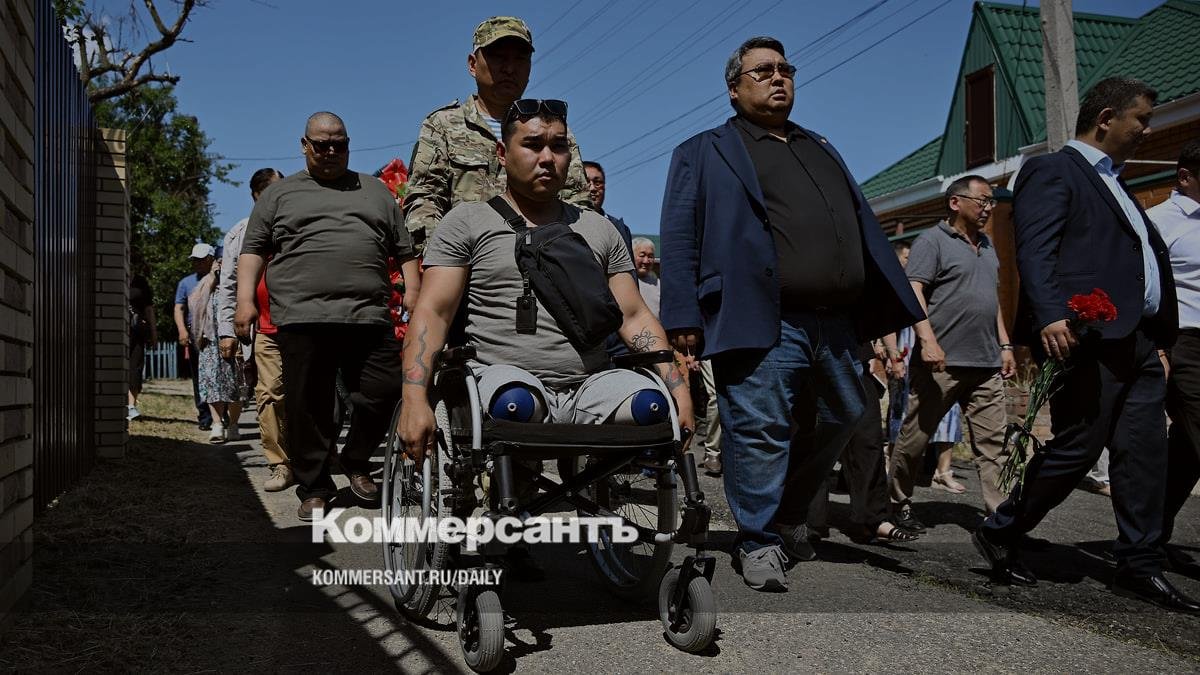
At some point, a group of young military men in summer field uniform approached the house. One of them tried for a long time to attach a medal to his chest. He had to do this with one hand; he simply didn’t have the other. As a result, a colleague helped him put on the award. A little later, another military man joined the company – a young Kalmyk with tattoos and metal rings in his ears. He was brought in a wheelchair; the guy was missing both legs.
When the prayer service ended, almost the entire street was filled with people. Many found it difficult to stand in the heat – on this day the temperature rose to 30 degrees – and they took out umbrellas and lent each other bottles of water. One of the girls took off her heels and stood barefoot.
A whisper swept through the crowd: the head of Kalmykia, Batu Khasikov, had arrived. He entered the house with flowers, then a military band began playing at the entrance.
The servicemen carried out a coffin covered with the flags of Russia and Kalmykia from the house. A cap was attached to its lid using ordinary tape. According to the Kalmyk tradition, the deceased was first carried in the direction of the sun around the house, and then, accompanied by a funeral march, along the main streets of Elista. More than a hundred ceremony participants walked behind the coffin with flowers and wreaths. The procession was led by the deceased’s two daughters, two sons, a widow and an elderly mother. Passers-by stopped on the sidewalks and cried, many joined the crowd – although it seemed that this was not originally planned. An elderly woman with a cane, in a shabby dress, saw the coffin, knelt down and, covering her mouth with her hand, began to cry. A passing man helped her up. The procession reached the city administration, where buses awaited the participants of the ceremony to the city cemetery, a significant part of which was reserved for the graves of military personnel. They also dug a hole there for Naran Ochir-Goryaev.
The coffin was taken out of the hearse and placed on two small stools. Soldiers stood next to him, holding the deceased’s awards and four photographs of him. In one of them, Vladimir Putin hangs the Hero of Russia star on Naran Ochir-Goryaev’s chest. “For me personally, this is a heavy, irreparable loss,” the head of the region, Batu Khasikov, spoke quietly, standing at the coffin. “Naran Alekseevich is a true warrior, a worthy son of his people. A real Kalmyk hero, Hero of Russia. The name Naran means “Sun”. He truly was a shining light for everyone all his life. And I’m not surprised that our president treated him this way and singled him out.”
Mr. Khasikov recalled how he suggested that the deceased finish his military service and begin “to be useful in a new field.” “I know that you also convinced him,” said the head of the republic, turning to the widow, and she nodded in response. “But Naran Alekseevich was adamant. He said: “They are waiting for me at the front. The boys are waiting for me.” The heroism of Naran Ochir-Goryaev, noted Batu Khasikov, lies in the decision to stay. “Yes, he liberated an important line with his company. But he, as a commander, acted in such a way as to take care of his boys.”
While the head of the region was speaking, one of the participants in the ceremony turned away and left the front row, facing the dug hole. The girl looked at it for a long time until the next speaker was invited to the microphone.
Colonel Mikhail Palekhov spoke on behalf of the command of the Southern Military District: “His life path is an example for all of us. He was a worthy commander who, through his actions, saved the lives of the soldiers. Thanks to people like Naran Alekseevich, we will definitely win.”
The funeral ceremony, according to military tradition, ended with the folding of the Russian flag. Military commissar of Kalmykia Andrey Sarangov explained to those gathered that each fold has a symbolic meaning. “The ninth is a tribute to my mother, who was able to instill love for everyone around her. The tenth is a tribute to the father who raised the citizen,” he said. “And finally the thirteenth is a symbol of eternal life.” The folded flag was presented to the widow Elena Borisovna. She pressed him to her face and lowered her head, at that moment the youngest son of the deceased put his hand on his mother’s shoulder. One of the organizers of the ceremony asked the woman if she needed more time before the coffin was lowered into the ground, and she nodded in the affirmative.
After some time, the coffin was lowered into the pit under shots from the guard of honor. Several traffic police vehicles turned on their sirens in memory of the deceased. Almost two dozen wreaths were brought to the grave – from military units, city administration and government, local senators and public organizations. All ceremony participants also laid flowers.
June 10 has been declared a day of mourning in Elista. All screens in the city display a photograph of Naran Ochir-Goryaev with the caption: “Baatrin nern ondin mana zurknd” (translated into Russian – “The name of the hero is forever in our heart”). In the center of the city, near the monument to USSR hero Basan Gorodovikov, a spontaneous memorial has been assembled, where administration employees now change flowers every time they wither in the hot sun.