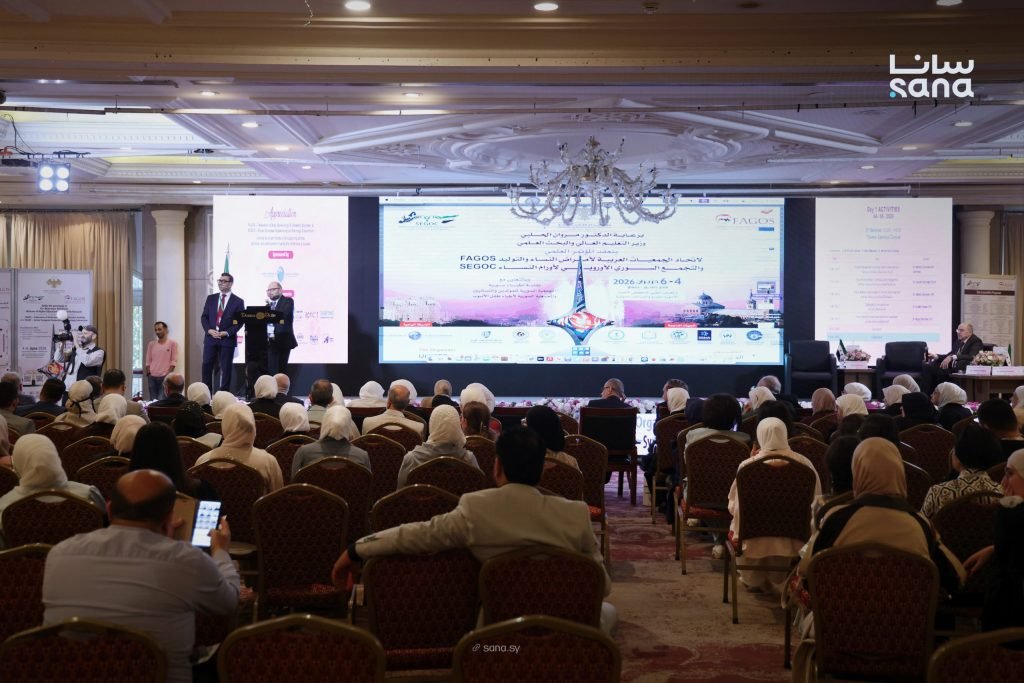
Damascus, June 5 (SANA) The first scientific conference of the Federation of Arab Gynecological and Obstetric Societies (FAGOS) and the Syrian European Gynecological Oncology Group (SEGOC) continued Friday in Damascus, featuring specialized workshops and lectures on obstetrics, gynecology and oncology.
Discussions covered early detection of HPV, surgical management of placenta accreta without hysterectomy, and cervical endoscopy for cancer prevention.
Mohamed Khalaf, a French oncologist and fetal medicine specialist working in a hospital south of Paris, told SANA that the conference provided an opportunity for Arab doctors from around the world to exchange information and expertise between European-based physicians and their Syrian colleagues, particularly as cancer rates rise among younger patients.
Khalaf said he presented the latest advances in ovarian protection during chemotherapy, aimed at preventing severe side effects that can damage ovarian tissue and lead to early menopause.

Dina Adwan, head of the maternal and fetal medicine committee at the Syrian Board, expressed hope that modern surgical techniques for twin-to-twin transfusion syndrome — using laser fetoscopic surgery inside the uterus — would soon be available in Syria.

Abdulaziz al-Hamza, an obstetrics and gynecology specialist and head of the gynecological council at the Syrian Board of Medical Specialties, said placenta accreta has become increasingly common due to rising rates of cesarean sections.

He stressed the importance of preoperative diagnosis and modern techniques that can preserve the uterus when possible, while emphasizing that patient safety remains the top priority.
The conference, which started Thursday and runs through Saturday, is being held under the patronage of the Ministry of Higher Education and Scientific Research, in cooperation with the Syrian Medical Association, the Syrian Society of Obstetricians and Gynecologists, and the Syrian Society of IVF Physicians.


KhA